Question: When you take a position and stick to it without listening to what the other person is saying or without considering any other way to
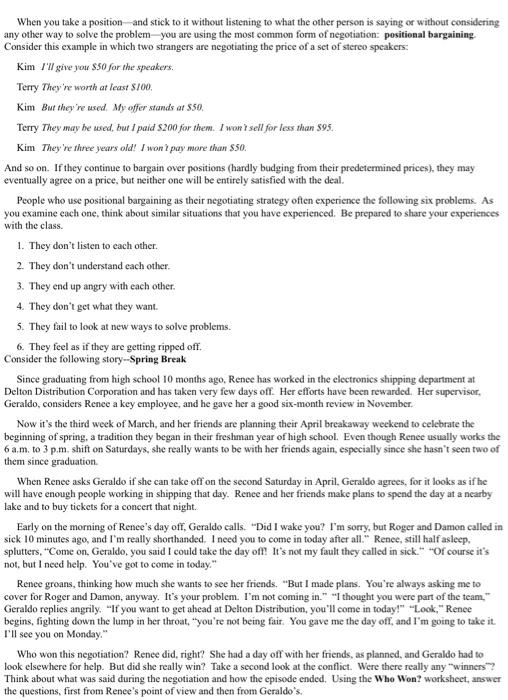
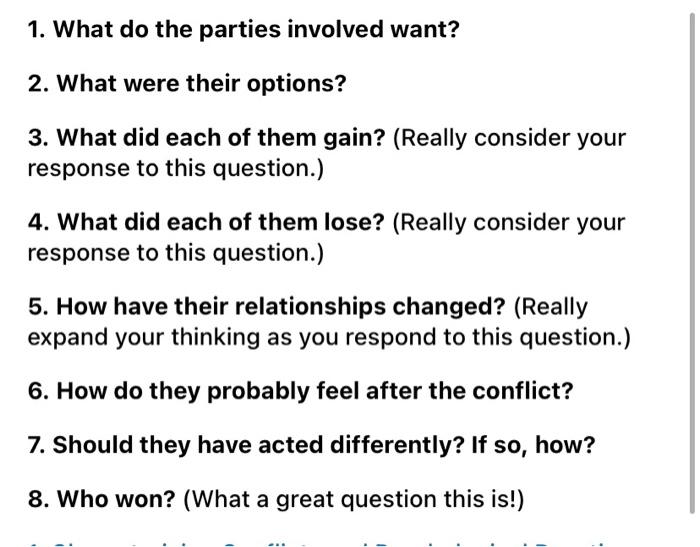
When you take a position and stick to it without listening to what the other person is saying or without considering any other way to solve the problem you are using the most common form of negotiation: positional bargaining Consider this example in which two strangers are negotiating the price of a set of stereo speakers: Kim I'll give you $50 for the speakers. Terry They're worth at least $100. Kim But they're used. My offer stands at $50. Terry They may be used, but I paid $200 for them. I won't sell for less than $95. Kim They're three years old! I won't pay more than $50. And so on. If they continue to bargain over positions (hardly budging from their predetermined prices), they may eventually agree on a price, but neither one will be entirely satisfied with the deal. People who use positional bargaining as their negotiating strategy often experience the following six problems. As you examine each one, think about similar situations that you have experienced. Be prepared to share your experiences with the class. 1. They don't listen to each other. 2. They don't understand each other. 3. They end up angry with each other. 4. They don't get what they want. 5. They fail to look at new ways to solve problems. 6. They feel as if they are getting ripped off. Consider the following story--Spring Break Since graduating from high school 10 months ago, Renee has worked in the electronics shipping department at Delton Distribution Corporation and has taken very few days off. Her efforts have been rewarded. Her supervisor, Geraldo, considers Renee a key employee, and he gave her a good six-month review in November. Now it's the third week of March, and her friends are planning their April breakaway weekend to celebrate the beginning of spring, a tradition they began in their freshman year of high school. Even though Renee usually works the 6 a.m. to 3 p.m. shift on Saturdays, she really wants to be with her friends again, especially since she hasn't seen two of them since graduation. When Renee asks Geraldo if she can take off on the second Saturday in April. Geraldo agrees, for it looks as if he will have enough people working in shipping that day. Renee and her friends make plans to spend the day at a nearby lake and to buy tickets for a concert that night. Early on the morning of Renee's day off, Geraldo calls. "Did I wake you? I'm sorry, but Roger and Damon called in sick 10 minutes ago, and I'm really shorthanded. I need you to come in today after all." Renee, still half asleep. splutters, "Come on, Geraldo, you said I could take the day off! It's not my fault they called in sick." "Of course it's not, but I need help. You've got to come in today." Renee groans, thinking how much she wants to see her friends. "But I made plans. You're always asking me to cover for Roger and Damon, anyway. It's your problem. I'm not coming in." "I thought you were part of the team," Geraldo replies angrily. "If you want to get ahead at Delton Distribution, you'll come in today!" "Look," Rence begins, fighting down the lump in her throat, "you're not being fair. You gave me the day off, and I'm going to take it. I'll see you on Monday." Who won this negotiation? Renee did, right? She had a day off with her friends, as planned, and Geraldo had to look elsewhere for help. But did she really win? Take a second look at the conflict. Were there really any "winners"? Think about what was said during the negotiation and how the episode ended. Using the Who Won? worksheet, answer the questions, first from Renee's point of view and then from Geraldo's. 1. What do the parties involved want? 2. What were their options? 3. What did each of them gain? (Really consider your response to this question.) 4. What did each of them lose? (Really consider your response to this question.) 5. How have their relationships changed? (Really expand your thinking as you respond to this question.) 6. How do they probably feel after the conflict? 7. Should they have acted differently? If so, how? 8. Who won? (What a great question this is!)









 Study Help