







Question: When you use R to perform any analyses to answer questions in the Exam, please providethe R output (statistical output or graphs) as a part
When you use R to perform any analyses to answer questions in the Exam, please providethe R output (statistical output or graphs) as a part of your answer. If not explicitly indicated in the problem, assume significance level (?) of 0.05.
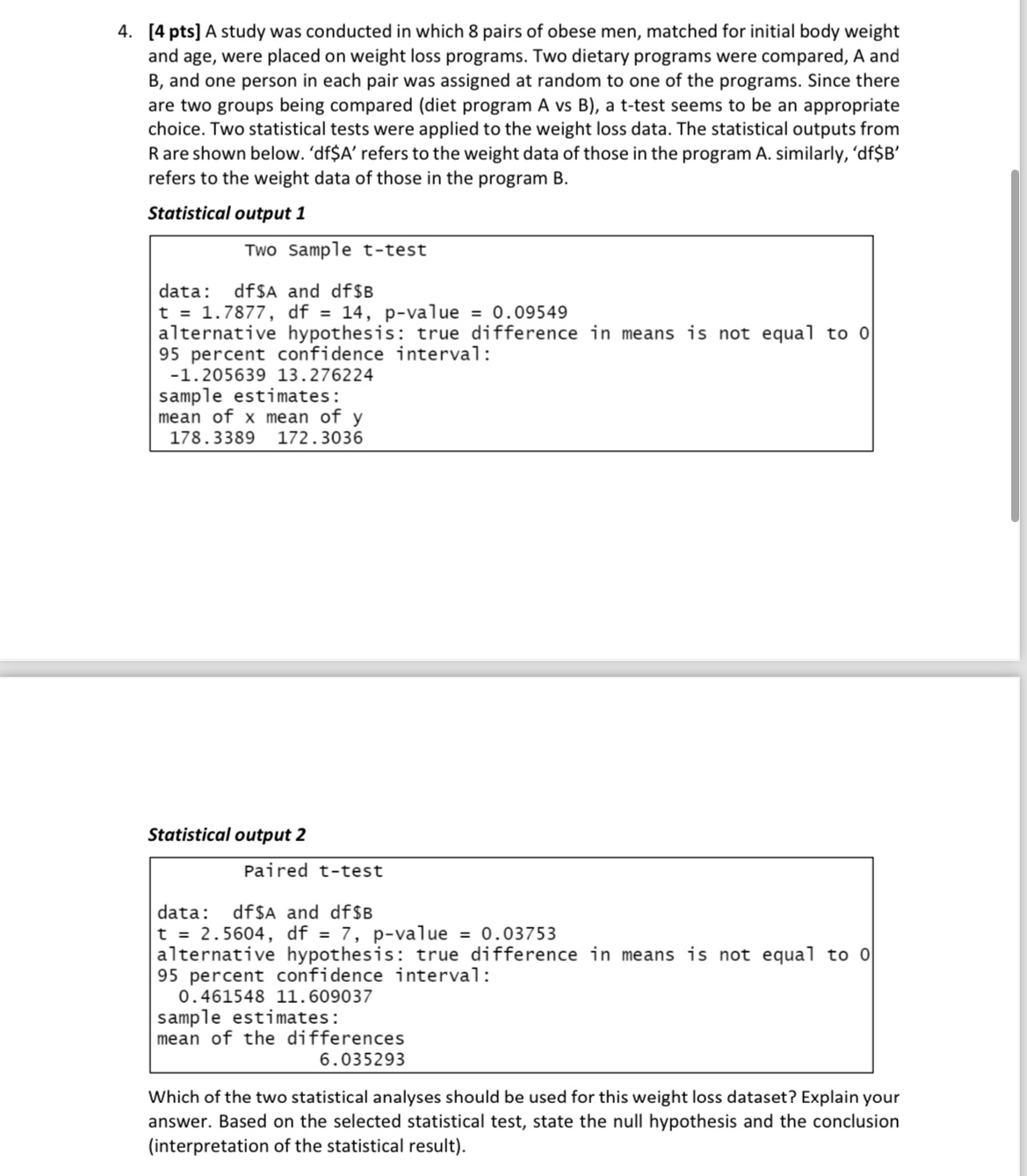
4. [4pts] A study was conducted in which 8 pairs of obese men, matched for initial body weight and age, were placed on weight loss programs. Two dietary programs were compared, A and B, and one person in each pair was assigned at random to one of the programs. Since there are two groups being compared (diet program A vs B), a t-test seems to be an appropriate choice. Two statistical tests were applied to the weight loss data. The statistical outputs from R are shown below. 'dfSA' refers to the weight data of those in the program A. similarly, 'df$B' refers to the weight data of those in the program B. Statistical output 1 Two Ssample t-test data: dfSA and dfs$s t = 1.7877, df = 14, p-value = 0.09549 alternative hypothesis: true difference in means is not equal to O 95 percent confidence interval: -1.205639 13.276224 sample estimates: mean of x mean of y 178.3389 172.3036 Statistical output 2 Paired t-test data: dfSA and dfss t = 2.5604, df = 7, p-value = 0.03753 alternative hypothesis: true difference in means is not equal to 0 95 percent confidence interval: 0.461548 11.609037 sample estimates: mean of the differences 6.035293 Which of the two statistical analyses should be used for this weight loss dataset? Explain your answer. Based on the selected statistical test, state the null hypothesis and the conclusion (interpretation of the statistical result)
Step by Step Solution
There are 3 Steps involved in it

Get step-by-step solutions from verified subject matter experts
 Study Help