







Question: where :, is the standard normal value associated with the smallest significance level at which the null hypothesis can be rejected. The p-value is regularly
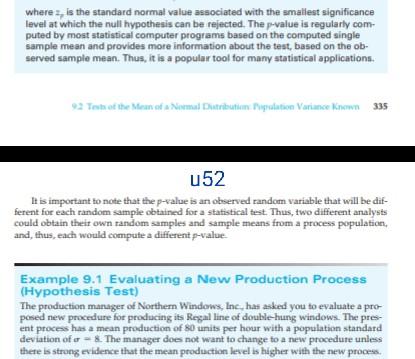
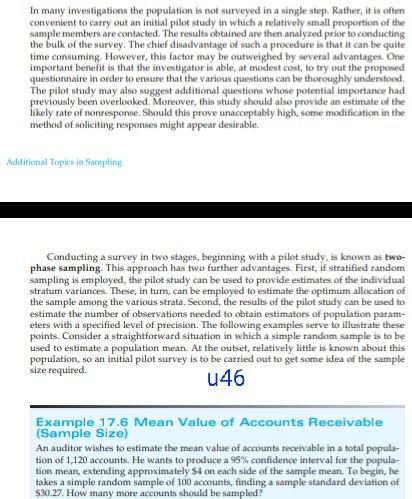
where :, is the standard normal value associated with the smallest significance level at which the null hypothesis can be rejected. The p-value is regularly com- puted by most statistical computer programs based on the computed single sample mean and provides more information about the test, based on the ob- served sample mean. Thus, it is a popular tool for many statistical applications. 92 Test of the Mean of a Normal Dutribution Palation Variance Known 335 u52 It is important to note that the p-value is an observed random Variable that will be dif- ferent for each random sample obtained for a statistical test. Thus, two different analysis could obtain their own random samples and sample means from a process population. and, thus, each would compute a different p-value Example 9.1 Evaluating a New Production Process (Hypothesis Test) The production manager of Northern Windows. Inc. has asked you to evaluate a pro- posed new procedure for producing its Regal line of double-hung windows. The pres- ent process has a mean production of 80 units per hour with a population standard deviation of r = & The manager does not want to change to a new procedure unless there is strong evidence that the mean production level is higher with the new process In many investigations the population is not surveyed in a single step. Rather, it is often convenient to carry out an initial pilot study in which a relatively small proportion of the sample members are contacted. The results obtained are then analyzed prior to conducting the bulk of the survey. The chief disadvantage of such a procedure is that it can be quite time consuming However, this factor may be outweighed by several advantages. One important benefit is that the investigator is able at modest cost, to try out the proposed questionnaire in order to ensure that the various questions can be thoroughly understood. The pilot study may also suggest additional questions whose potential importance had previously been overlooked. Moreover, this study should also provide an estimate of the likely rate of nonresponse. Should this prove unacceptably high, some modification in the method of soliciting responses might appear desirable. Additional Topics in Sampling Conducting a survey in two stages, beginning with a pilot study, is known as two- phase sampling. This approach has two further advantages. First, if stratified random sampling is employed, the pilot study can be used to provide estimates of the individual stratum variances. These, in tum, can be employed to estimate the optimum allocation of the sample among the various strata. Second, the results of the pilot study can be used to estimate the number of observations needed to obtain estimators of population param- eters with a specified level of precision. The following examples serve to illustrate these points. Consider a straightforward situation in which a simple random sample is to be used to estimate a population mean. At the outset, relatively little is known about this population, so an initial pilot survey is to be carried out to get some idea of the sample size required. 446 Example 17.6 Mean Value of Accounts Receivable (Sample Size) An auditor wishes to estimate the mean value of accounts receivable in a total popula- tion of 1,120 accounts. He wants to produce a 95% confidence interval for the popula- tion mean, extending approximately si on each side of the sample mean. To begin, he takes a simple random sample of 100 accounts, finding a sample standard deviation of $30.27. How many more accounts should be sampled
Step by Step Solution
There are 3 Steps involved in it
1 Expert Approved Answer
Step: 1 Unlock

Question Has Been Solved by an Expert!
Get step-by-step solutions from verified subject matter experts
Step: 2 Unlock
Step: 3 Unlock
 Study Help