







Question: Which statement best summarizes the difference between ionic and molecular compounds? (a) Molecular compounds contain highly directional covalent bonds, which results in the formation
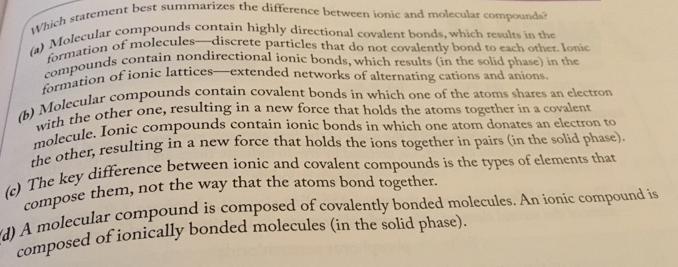
Which statement best summarizes the difference between ionic and molecular compounds? (a) Molecular compounds contain highly directional covalent bonds, which results in the formation of molecules-discrete particles that do not covalently bond to each other. Ionic compounds contain nondirectional ionic bonds, which results (in the solid phase) in the formation of ionic lattices-extended networks of alternating cations and anions. (b) Molecular compounds contain covalent bonds in which one of the atoms shares an electron with the other one, resulting in a new force that holds the atoms together in a covalent molecule. Ionic compounds contain ionic bonds in which one atom donates an electron to the other, resulting in a new force that holds the ions together in pairs (in the solid phase). (c) The key difference between ionic and covalent compounds is the types of elements that compose them, not the way that the atoms bond together. d) A molecular compound is composed of covalently bonded molecules. An ionic compound is composed of ionically bonded molecules (in the solid phase).
Step by Step Solution
There are 3 Steps involved in it
The detailed answer for the above question is provided below Answer b Molecular compounds are also k... View full answer

Get step-by-step solutions from verified subject matter experts
 Study Help