







Question: Why can't we design a combinational digital logic circuit to control a light so that the light changes state any time its push-button switch is
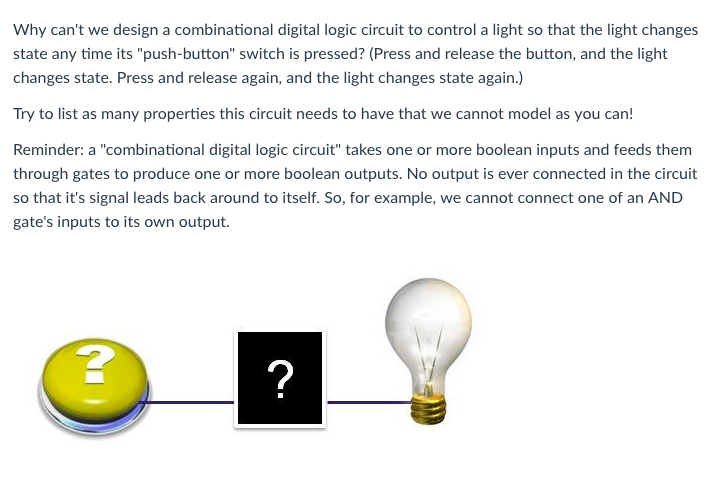
Why can't we design a combinational digital logic circuit to control a light so that the light changes state any time its "push-button" switch is pressed (Press and release the button, and the light changes state. Press and release again, and the light changes state again.) Try to list as many properties this circuit needs to have that we cannot model as you can! Reminder: a "combinational digital logic circuit" takes one or more boolean inputs and feeds them through gates to produce one or more boolean outputs. No output is ever connected in the circuit so that it's signal leads back around to itself. So, for example, we cannot connect one of an AND gate's inputs to its own output. 7 Why can't we design a combinational digital logic circuit to control a light so that the light changes state any time its "push-button" switch is pressed (Press and release the button, and the light changes state. Press and release again, and the light changes state again.) Try to list as many properties this circuit needs to have that we cannot model as you can! Reminder: a "combinational digital logic circuit" takes one or more boolean inputs and feeds them through gates to produce one or more boolean outputs. No output is ever connected in the circuit so that it's signal leads back around to itself. So, for example, we cannot connect one of an AND gate's inputs to its own output. 7
Step by Step Solution
There are 3 Steps involved in it

Get step-by-step solutions from verified subject matter experts
 Study Help