



Question: will not be able to come back to the skipped part. Tutorial Exercise A die is a cube with dots on each face. The faces
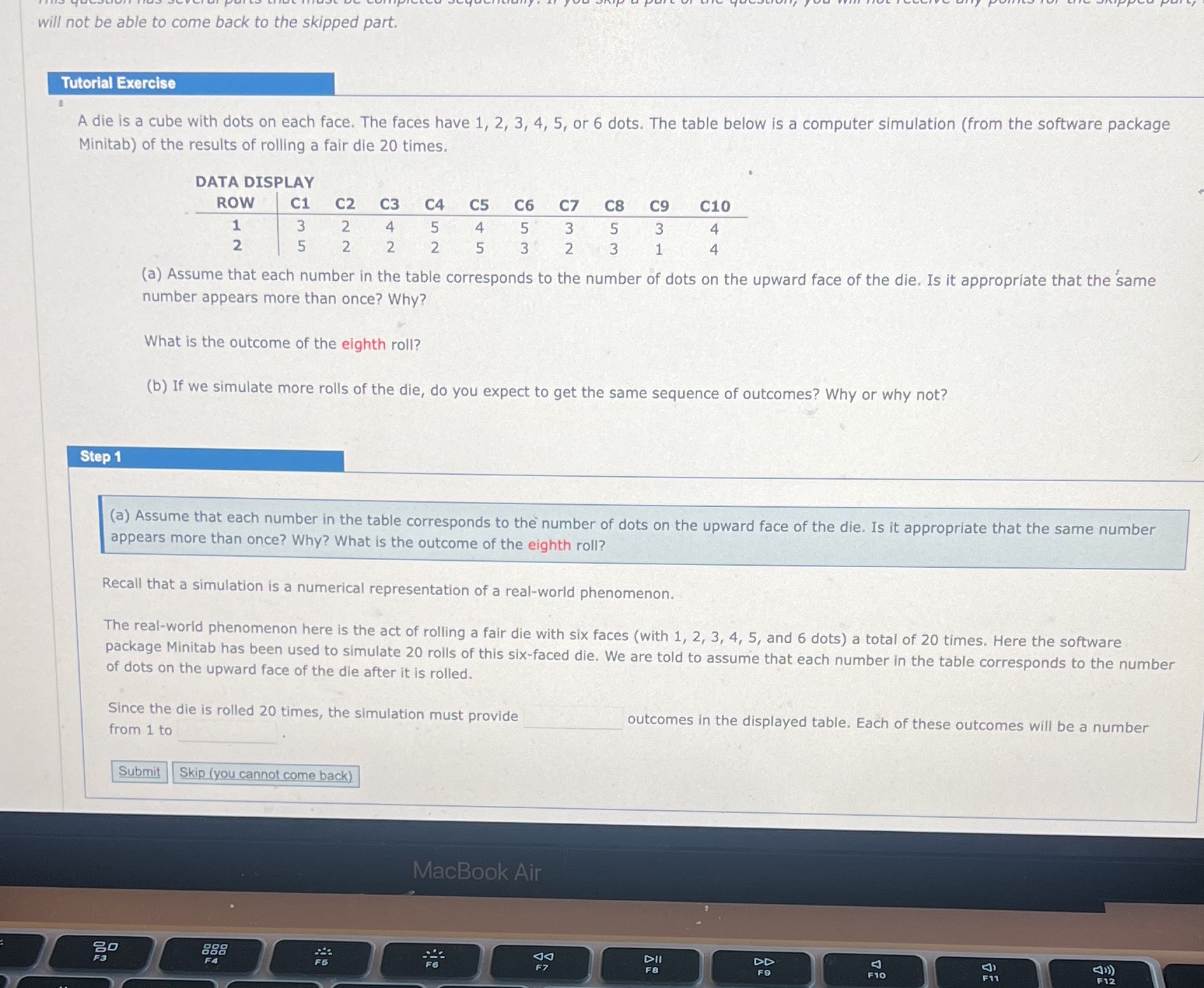
will not be able to come back to the skipped part. Tutorial Exercise A die is a cube with dots on each face. The faces have 1, 2, 3, 4, 5, or 6 dots. The table below is a computer simulation (from the software package Minitab) of the results of rolling a fair die 20 times. DATA DISPLAY ROW C1 C2 C3 C4 C5 C6 C7 C8 C9 C10 3 2 4 5 4 5 3 5 3 (a) Assume that each number in the table corresponds to the number of dots on the upward face of the die. Is it appropriate that the same number appears more than once? Why? What is the outcome of the eighth roll? (b) If we simulate more rolls of the die, do you expect to get the same sequence of outcomes? Why or why not? Step 1 a) Assume that each number in the table corresponds to the number of dots on the upward face of the die. Is it appropriate that the same number appears more than once? Why? What is the outcome of the eighth roll? Recall that a simulation is a numerical representation of a real-world phenomenon. The real-world phenomenon here is the act of rolling a fair die with six faces (with 1, 2, 3, 4, 5, and 6 dots) a total of 20 times. Here the software package Minitab has been used to simulate 20 rolls of this six-faced die. We are told to assume that each number in the table corresponds to the number of dots on the upward face of the die after it is rolled. Since the die is rolled 20 times, the simulation must provide from 1 to outcomes in the displayed table. Each of these outcomes will be a number Submit Skip (you cannot come back) MacBook Air 20 898 F6 FO
Step by Step Solution
There are 3 Steps involved in it

Get step-by-step solutions from verified subject matter experts