







Question: With respect to HTTP: Explain how Web caching can reduce the delay in receiving a requested object. Consider an HTTP client that wants to retrieve
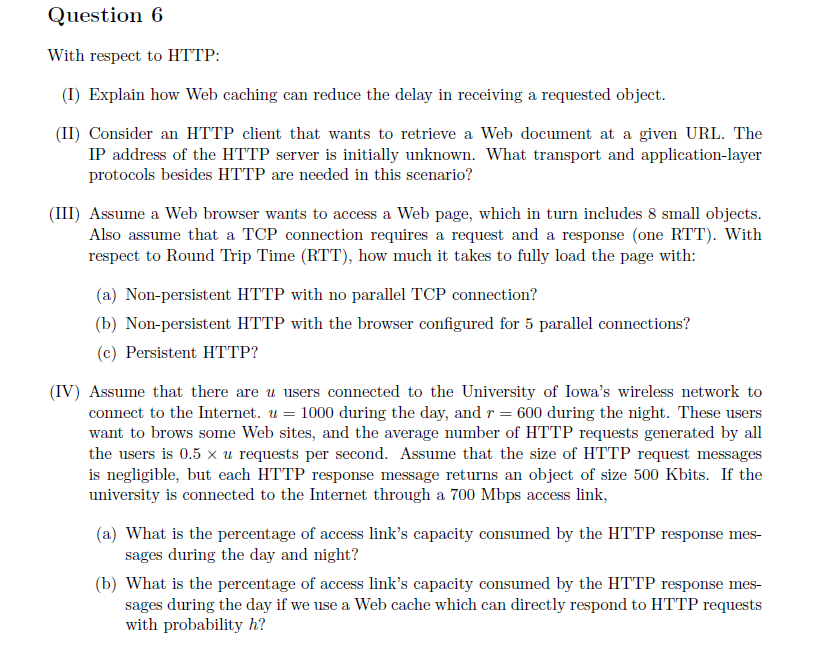
With respect to HTTP: Explain how Web caching can reduce the delay in receiving a requested object. Consider an HTTP client that wants to retrieve a Web document at a given URL. The IP address of the HTTP server is initially unknown. What transport and application-layer protocols besides HTTP are needed in this scenario? Assume a Web browser wants to access a Web page, which in turn includes 8 small objects. Also assume that a TCP connection requires a request and a response (one RTT). With respect to Round Trip Time (RTT), how much it takes to fully load the page with: Non-persistent HTTP with no parallel TCP connection? Non-persistent HTTP with the browser configured for 5 parallel connections? Persistent HTTP? (IV) Assume that there are u users connected to the University of Iowa's wireless network to connect to the Internet, u = 1000 during the day, and r = 600 during the night. These users want to brows some Web sites, and the average number of HTTP requests generated by all the users is 0.5 x u requests per second. Assume that the size of HTTP request messages is negligible, but each HTTP response message returns an object of size 500 Kbits. If the university is connected to the Internet through a 700 Mbps access fink, What is the percentage of access link's capacity consumed by the HTTP response messages during the day and night? What is the percentage of access link's capacity consumed by the HTTP response messages during the day if we use a Web cache which can directly respond to HTTP requests with probability h
Step by Step Solution
There are 3 Steps involved in it

Get step-by-step solutions from verified subject matter experts
 Study Help