







Question: with the 3 dimensional array: #define NUM_ROW 4 #define NUM_COLUMN 4 #define NUM_DEPTH 3 double value[NUM_ROW][NUM_COLUMN][NUM_DEPTH] = { 1.1, 1.2, 1.3, 1.4, 1.5, 1.6, 1.7,
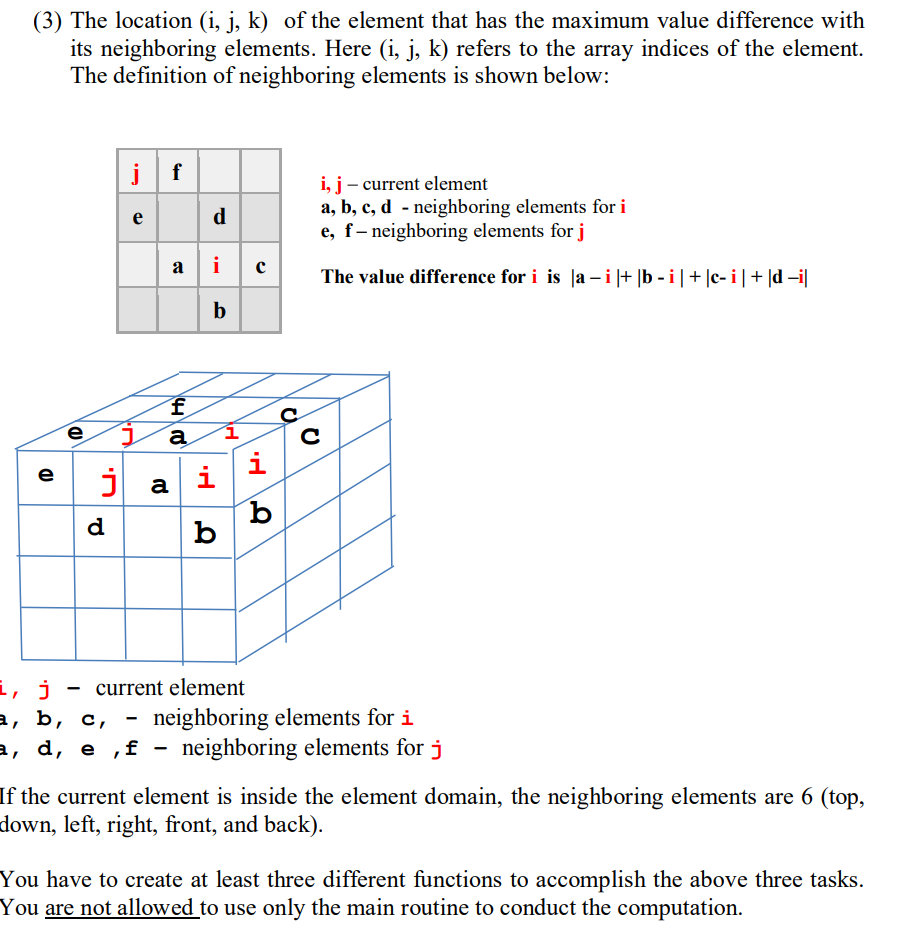
with the 3 dimensional array:
#define NUM_ROW 4
#define NUM_COLUMN 4
#define NUM_DEPTH 3
double value[NUM_ROW][NUM_COLUMN][NUM_DEPTH] = { 1.1, 1.2, 1.3, 1.4, 1.5, 1.6, 1.7, 1.8, 1.9, 2.0, 2.1, 2.2, 2.1, 2.2, 2.3, 2.4, 2.5, 2.6, 2.7, 2.8, 2.9, 3.0, 3.1, 3.2, 3.1, 3.2, 3.3, 3.4, 3.5, 3.6, 3.7, 3.8, 3.9, 4.0, 4.1, 4.2, 4.1, 4.2, 4.3, 4.4, 2.5, 2.6, 2.7, 2.8, 2.9, 3.0, 3.1, 3.2};
(3) The location (i, j, k) of the element that has the maximum value difference with its neighboring elements. Here (i, j, k) refers to the array indices of the element. The definition of neighboring elements is shown below: i, j - current element a, b, c, d - neighboring elements for i e, f - neighboring elements for j The value difference for i is |a- i + b-i| + lc-i +d -i| L , j - current element , b, c, a, d, e ,f - neighboring elements for j neighboring elements for i If the current element is inside the element domain, the neighboring elements are 6 (top, down, left, right, front, and back) You have to create at least three different functions to accomplish the above three tasks You are not allowed to use only the main routine to conduct the computation
Step by Step Solution
There are 3 Steps involved in it

Get step-by-step solutions from verified subject matter experts
 Study Help