



Question: Would you please help answer question 4 a)? Not sure how this tutoring works...? 4. There are # identical households, each with utility function: U(ph,(,
Would you please help answer question 4 a)? Not sure how this tutoring works...?
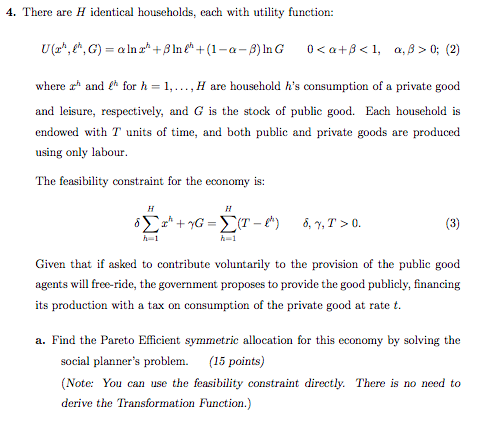
4. There are # identical households, each with utility function: U(ph,(, G) = alar + Ble + (1-a-8)InG 0 0; (2) where ph and (" for h = 1, ..., # are household h's consumption of a private good and leisure, respectively, and G is the stock of public good. Each household is endowed with 7' units of time, and both public and private goods are produced using only labour. The feasibility constraint for the economy is: H H 6) r+G =)(-() 6,4720. (3) h 1 Given that if asked to contribute voluntarily to the provision of the public good agents will free-ride, the government proposes to provide the good publicly, financing its production with a tax on consumption of the private good at rate t. a. Find the Pareto Efficient symmetric allocation for this economy by solving the social planner's problem. (15 points) (Note: You can use the feasibility constraint directly. There is no need to derive the Transformation Function.)
Step by Step Solution
There are 3 Steps involved in it

Get step-by-step solutions from verified subject matter experts