Question: WRITE 2 PARAGRAPHS FOR YOUR RESPONSE. EACH PARAGRAPH SHOULD HAVE AT LEAST 5 SENTENCES: Can you relate anything from information below to any recent current
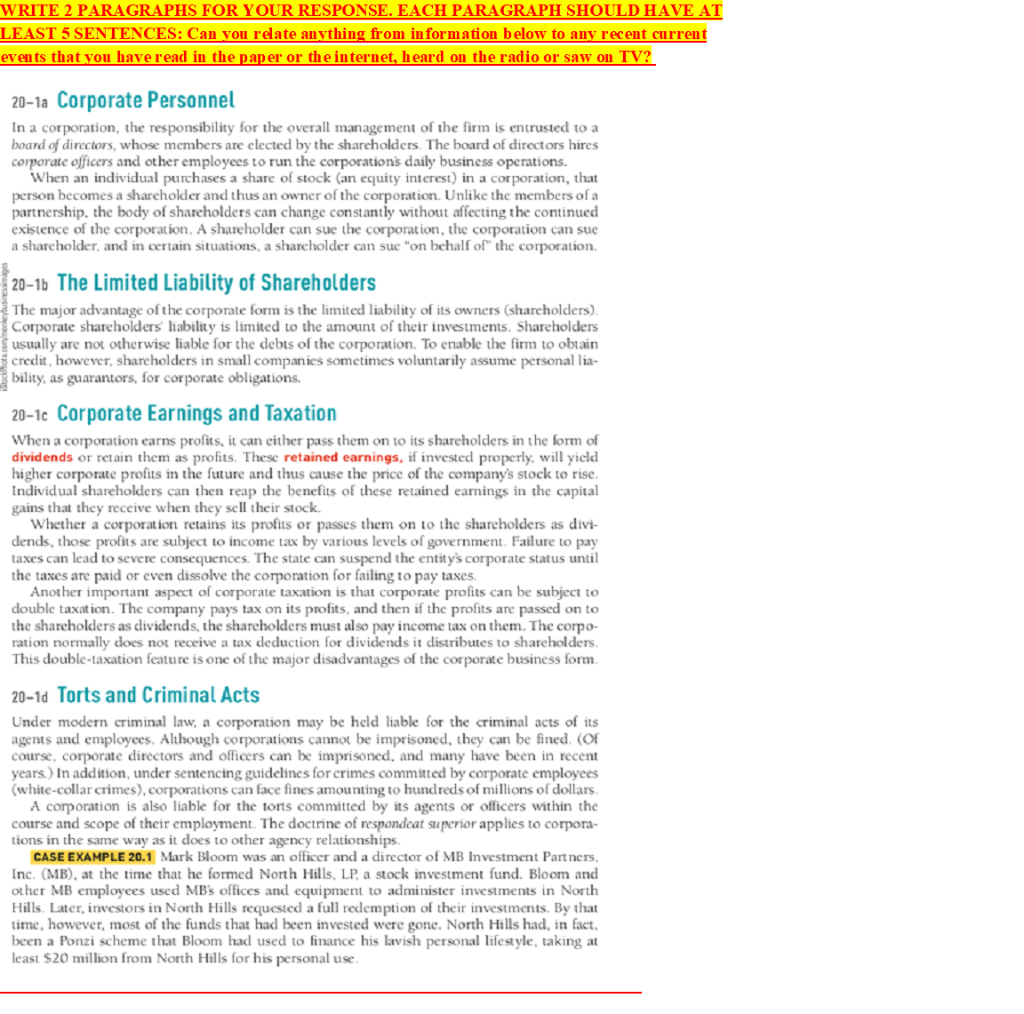

WRITE 2 PARAGRAPHS FOR YOUR RESPONSE. EACH PARAGRAPH SHOULD HAVE AT LEAST 5 SENTENCES: Can you relate anything from information below to any recent current even ts that you have read in the paper or the internet, heard on the radio or saw on TV? 20-1a Corporate Personnel In a corporation, the responsibility for the overall management of the firm is entrusted to a board of directors, whose members are elected by the shareholders. The board of directors hires corporate officers and other employees to run the corporations daily business operations. When an individual purchases a share of stock (an equity interest) in a corporation, that person becomes a shareholder and thus an owner of the corporation. Unlike the members of a partnership, the body of shareholders can change constantly without affecting the continued existence of the corporation. A shareholder can sue the corporation, the corporation can sue a sharcholder, and in certain situations, a sharcholder can sue "on behalf of" the corporation. 20-1b The Limited Liability of Shareholders The major advantage of the corporate form is the limited liability of its owners (shareholders). Corporate shareholders' liability is limited to the amount of their investments. Shareholders usually are not otherwise liable for the debts of the corporation. To enable the firm to obtain credit, however, shareholders in small companies sometimes voluntarily assume personal lia- bility, as guarantors, for corporate obligations. 20-1c Corporate Earnings and Taxation When a corporation earns profits, it can either pass them on to its shareholders in the form of dividends or retain them as profits. These retained earnings, if invested properly, will yield higher corporate profits in the future and thus cause the price of the company's stock to rise. Individual shareholders can then reap the benefits of these retained earnings in the capital gains that they receive when they sell their stock. Whether a corporation retains its profits or passes them on to the shareholders as divi- dends, those profits are subject to income tax by various levels of government. Failure to pay taxes can lead to severe consequences. The state can suspend the entity's corporate status until the taxes are paid or even dissolve the corporation for failing to pay taxes. Another important aspect of corporate taxation is that corporate profits can be subject to double taxation. The company pays tax on its profits, and then if the profits are passed on to the shareholders as dividends, the shareholders must also pay income tax on them. The corpo- ration normally does not receive a tax deduction for dividends it distributes to shareholders. This double-taxation feature is one of the major disadvantages of the corporate business form. 20-1d Torts and Criminal Acts Under modern criminal law, a corporation may be held liable for the criminal acts of its agents and employees. Although corporations cannot be imprisoned, they can be fined. (Of course, corporate directors and officers can be imprisoned, and many have been in recent years.) In addition, under sentencing guidelines for crimes committed by corporate employees (white-collar crimes), corporations can face fines amounting to hundreds of millions of dollars. A corporation is also liable for the torts committed by its agents or officers within the course and scope of their employment. The doctrine of respondeat superior applies to corpora- tions in the same way as it does to other agency relationships. CASE EXAMPLE 20.1 Mark Bloom was an officer and a director of MB Investment Part ners, Inc. (MB), at the other MB employees used MB's offices and equipment to administer investments in North Hills. Later, investors in North Hills requested a full redemption of their investments. By that time, however, most of the funds that had been invested were gone. North Hills had, in fact, been a Ponzi scheme that Bloom had used to finance his lavish personal lifestyle, taking at least $20 million from North Hills for his personal use. that he formed Hills, LP, a stock investment fund. Bloom and Barry Belmont and other North Hills Investors filed a suit in a federal district court against MB, alleging fraud. The court held that MB was liable for Blooms fraud. MB appealed, and the appellate court affirmed. Tort liability can be attributed to a corporation for the acts of its agent that were committed within the scope of the agent's employment.'I









 Study Help