







Question: Write a function to calculate the drag coefficient, Co, of an airfoil, based on the following empirical relationship 2. 1.328 Re 0.074 for laminar flow
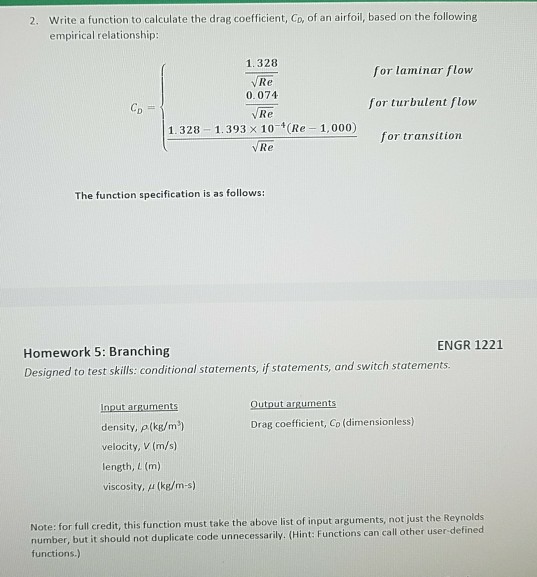
Write a function to calculate the drag coefficient, Co, of an airfoil, based on the following empirical relationship 2. 1.328 Re 0.074 for laminar flow for turbulent flow for transition 1.328 1.393 x 10 4(Re 1,00o) Re The function specification is as follows: ENGR 1221 Homework 5: Branching Designed to test skill: conditional statements, if statements, and switch statements esigned to test Output arguments density, p(kg/m) velocity, V (m/s) length, L (m) viscosity, (ke/m-s) Drag coefficient, Co (dimensionless) Note: for full credit, t his function must take the above list of input arguments, not just the Reynolds number, but it should not duplicate code unnecessarily. (Hint: Functions can call other user defined functions.) Write a function to calculate the drag coefficient, Co, of an airfoil, based on the following empirical relationship 2. 1.328 Re 0.074 for laminar flow for turbulent flow for transition 1.328 1.393 x 10 4(Re 1,00o) Re The function specification is as follows: ENGR 1221 Homework 5: Branching Designed to test skill: conditional statements, if statements, and switch statements esigned to test Output arguments density, p(kg/m) velocity, V (m/s) length, L (m) viscosity, (ke/m-s) Drag coefficient, Co (dimensionless) Note: for full credit, t his function must take the above list of input arguments, not just the Reynolds number, but it should not duplicate code unnecessarily. (Hint: Functions can call other user defined functions.)
Step by Step Solution
There are 3 Steps involved in it

Get step-by-step solutions from verified subject matter experts
 Study Help