







Question: Write C programs that simulate Geo/Geo/1 queue, Geo/D/1 queue, and Geo/X/1 queue, respectively. Plot their mean queue length against E (0, 0.5) and service rate
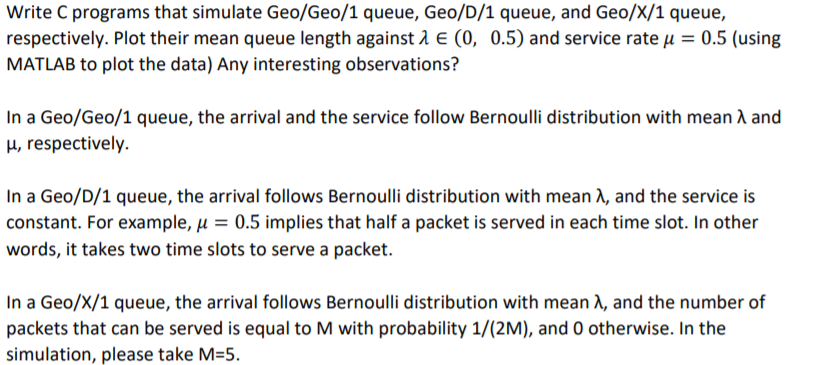
Write C programs that simulate Geo/Geo/1 queue, Geo/D/1 queue, and Geo/X/1 queue, respectively. Plot their mean queue length against E (0, 0.5) and service rate -0.5 (using MATLAB to plot the data) Any interesting observations? in a Geo/Geo/1 queue, the arrival and the service follow Bernoulli distribution with mean and , respectively. in a Geo/D/1 queue, the arrival follows Bernoulli distribution with mean , and the service is constant. For example, -0.5 implies that half a packet is served in each time slot. In other words, it takes two time slots to serve a packet. in a Geo/X/1 queue, the arrival follows Bernoulli distribution with mean , and the number of packets that can be served is equal to M with probability 1/(2M), and 0 otherwise. In the simulation, please take M-5. Write C programs that simulate Geo/Geo/1 queue, Geo/D/1 queue, and Geo/X/1 queue, respectively. Plot their mean queue length against E (0, 0.5) and service rate -0.5 (using MATLAB to plot the data) Any interesting observations? in a Geo/Geo/1 queue, the arrival and the service follow Bernoulli distribution with mean and , respectively. in a Geo/D/1 queue, the arrival follows Bernoulli distribution with mean , and the service is constant. For example, -0.5 implies that half a packet is served in each time slot. In other words, it takes two time slots to serve a packet. in a Geo/X/1 queue, the arrival follows Bernoulli distribution with mean , and the number of packets that can be served is equal to M with probability 1/(2M), and 0 otherwise. In the simulation, please take M-5
Step by Step Solution
There are 3 Steps involved in it

Get step-by-step solutions from verified subject matter experts
 Study Help