







Question: Write code in Java Summary of problem: This program models a supermarket. There are two types of shoppers - fast shoppers and big shoppers. They
Write code in Java
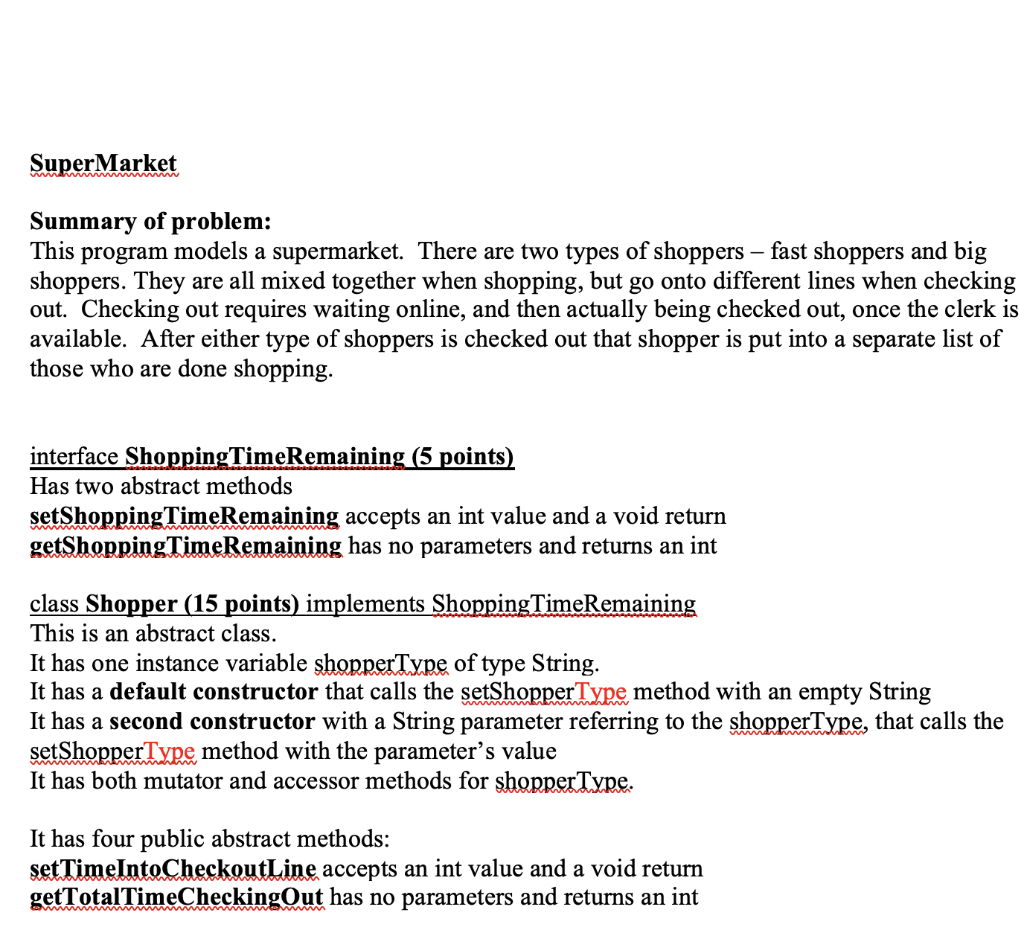
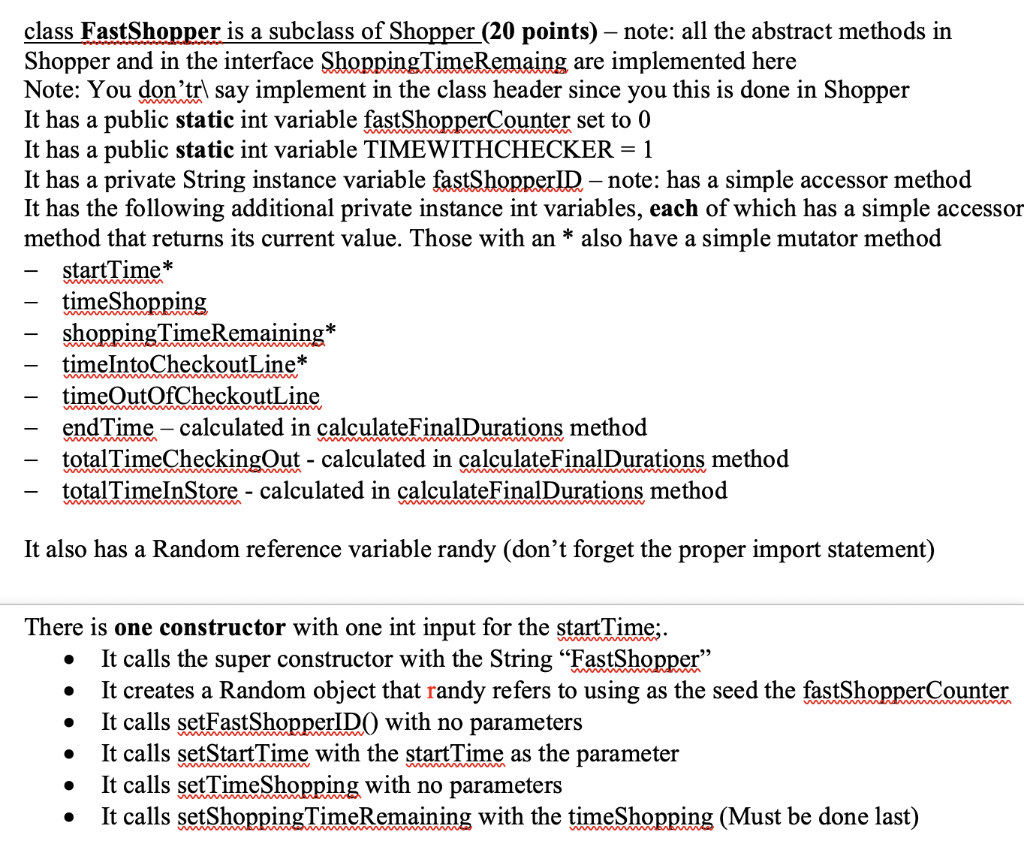
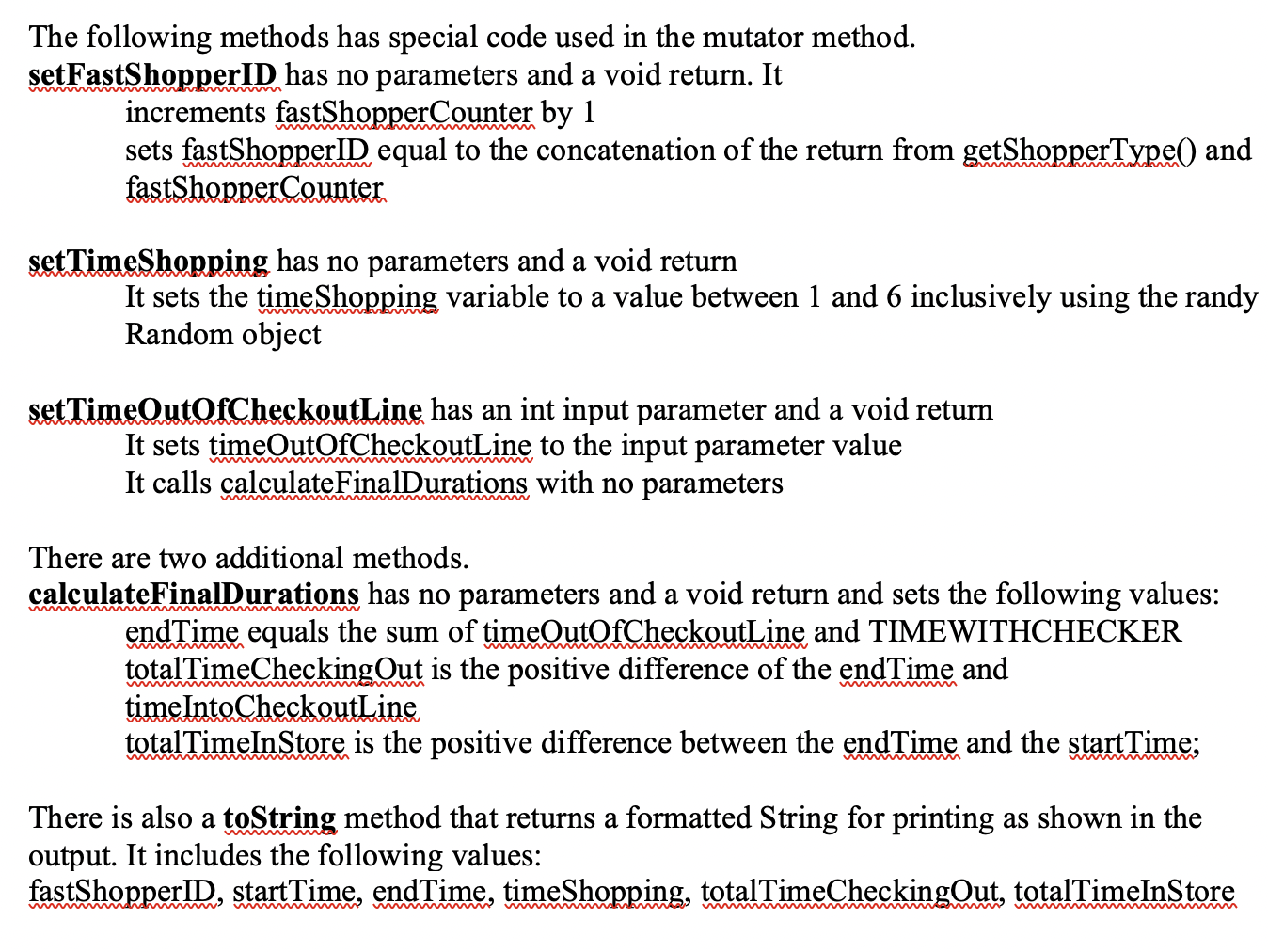
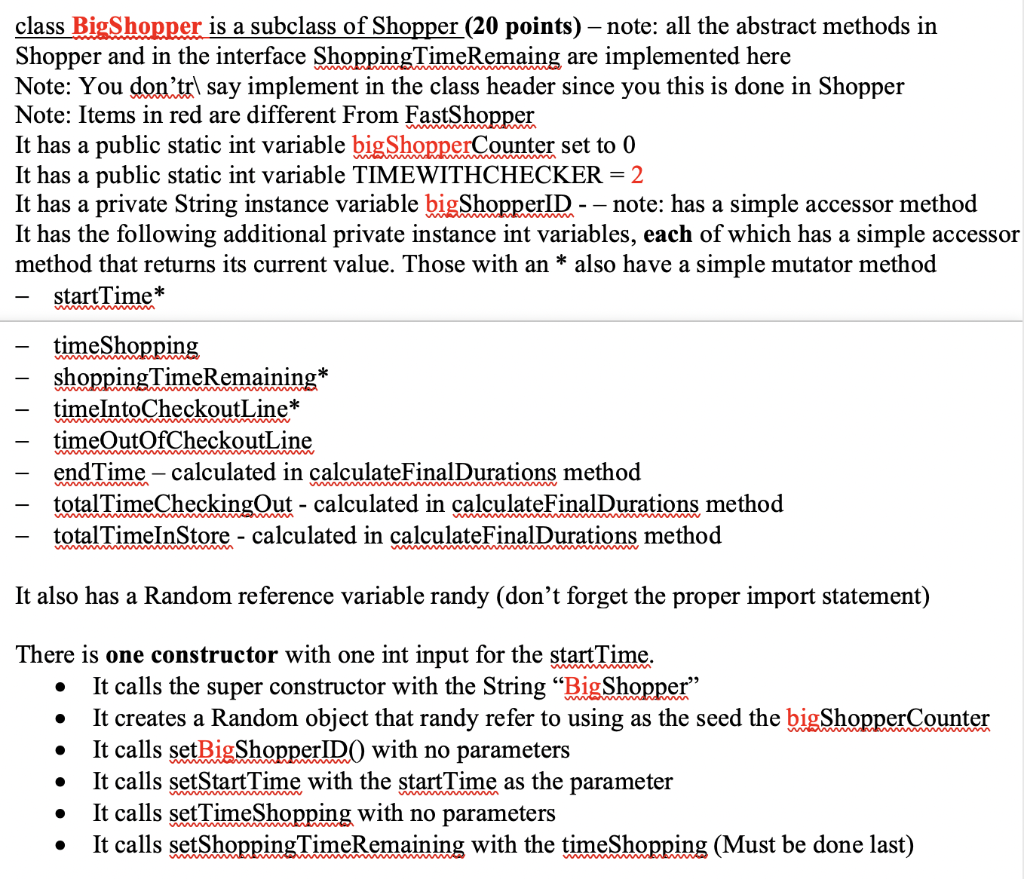
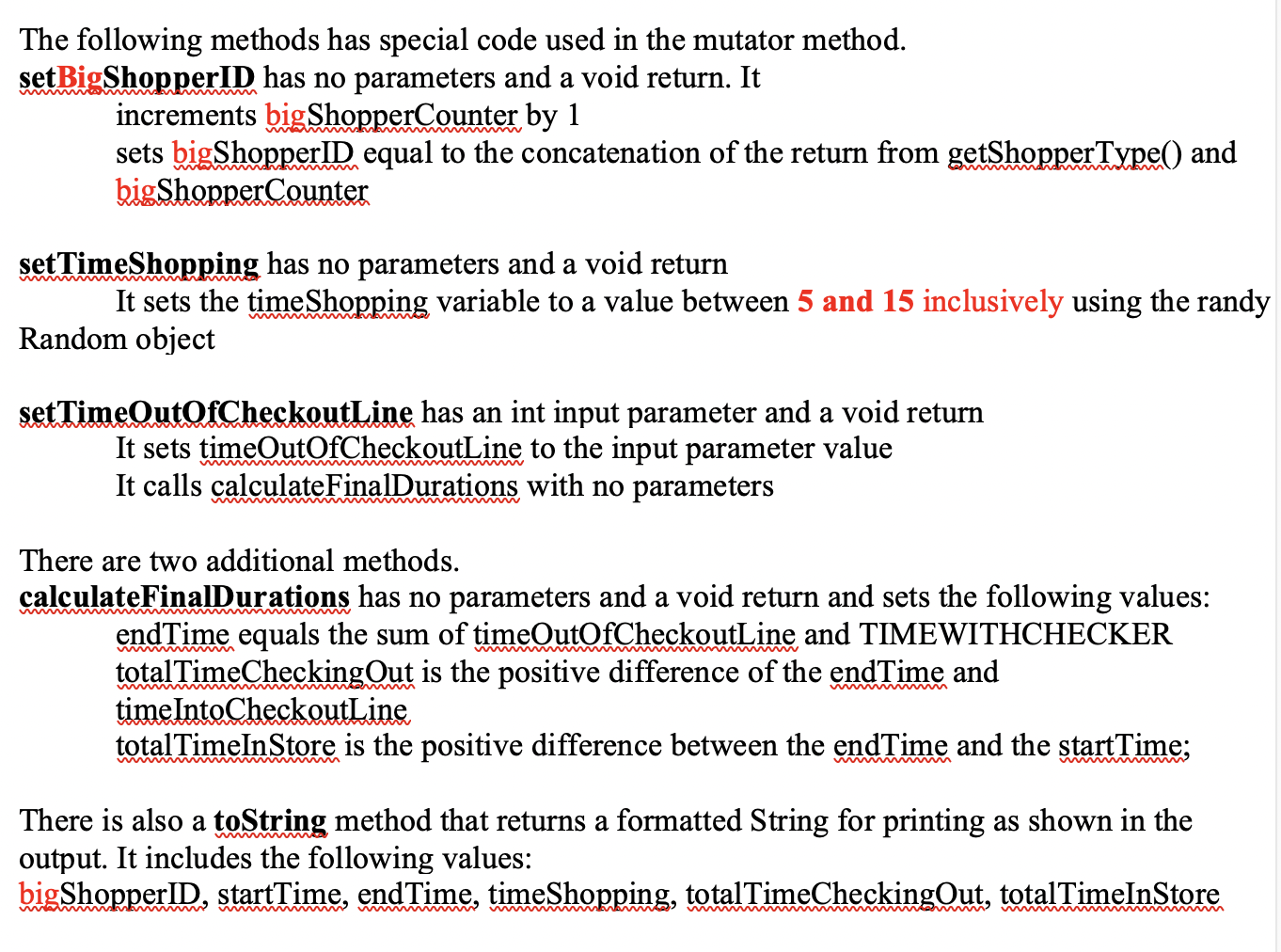
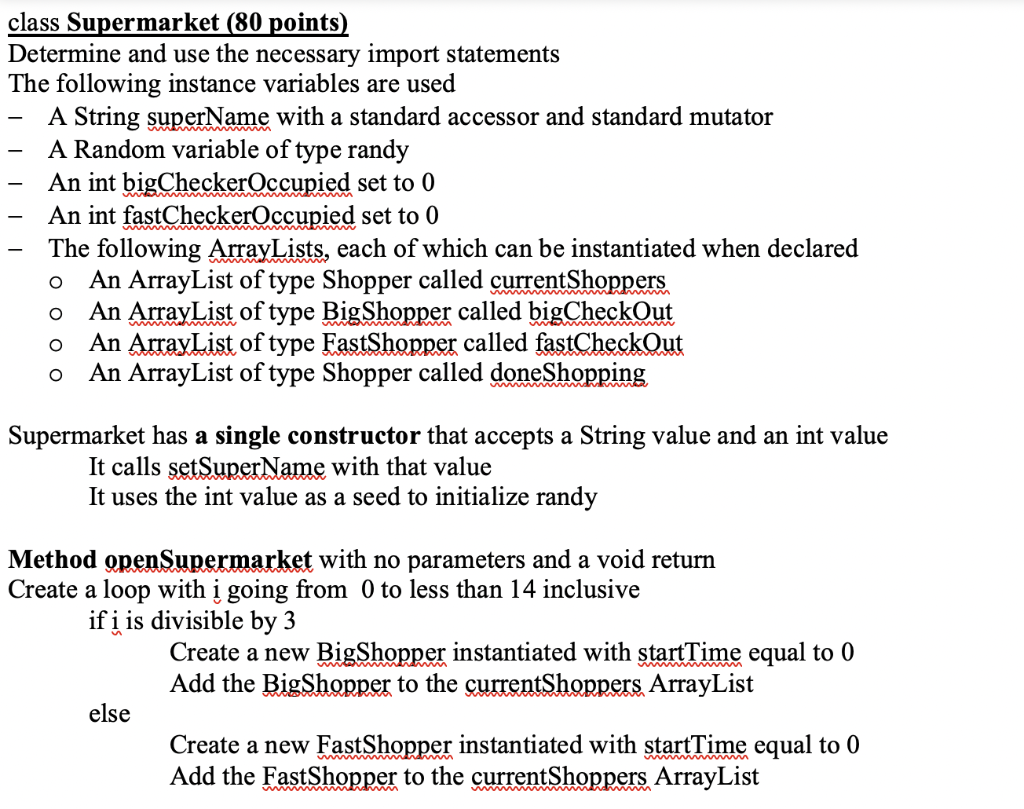
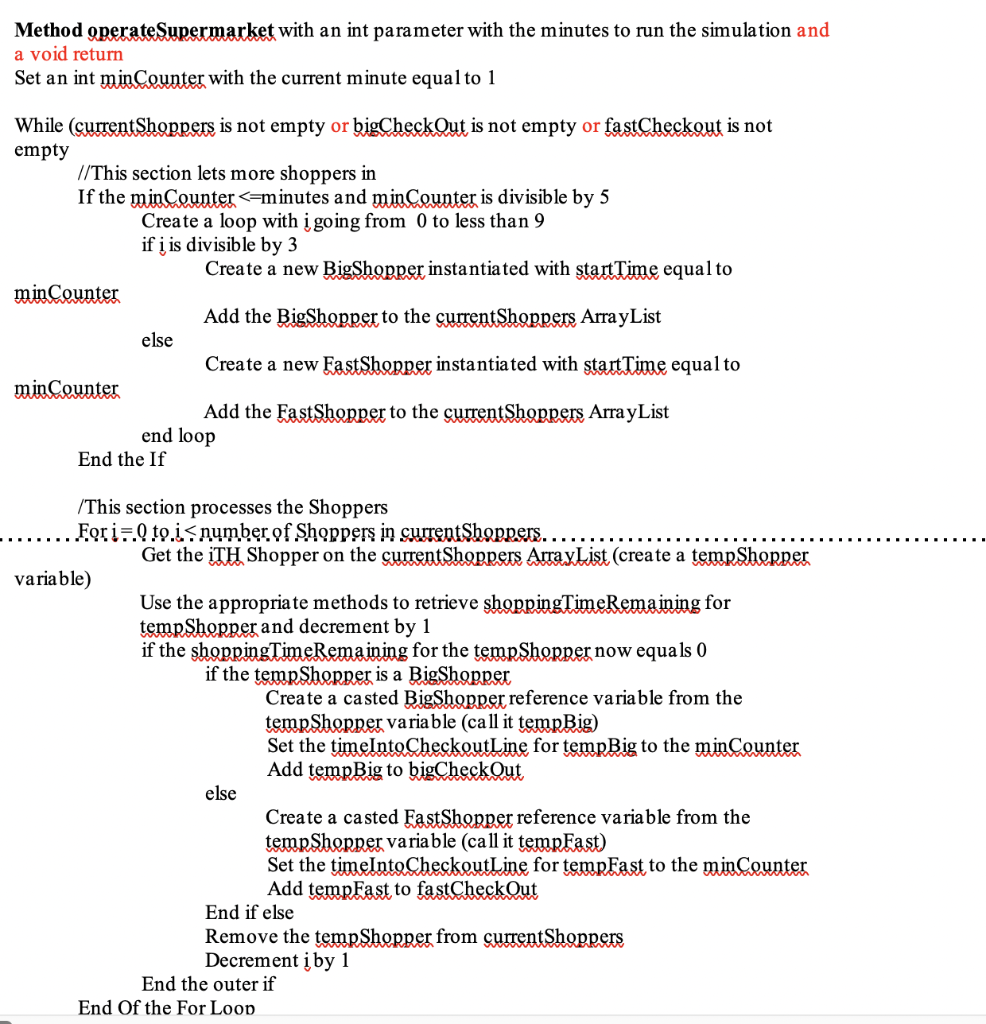
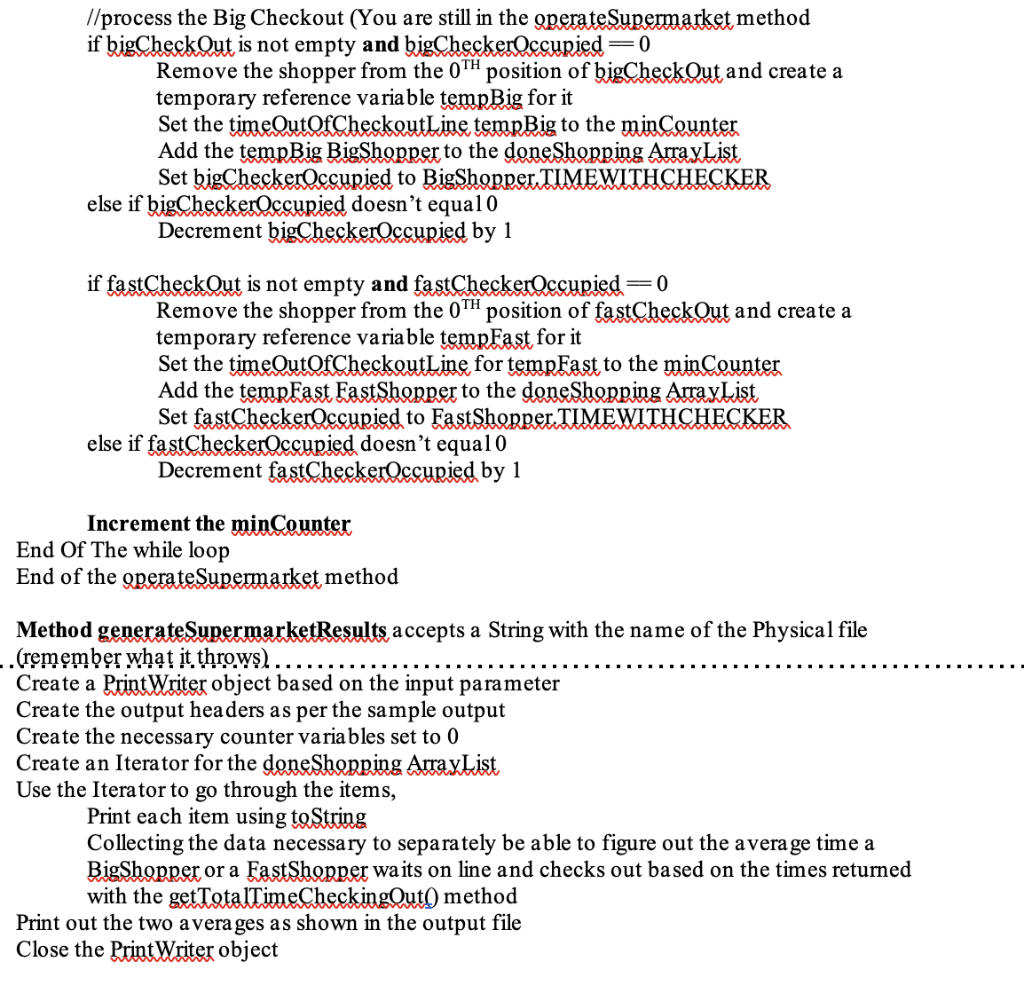
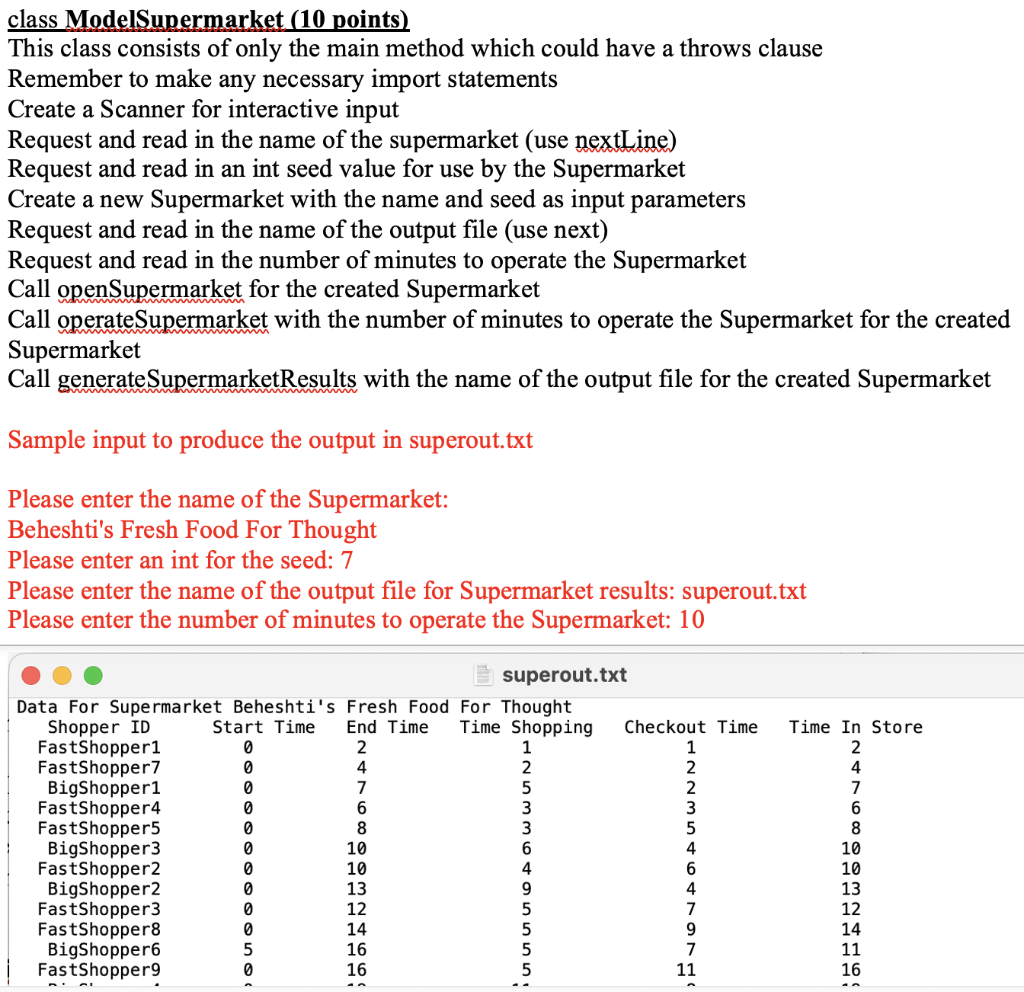
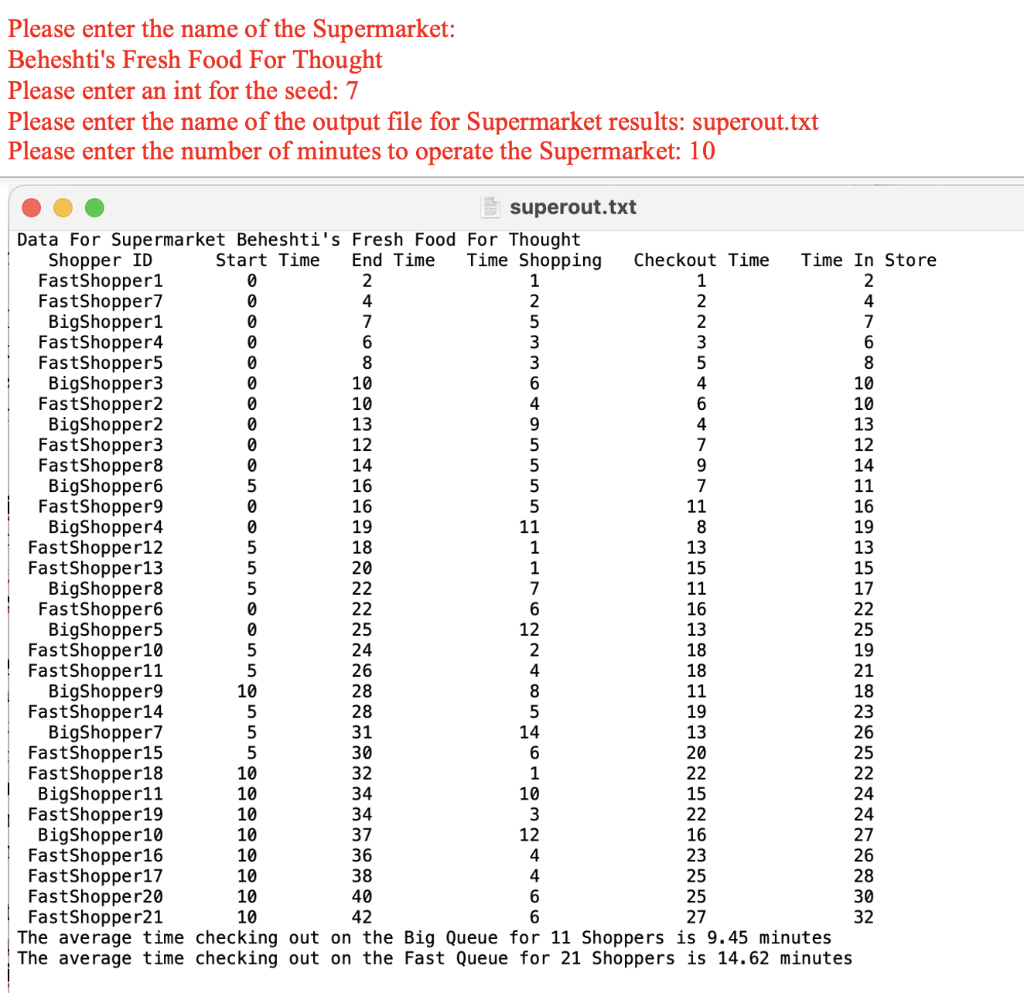
Summary of problem: This program models a supermarket. There are two types of shoppers - fast shoppers and big shoppers. They are all mixed together when shopping, but go onto different lines when checking out. Checking out requires waiting online, and then actually being checked out, once the clerk is available. After either type of shoppers is checked out that shopper is put into a separate list of those who are done shopping. interface ShoppingTimeRemaining (5 points) Has two abstract methods setShoppingTimeRemaining accepts an int value and a void return getShoppingTimeRemaining has no parameters and returns an int class Shopper (15 points) implements ShoppingTimeRemaining This is an abstract class. It has one instance variable shopperType of type String. It has a default constructor that calls the setShopperType method with an empty String It has a second constructor with a String parameter referring to the shopperType, that calls the setShopperType method with the parameter's value It has both mutator and accessor methods for shopperType. It has four public abstract methods: setTimeIntoCheckoutline accepts an int value and a void return getTotalTimeCheckingOut has no parameters and returns an int class FastShopper is a subclass of Shopper (20 points) - note: all the abstract methods in Shopper and in the interface ShoppingTimeRemaing are implemented here Note: You don'trl say implement in the class header since you this is done in Shopper It has a public static int variable fastShopperCounter set to 0 It has a public static int variable TIMEWITHCHECKER =1 It has a private String instance variable fastShopperID - note: has a simple accessor method It has the following additional private instance int variables, each of which has a simple accesso method that returns its current value. Those with an * also have a simple mutator method - startTime* - timeShopping - shoppingTimeRemaining* - timeIntoCheckoutLine* - timeOutOfCheckoutLine - endTime - calculated in calculateFinalDurations method - totalTimeCheckingOut - calculated in calculateFinalDurations method - totalTimeInStore - calculated in calculateFinalDurations method It also has a Random reference variable randy (don't forget the proper import statement) There is one constructor with one int input for the startTime;. - It calls the super constructor with the String "FastShopper" - It creates a Random object that randy refers to using as the seed the fastShopperCounter - It calls setFastShopperID() with no parameters - It calls setStartTime with the startTime as the parameter - It calls setTimeShopping with no parameters - It calls setShoppingTimeRemaining with the timeShopping (Must be done last) The following methods has special code used in the mutator method. setFastShopperID has no parameters and a void return. It increments fastShopperCounter by 1 sets fastShopperID equal to the concatenation of the return from getShopperType() and fastShopperCounter setTimeShopping has no parameters and a void return It sets the timeShopping variable to a value between 1 and 6 inclusively using the randy Random object setTimeOutOfCheckoutLine has an int input parameter and a void return It sets timeOutOfCheckoutLine to the input parameter value It calls calculateFinalDurations with no parameters There are two additional methods. calculateFinalDurations has no parameters and a void return and sets the following values: endTime equals the sum of timeOutOfCheckoutLine and TIMEWITHCHECKER totalTimeCheckingOut is the positive difference of the endTime and timeIntoCheckoutLine totalTimeInStore is the positive difference between the endTime and the startTime; There is also a toString method that returns a formatted String for printing as shown in the output. It includes the following values: fastShopperID, startTime, endTime, timeShopping, totalTimeCheckingOut, totalTimeInStore class BigShopper is a subclass of Shopper (20 points) - note: all the abstract methods in Shopper and in the interface ShoppingTimeRemaing are implemented here Note: You don'trl say implement in the class header since you this is done in Shopper Note: Items in red are different From FastShopper It has a public static int variable bigShopperCounter set to 0 It has a public static int variable TIMEWITHCHECKER =2 It has a private String instance variable bigShopperID - - note: has a simple accessor method It has the following additional private instance int variables, each of which has a simple accessor method that returns its current value. Those with an also have a simple mutator method - startTime* - timeShopping - shoppingTimeRemaining* - timeIntoCheckoutLine* - timeOutOfCheckoutLine - endTime - calculated in calculateFinalDurations method - totalTimeCheckingOut - calculated in calculateFinalDurations method - totalTimeInStore - calculated in calculateFinalDurations method It also has a Random reference variable randy (don't forget the proper import statement) There is one constructor with one int input for the startTime. - It calls the super constructor with the String "BigShopper" - It creates a Random object that randy refer to using as the seed the bigShopperCounter - It calls setBigShopperID0 with no parameters - It calls setStartTime with the startTime as the parameter - It calls setTimeShopping with no parameters - It calls setShoppingTimeRemaining with the timeShopping (Must be done last) The following methods has special code used in the mutator method. setBigShopperID has no parameters and a void return. It increments bigShopperCounter by 1 sets bigShopperID equal to the concatenation of the return from getShopperType() and bigShopperCounter setTimeShopping has no parameters and a void return It sets the timeShopping variable to a value between 5 and 15 inclusively using the randy Random object setTimeOutOfCheckoutLine has an int input parameter and a void return It sets timeOutOfCheckoutLine to the input parameter value It calls calculateFinalDurations with no parameters There are two additional methods. calculateFinalDurations has no parameters and a void return and sets the following values: endTime equals the sum of timeOutOfCheckoutLine and TIMEWITHCHECKER totalTimeCheckingOut is the positive difference of the endTime and timeIntoCheckoutLine totalTimeInStore is the positive difference between the endTime and the startTime; There is also a toString method that returns a formatted String for printing as shown in the output. It includes the following values: bigShopperID, startTime, endTime, timeShopping, totalTimeCheckingOut, totalTimeInStore class Supermarket (80 points) Determine and use the necessary import statements The following instance variables are used - A String superName with a standard accessor and standard mutator - A Random variable of type randy - An int bigCheckerOccupied set to 0 - An int fastCheckerOccupied set to 0 - The following ArrayLists, each of which can be instantiated when declared - An ArrayList of type Shopper called currentShoppers - An ArrayList of type BigShopper called bigCheckOut - An ArrayList of type FastShopper called fastCheckOut - An ArrayList of type Shopper called doneShopping Supermarket has a single constructor that accepts a String value and an int value It calls setSuperName with that value It uses the int value as a seed to initialize randy Method openSupermarket with no parameters and a void return Create a loop with i going from 0 to less than 14 inclusive if i is divisible by 3 Create a new BigShopper instantiated with startTime equal to 0 Add the BigShopper to the currentShoppers ArrayList else Create a new FastShopper instantiated with startTime equal to 0 Add the FastShopper to the currentShoppers ArrayList Method operateSupermarket with an int parameter with the minutes to run the simulation and a void return Set an int minCounter with the current minute equal to 1 While (currentShoppers is not empty or bigCheckQut is not empty or fastCheckout is not empty //This section lets more shoppers in If the minCounter
Step by Step Solution
There are 3 Steps involved in it

Get step-by-step solutions from verified subject matter experts
 Study Help