







Question: write one short similarity and one difference between the red and blue paragraphs MINIMIZING RELATIONSHIP CONFLICT DURING TASK CONFLICT From our discussion so far, the
write one short similarity and one difference between the red and blue paragraphs 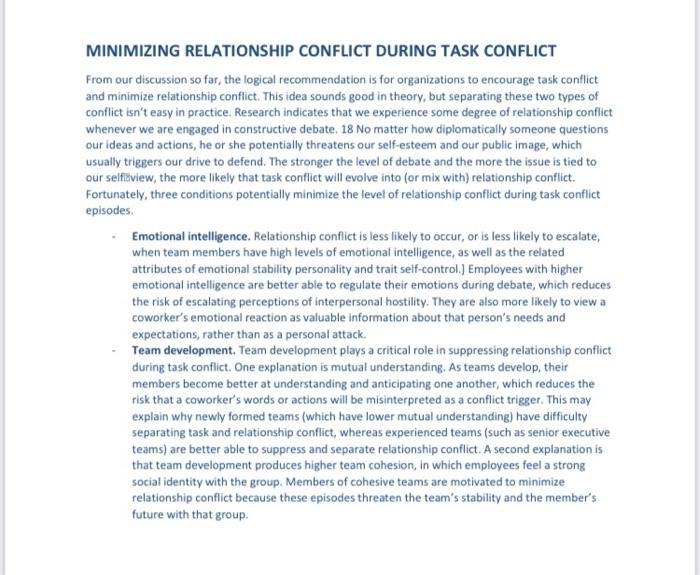
MINIMIZING RELATIONSHIP CONFLICT DURING TASK CONFLICT From our discussion so far, the logical recommendation is for organizations to encourage task conflict and minimize relationship conflict. This idea sounds good in theory, but separating these two types of conflict isn't easy in practice. Research indicates that we experience some degree of relationship conflict whenever we are engaged in constructive debate. 18 No matter how diplomatically someone questions our ideas and actions, he or she potentially threatens our self-esteem and our public image, which usually triggers our drive to defend. The stronger the level of debate and the more the issue is tied to our selfitiview, the more likely that task conflict will evolve into (or mix with) relationship conflict. Fortunately, three conditions potentially minimize the level of relationship conflict during task conflict episodes: - Emotional intelligence. Relationship conflict is less likely to occur, or is less likely to escalate, when team members have high levels of emotional intelligence, as well as the related attributes of emotional stability personality and trait self-control.] Employees with higher emotional intelligence are better able to regulate their emotions during debate, which reduces the risk of escalating perceptions of interpersonal hostility. They are also more likely to view a coworker's emotional reaction as valuable information about that person's needs and expectations, rather than as a personal attack. - Team development. Team development plays a critical role in suppressing relationship conflict during task conflict. One explanation is mutual understanding. As teams develop, their members become better at understanding and anticipating one another, which reduces the risk that a coworker's words or actions will be misinterpreted as a conflict trigger. This may explain why newly formed teams (which have lower mutual understanding) have difficulty separating task and relationship conflict, whereas experienced teams (such as senior executive teams) are better able to suppress and separate relationship conflict. A second explanation is that team development produces higher team cohesion, in which employees feel a strong social identity with the group. Members of cohesive teams are motivated to minimize relationship conflict because these episodes threaten the team's stability and the member's future with that group
Step by Step Solution
There are 3 Steps involved in it
1 Expert Approved Answer
Step: 1 Unlock

Question Has Been Solved by an Expert!
Get step-by-step solutions from verified subject matter experts
Step: 2 Unlock
Step: 3 Unlock
 Study Help