







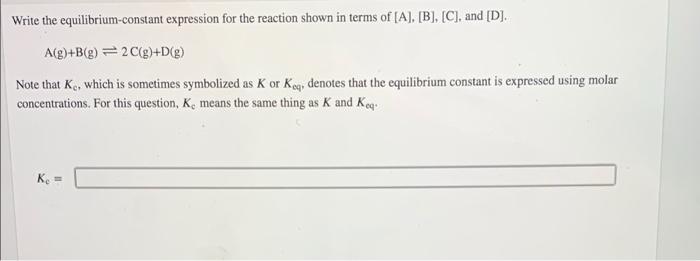
Question: Write the equilibrium-constant expression for the reaction shown in terms of [A], [B], [C] and [D]. A(g)+B(g) = 2(g)+D(g) Note that Ke, which is sometimes
![[A], [B], [C] and [D]. A(g)+B(g) = 2(g)+D(g) Note that Ke, which](https://dsd5zvtm8ll6.cloudfront.net/si.experts.images/questions/2024/09/66f90a098598c_06566f90a09389d3.jpg)
Write the equilibrium-constant expression for the reaction shown in terms of [A], [B], [C] and [D]. A(g)+B(g) = 2(g)+D(g) Note that Ke, which is sometimes symbolized as Kor Kog, denotes that the equilibrium constant is expressed using molar concentrations. For this question, K. means the same thing as K and Keys K = Write the equilibrium-constant expression for the reaction A(s) + 3 B(1) = 2(aq)+D(aq) in terms of [A].[B], [C], and [D] as needed. Note that Kc, which is sometimes symbolized as Keq, denotes that the equilibrium constant is expressed using molar concentrations. For this question, Ke means the same thing as Keq. K. =
Step by Step Solution
There are 3 Steps involved in it
1 Expert Approved Answer
Step: 1 Unlock

Question Has Been Solved by an Expert!
Get step-by-step solutions from verified subject matter experts
Step: 2 Unlock
Step: 3 Unlock
 Study Help