



Question: Write the heat balance equations for a sunlit double-glazed fenestration shown in Figure 1, and show that the outdoor glass temperature, tgo, can be
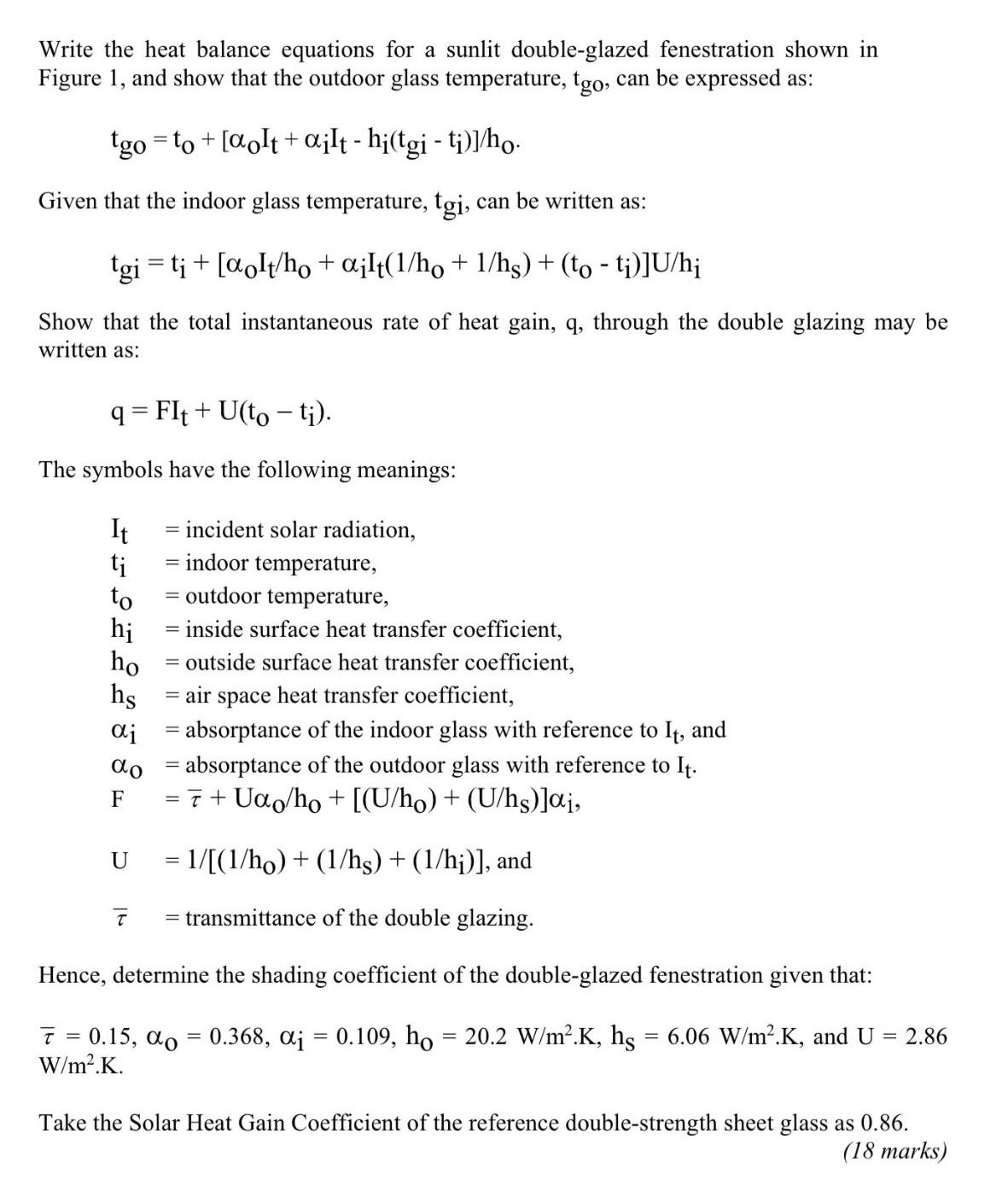
Write the heat balance equations for a sunlit double-glazed fenestration shown in Figure 1, and show that the outdoor glass temperature, tgo, can be expressed as: tgo = to + [aolt + ilt - hi(tgi - ti)]/ho- Given that the indoor glass temperature, tgi, can be written as: = tgi ti + [aolt/ho + aIt(1/ho + 1/hs) + (to - ti)]U/hi Show that the total instantaneous rate of heat gain, q, through the double glazing may be written as: q - Flt + U(to - ti). The symbols have the following meanings: It ti to hj ho hs ai do F absorptance of the indoor glass with reference to It, and absorptance of the outdoor glass with reference to It. = 7 + Uao/h + [(U/ho) + (U/hs)]aj, = 1/[(1/ho) + (1/hs) + (1/h;)], and transmittance of the double glazing. Hence, determine the shading coefficient of the double-glazed fenestration given that: 7 = 0.15, ao = 0.368, aj = 0.109, ho = 20.2 W/m.K, hg = 6.06 W/m.K, and U = 2.86 W/m.K. U = incident solar radiation, = indoor temperature, = - outdoor temperature, T = inside surface heat transfer coefficient, = outside surface heat transfer coefficient, = air space heat transfer coefficient, Take the Solar Heat Gain Coefficient of the reference double-strength sheet glass as 0.86. (18 marks)
Step by Step Solution
3.41 Rating (157 Votes )
There are 3 Steps involved in it
Certainly lets break down the solution step by step 1 Heat Balance Equations The heat balance equati... View full answer

Get step-by-step solutions from verified subject matter experts