







Question: Writean opinion-based response on whether or not the article was effectively written and why. Use the first person (I, me, my). In the response, cite
- Writean opinion-basedresponseon whether or not the article was effectively written and why. Use the first person (I, me, my). In the response, cite at leastthree pieces of evidencefrom the article (quotations and/or paraphrases) to support your points. Also, In your paragraph response, answer the following questions:
a)Do you agree or disagree with the author's point of view? Why or why not?
b)How does the article relate to your personal life? Provide two examples.
c)How do you feel about what you read?
https://www.winwithoutpitching.com/creativity-and-business-development/
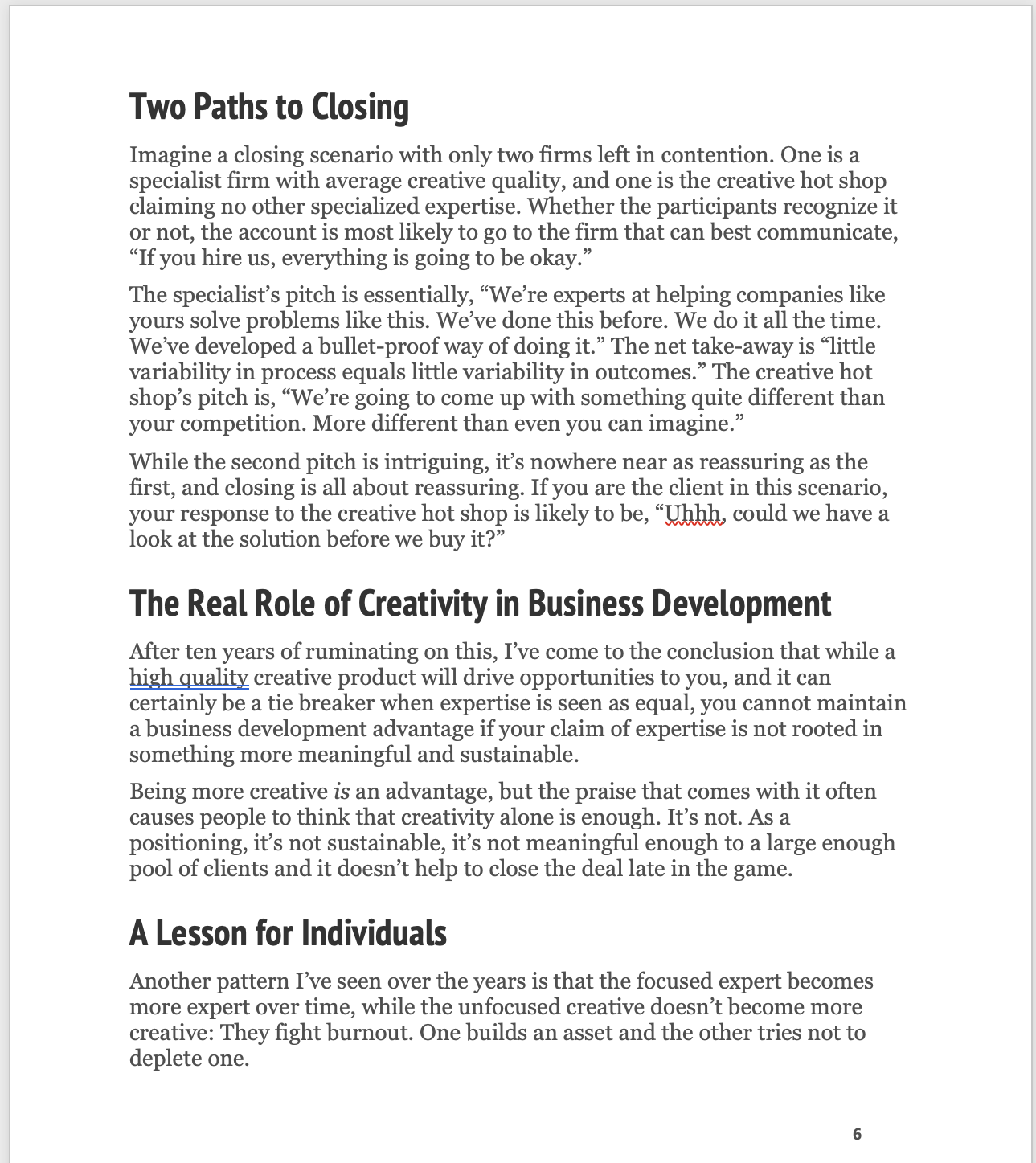
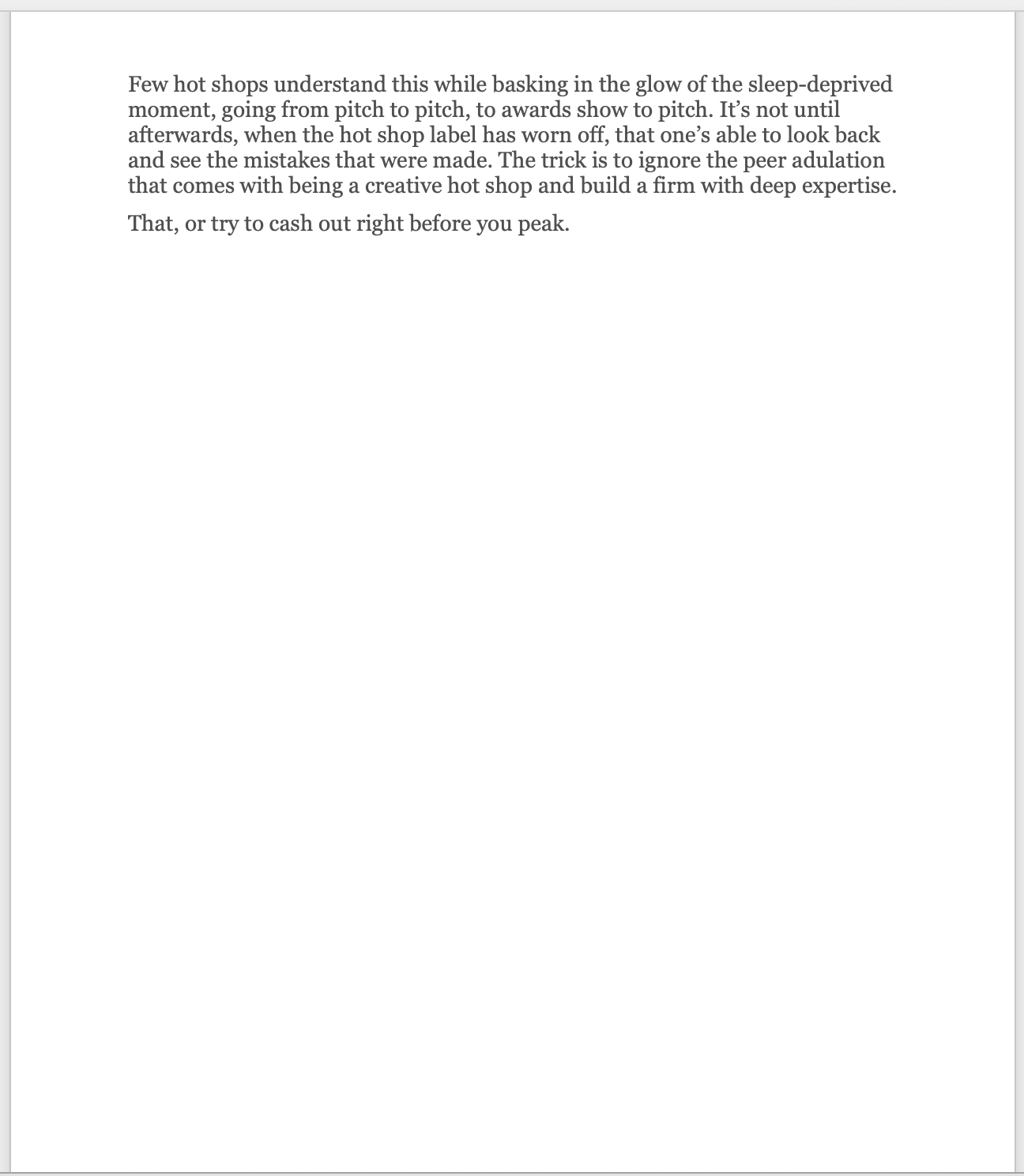
The Impact of Creative Quality on Business Development Success by Biair Enns Imagine that you've won a full-page ad in The New York Times for the use of promoting your rm. What would you say in that ad? If yours is a specialist rm, the answer is easy. In one variation or another, you would stake a claim to your expertise as the leading provider of X service to Y market. Being a creative firm, you would endeavor to express this expertise as creatively as possible. Thus, the two components of your ad would be deep expertise, communicated in a compelling manner. For many rms however the answer isn't so easy. I once worked for a highly creative but broadly positioned rm that was given considerable ad space (not in The New York Times, granted). The difculty we had coming up with something meaningful to say prompted me to write an article titled Why Advertising Agencies Don't Advertise. Advertising agencies and other creative rms generally do not advertise because they don't know what to say about themselves that numerous other rms are not already saying. When forced to advertise (as we were through the gift of free ad space) they tend to focus on the second of the two components identied above: creativity. The default message is we're more creative. Awards shows around the world are testament to some funny, intelligent and otherwise highly creative self-promotion ads. The Question of Creativity 2 But do such ads really drive new business? When everyone is making the same claim, can any one of them be right? Is creative hot shop a viable positioning for a creative rm? I've grappled with these questions for more than ten years, and I'll try to answer them here, along with the broader issue of the role of a rm's creative quality in its business development success. My own experience has been that the quality of a firm's creative product is rarely a deciding factor when winning or losing new business. Every so often, however, I encounter a rm where the creative is so good that I think I may have discovered one that can resist the economic argument to specialize. So, about once a year or so, I'm faced with the question that won't go away: can this rm be built on the position of creative hot shop? Here are the challenges I encounter. In Time, Everything Reverts to the Mean The rst problem with the creative hot shop positioning is that it's difcult to sustain. In any other business that possessed an intangible like \"creativity\" that was meaningfuy better than that of its competitors, any astute owner would seek to codify that difference so that it could be replicated and perpetuated. Many will argue that creativity cannot be codied and while they are wrong, they may as well be right. The nature of creativity is such that those who possess it are least interested in codifying it (or anything else for that matter. I've written about this cost of creativity here and elsewhere.) So, while these rms possess a creative product so good that it gives them an advantage when competing for clients, their inability to codify and perpetuate it means the advantage resides only as long as the people who possess it remain with the rm and retain their prowess. In the advertising world at any one time, there is always a rm that is seen as so hot it simply gets handed business. In my 20+ years I've seen the hot shop mantle passed from Chiat to Wm mm to Fallon to Crispin. Each one of them, in their day, was able to win without pitching, yet none of them were able to sustain this. Chuck Porter of Crispin, Porter + m famously posed the question, how big can you get before you get bad? Today's glib response would be \"Big enough for Alex W to cash out and leave.\" Qconrse this isn't fair to CP+B (or their former creative director Alex W almost everyone would agree the rm is light years from \"bad,\" but it does illustrate the point 3 that unlike a McKinsey, whose success in the consulting profession continues while its people come and go, the success of a creative hot shop is tied to the individuals it employs and not its processes or other institutionalized knowledge. Creative advantages are eeting. Nobody has ever sustained this position over the long run, and, as Chuck Porter's question implies, to try to scale it is to kill it. The Subjectivity of Creative Quality Another challenge of a \"more creative\" positioning is that we don't all agree on what is more creative. The subjectivity of creative quality is indeed one of the commoditizing forces of the creative professions. Commodities are products or services that have little to no quality difference, are readily available from numerous producers and, therefore, cannot sustain a price premium. It's the difference in creative quality that keeps advertising and design from being true commodities, but that quality difference is so subjective that the market will not agree on its value. One client sees a high- quality creative product; another sees just a high price. Sophisticated Buyers Bring lngrained Purchasing Habits There are some buyers who know good creative when they see it, and they are highly desirable clients, but they bring challenges, too. The creative hot shops get lots of web trafc, they get plugged by the industry press and blogs and they're highly awarded at the shows. There is no arguing the fact that a superior creative quality brings attention to a rm. And while the vast majority of that attention is from peers (competitors) and job seekers, the small number of potential clients in the mix are meaningful because they often come from big companies, possess big budgets and have discerning eyes when it comes to creative quality. Many are exagency types who've crossed over to manage the client's agency relationships. Thus, we get to the true advantage of a high-quality creative product: a lead generation advantage. Creative quality gets rms noticed. Lead gen is about uncovering opportunities, but proper positioning (which I dene strategy articulated then proven) should provide an advantage throughout the entire buying cycle, becoming more pronounced as the prospect gets closer to buying. While creative quality gets a firm on the consideration list, unlike more meaningful differentiators (deep expertise) its power diminishes as you get deeper into the buying cycle. Further, the types of buyers attracted by creative quality often have set ideas on how a creative rm should sell its wares, including the requirement to pitch for free. The arguments are many: \"I did it when I was with (famous rm).\" \"We are (famous brand), we call the shots.\" \"Everybody wants to work with us. Let's see your stuff.\" It's an unmistakable pattern that I've seen over the years: the more a an trades on its creativity, the more likely it will have to part with speculative creative in a free pitch to win the business. Clearly, creative quality is worth something in business development terms, but it only gets a rm so far and it brings with it a significant cost of sale. Why? Creativity Excites, But Closing Should Calm As the prospect moves through the buying cycle the business development evolves from helping to inspiring then reassuring. A rm's portfolio is inspiring. It invokes the possibilities of how good things could be. Clients nd this compelling in the middle of the buying cycle when they're building a vision of how good the future could be. The vision is required before a decision (intent to act) can be made. Once intent to hire a rm (or change rms) is cemented, the buyer's focus turns from the vision of how great things could be, to all that might go wrong. Thus, closing, in any sales situation, not just agency business development, is all about conveying how bad things will not be. Your job in closing is to calm the prospect down and reassure him that everything is going to be ne. If you are selling creative quality over deep expertise then unless you've codied the rm's creativity the way McKinsey and other professional rms codify their problem solving and you can use that code to convince the client that there is a high likelihood of you nailing any engagement, he's going to ask you to solve the problem as proof of your ability to do so. And while it's nice just to get invited to the dance, what gets you there isn't what wins you the business. Two Paths to Closing Imagine a closing scenario with only two rms left in contention. One is a specialist firm with average creative quality, and one is the creative hot shop claiming no other specialized expertise. Whether the participants recognize it or not, the account is most likely to go to the firm that can best communicate, \"If you hire us, everything is going to be okay.\" The specialist's pitch is essentially, \"We're experts at helping companies like yours solve problems like this. We've done this before. We do it all the time. We've developed a bullet-proof way of doing it.\" The net take-away is \"little variability in process equals little variability in outcomes.\" The creative hot shop's pitch is, \"We're going to come up with something quite different than your competition. More different than even you can imagine.\" While the second pitch is intriguing, it's nowhere near as reassuring as the rst, and closing is all about reassuring. If you are the client in this scenario, your response to the creative hot shop is likely to be, \"m could we have a look at the solution before we buy it?\" The Real Role of Creativity in Business Development After ten years of ruminating on this, I've come to the conclusion that while a M creative product will drive opportunities to you, and it can certainly be a tie breaker when expertise is seen as equal, you cannot maintain a business development advantage if your claim of expertise is not rooted in something more meaningful and sustainable. Being more creative is an advantage, but the praise that comes with it often causes people to think that creativity alone is enough. It's not. As a positioning, it's not sustainable, it's not meaningful enough to a large enough pool of clients and it doesn't help to close the deal late in the game. A Lesson for Individuals Another pattern I've seen over the years is that the focused expert becomes more expert over time, while the unfocused creative doesn't become more creative: They ght burnout. One builds an asset and the other tries not to deplete one. Few hot shops understand this while basking in the glow of the sleep-deprived moment, going from pitch to pitch, to awards show to pitch. It's not until afterwards, when the hot shop label has worn off, that one's able to look back and see the mistakes that were made. The trick is to ignore the peer adulation that comes with being a creative hot shop and build a rm with deep expertise. That, or try to cash out right before you peak
Step by Step Solution
There are 3 Steps involved in it

Get step-by-step solutions from verified subject matter experts
 Study Help