







Question: Writing Model What Is Language? 1 We all speak it, and we all write it, but what exactly is it? The Longman Advanced American
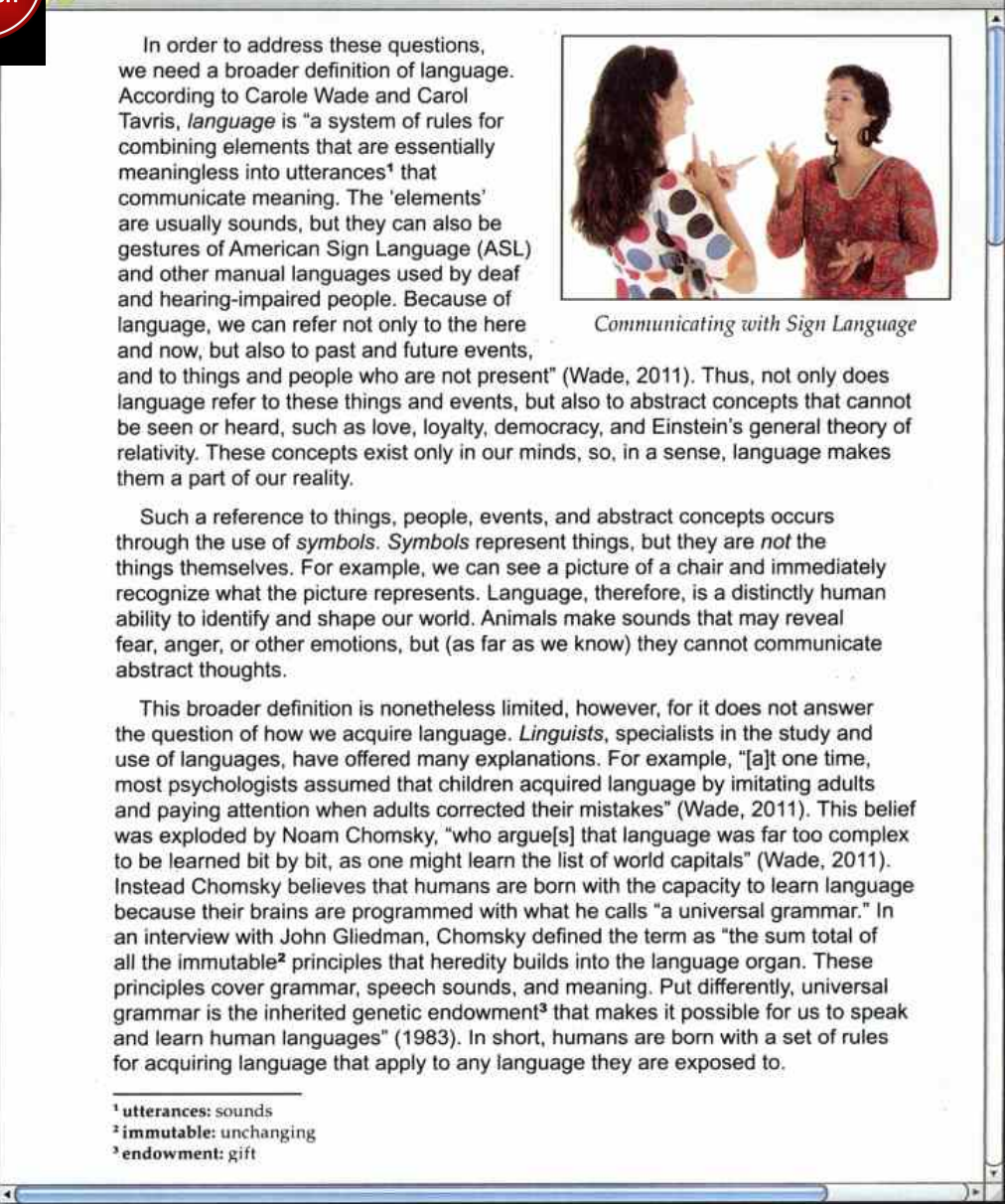
Writing Model What Is Language? 1 We all speak it, and we all write it, but what exactly is it? The Longman Advanced American Dictionary defines language as "a system of communication by written or spoken words which is used by the people of a particular country or area." While this general definition is useful, it seems far too limited. It refers only to people in one country or area, not to all people everywhere. Furthermore, it does not explain the "system," and ignores the fact that words alone are only a partial element of language. The arrangement and form of words (and often other nonverbal signals) also convey meaning. Clearly, language is more complex than merely writing and speaking, and therefore, must involve a deeper set of processes operating in the human brain. What are these processes, and where do they come from? (continued on next page) In order to address these questions, we need a broader definition of language. According to Carole Wade and Carol Tavris, language is "a system of rules for combining elements that are essentially meaningless into utterances that communicate meaning. The 'elements' are usually sounds, but they can also be gestures of American Sign Language (ASL) and other manual languages used by deaf and hearing-impaired people. Because of language, we can refer not only to the here and now, but also to past and future events, Communicating with Sign Language and to things and people who are not present" (Wade, 2011). Thus, not only does language refer to these things and events, but also to abstract concepts that cannot be seen or heard, such as love, loyalty, democracy, and Einstein's general theory of relativity. These concepts exist only in our minds, so, in a sense, language makes them a part of our reality. Such a reference to things, people, events, and abstract concepts occurs through the use of symbols. Symbols represent things, but they are not the things themselves. For example, we can see a picture of a chair and immediately recognize what the picture represents. Language, therefore, is a distinctly human ability to identify and shape our world. Animals make sounds that may reveal fear, anger, or other emotions, but (as far as we know) they cannot communicate abstract thoughts. This broader definition is nonetheless limited, however, for it does not answer the question of how we acquire language. Linguists, specialists in the study and use of languages, have offered many explanations. For example, "[a]t one time, most psychologists assumed that children acquired language by imitating adults and paying attention when adults corrected their mistakes" (Wade, 2011). This belief was exploded by Noam Chomsky, "who argue[s] that language was far too complex to be learned bit by bit, as one might learn the list of world capitals" (Wade, 2011). Instead Chomsky believes that humans are born with the capacity to learn language because their brains are programmed with what he calls "a universal grammar." In an interview with John Gliedman, Chomsky defined the term as "the sum total of all the immutable principles that heredity builds into the language organ. These principles cover grammar, speech sounds, and meaning. Put differently, universal grammar is the inherited genetic endowment that makes it possible for us to speak and learn human languages" (1983). In short, humans are born with a set of rules for acquiring language that apply to any language they are exposed to. 1utterances: sounds immutable: unchanging 'endowment: gift While most linguists and psychologists today agree with Chomsky's general idea, experts differ on how to explain the origin of universal grammar. Many believe that the ability to acquire a language is instinctual, like the untaught behavior of animals. Charles Darwin, the English naturalist famous for his theory of evolution, first expressed this theory in 1871. He argued that the language ability evolved over time: [M]an has an instinctive tendency to speak, as we see in the babble of our young children; whilst no child has an instinctive tendency to brew, bake, or write. Moreover, no philologist now supposes that any language has been deliberately invented; it has been slowly and unconsciously developed by many steps (1874). Stephen Pinker, a professor of psychology at Harvard University, has written several books that support Darwin's position. Pinker states, "I think it is fruitful to consider language as an evolutionary adaptation, like the eye" (1994). Further proof that the ability to use language has evolved comes from our understanding of anatomy. The primary functions of the organs associated with producing oral language relate to eating and breathing, not speaking. Communicative ability in humans comes from an area of the brain called the cerebral cortex, where the elements of language are located. The brains of animals lack highly developed cortexes, so the sources of their sounds come from other areas of the brain that are largely associated with emotion (Pinker, 1994). The human brain is programmed to produce language. What exactly is language, then, and where does it come from? The answer is that language represents and creates our reality through symbols. Human beings have evolved into speaking, writing, and signing creatures through a long process of evolution that makes us ready to acquire language at birth. Although languages differ greatly throughout the world, our brains possess a universal grammar that prepares us to communicate in any of them. Language is what makes us human. Sources: 1. Chomsky, Noam. "Things No Amount of Learning Can Teach." 2. Darwin, C.E. The Descent of Man. 3. Longman Advanced American Dictionary. 4. Pinker, Stephen. The Language Instinct. 5. Wade, Carole and Carol Tavris (2011). Psychology. *philologist: a person who studies language
Step by Step Solution
There are 3 Steps involved in it

Get step-by-step solutions from verified subject matter experts
 Study Help