







Question: WRITTEN ASSIGNMENT: AS/AD ANALYSIS NAME: Your assignment is forecast the future of the U.S. national economy using AS/AD analysis. (If you want to be bold
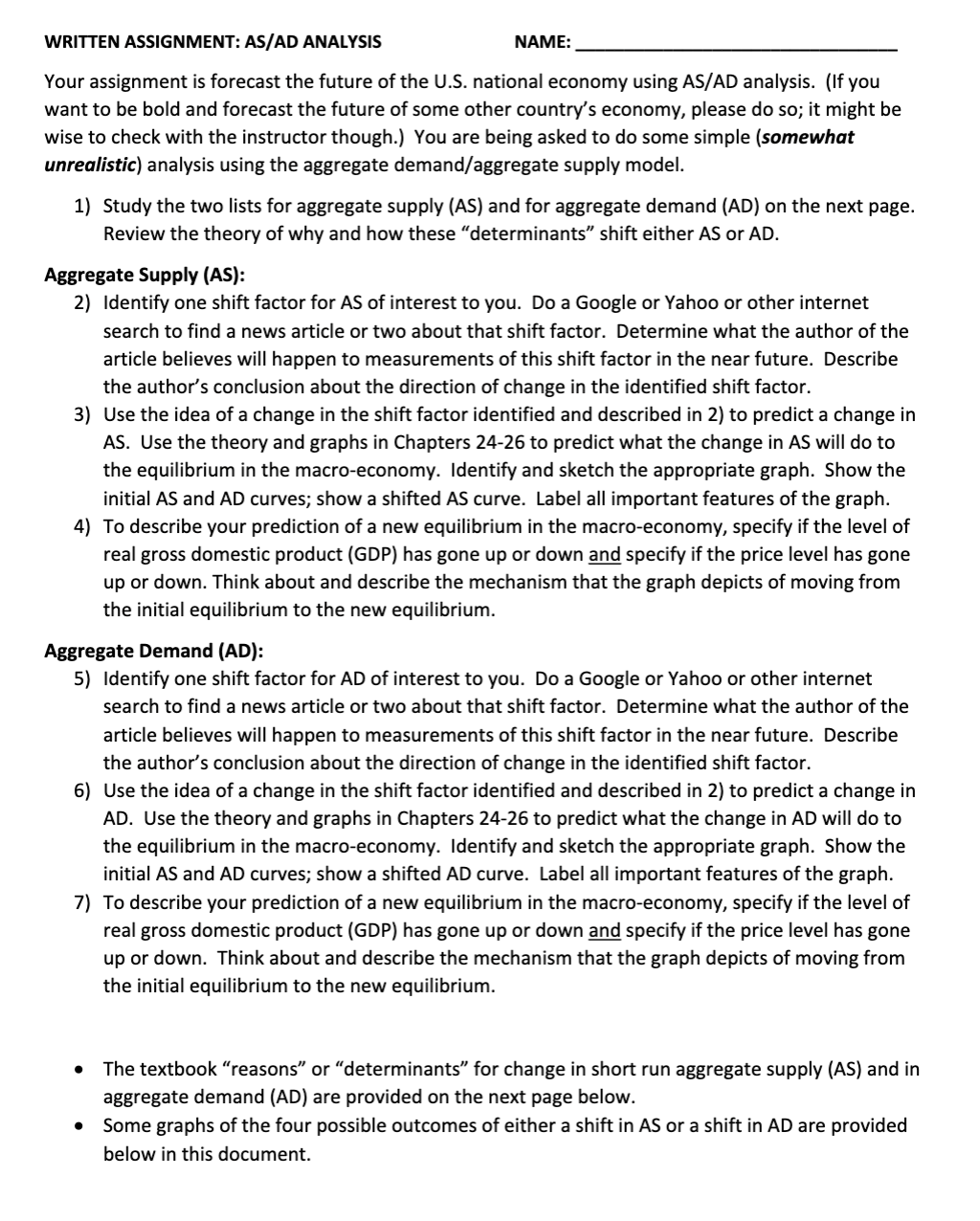
WRITTEN ASSIGNMENT: AS/AD ANALYSIS NAME: Your assignment is forecast the future of the U.S. national economy using AS/AD analysis. (If you want to be bold and forecast the future of some other country's economy, please do so; it might be wise to check with the instructor though.) You are being asked to do some simple (somewhat unrealistic) analysis using the aggregate demand/aggregate supply model. 1) Study the two lists for aggregate supply (AS) and for aggregate demand (AD) on the next page. Review the theory of why and how these "determinants" shift either AS or AD. Aggregate Supply (AS): 2) Identify one shift factor for AS of interest to you. Do a Google or Yahoo or other internet search to find a news article or two about that shift factor. Determine what the author of the article believes will happen to measurements of this shift factor in the near future. Describe the author's conclusion about the direction of change in the identified shift factor. 3) Use the idea of a change in the shift factor identified and described in 2) to predict a change in AS. Use the theory and graphs in Chapters 24-26 to predict what the change in AS will do to the equilibrium in the macro-economy. Identify and sketch the appropriate graph. Show the initial AS and AD curves; show a shifted AS curve. Label all important features of the graph. 4) To describe your prediction of a new equilibrium in the macro-economy, specify if the level of real gross domestic product (GDP) has gone up or down and specify if the price level has gone up or down. Think about and describe the mechanism that the graph depicts of moving from the initial equilibrium to the new equilibrium. Aggregate Demand (AD): 5) Identify one shift factor for AD of interest to you. Do a Google or Yahoo or other internet search to find a news article or two about that shift factor. Determine what the author of the article believes will happen to measurements of this shift factor in the near future. Describe the author's conclusion about the direction of change in the identified shift factor. 6) Use the idea of a change in the shift factor identified and described in 2) to predict a change in AD. Use the theory and graphs in Chapters 24-26 to predict what the change in AD will do to the equilibrium in the macro-economy. Identify and sketch the appropriate graph. Show the initial AS and AD curves; show a shifted AD curve. Label all important features of the graph. 7) To describe your prediction of a new equilibrium in the macro-economy, specify if the level of real gross domestic product (GDP) has gone up or down and specify if the price level has gone up or down. Think about and describe the mechanism that the graph depicts of moving from the initial equilibrium to the new equilibrium. - The textbook "reasons" or "determinants" for change in short run aggregate supply (AS) and in aggregate demand (AD) are provided on the next page below. - Some graphs of the four possible outcomes of either a shift in AS or a shift in AD are provided below in this document. WRITTEN ASSIGNMENT: AS/AD ANALYSIS NAME: Your assignment is forecast the future of the U.S. national economy using AS/AD analysis. (If you want to be bold and forecast the future of some other country's economy, please do so; it might be wise to check with the instructor though.) You are being asked to do some simple (somewhat unrealistic) analysis using the aggregate demand/aggregate supply model. 1) Study the two lists for aggregate supply (AS) and for aggregate demand (AD) on the next page. Review the theory of why and how these "determinants" shift either AS or AD. Aggregate Supply (AS): 2) Identify one shift factor for AS of interest to you. Do a Google or Yahoo or other internet search to find a news article or two about that shift factor. Determine what the author of the article believes will happen to measurements of this shift factor in the near future. Describe the author's conclusion about the direction of change in the identified shift factor. 3) Use the idea of a change in the shift factor identified and described in 2) to predict a change in AS. Use the theory and graphs in Chapters 24-26 to predict what the change in AS will do to the equilibrium in the macro-economy. Identify and sketch the appropriate graph. Show the initial AS and AD curves; show a shifted AS curve. Label all important features of the graph. 4) To describe your prediction of a new equilibrium in the macro-economy, specify if the level of real gross domestic product (GDP) has gone up or down and specify if the price level has gone up or down. Think about and describe the mechanism that the graph depicts of moving from the initial equilibrium to the new equilibrium. Aggregate Demand (AD): 5) Identify one shift factor for AD of interest to you. Do a Google or Yahoo or other internet search to find a news article or two about that shift factor. Determine what the author of the article believes will happen to measurements of this shift factor in the near future. Describe the author's conclusion about the direction of change in the identified shift factor. 6) Use the idea of a change in the shift factor identified and described in 2) to predict a change in AD. Use the theory and graphs in Chapters 24-26 to predict what the change in AD will do to the equilibrium in the macro-economy. Identify and sketch the appropriate graph. Show the initial AS and AD curves; show a shifted AD curve. Label all important features of the graph. 7) To describe your prediction of a new equilibrium in the macro-economy, specify if the level of real gross domestic product (GDP) has gone up or down and specify if the price level has gone up or down. Think about and describe the mechanism that the graph depicts of moving from the initial equilibrium to the new equilibrium. - The textbook "reasons" or "determinants" for change in short run aggregate supply (AS) and in aggregate demand (AD) are provided on the next page below. - Some graphs of the four possible outcomes of either a shift in AS or a shift in AD are provided below in this document
Step by Step Solution
There are 3 Steps involved in it

Get step-by-step solutions from verified subject matter experts
 Study Help