







Question: Osmosis occurs when two solutions of different concentrations are separated by a semipermeable membrane. The membrane allows solvent particles, but not solute particles, to
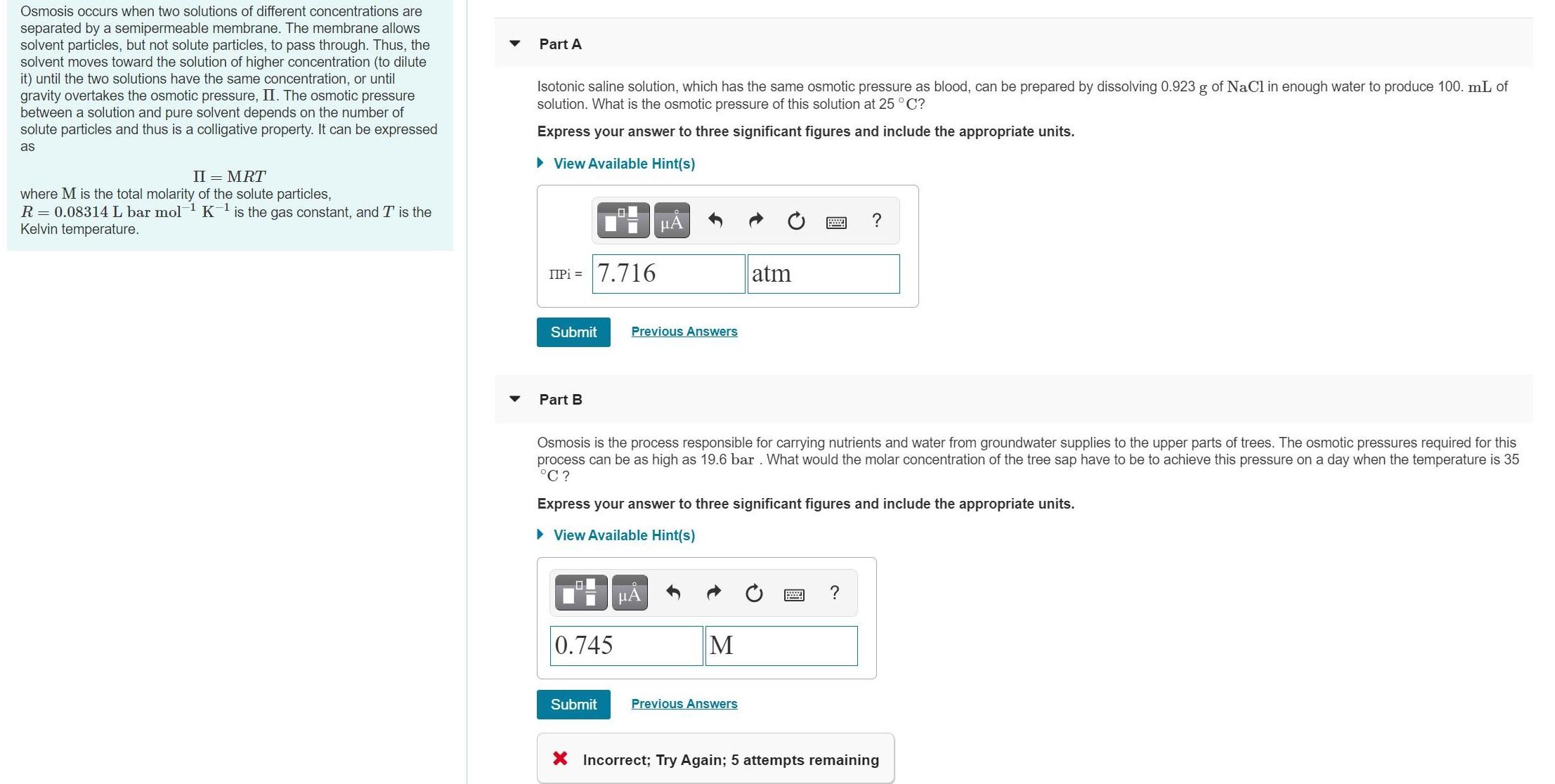
Osmosis occurs when two solutions of different concentrations are separated by a semipermeable membrane. The membrane allows solvent particles, but not solute particles, to pass through. Thus, the solvent moves toward the solution of higher concentration (to dilute it) until the two solutions have the same concentration, or until gravity overtakes the osmotic pressure, II. The osmotic pressure between a solution and pure solvent depends on the number of solute particles and thus is a colligative property. It can be expressed Part A Isotonic saline solution, which has the same osmotic pressure as blood, can be prepared by dissolving 0.923 g of NaCl in enough water to produce 100. mL of solution. What is the osmotic pressure of this solution at 25 C? Express your answer to three significant figures and include the appropriate units. as > View Available Hint(s) II = MRT where M is the total molarity of the solute particles, R = 0.08314L bar mol K is the gas constant, and T is the Kelvin temperature. IIPI = 7.716 atm Submit Previous Answers Part B Osmosis is the process responsible for carrying nutrients and water from groundwater supplies to the upper parts of trees. The osmotic pressures required for this process can be as high as 19.6 bar . What would the molar concentration of the tree sap have to be to achieve this pressure on a day when the temperature is 35 C ? Express your answer to three significant figures and include the appropriate units. > View Available Hint(s) A 0.745 M Submit Previous Answers X Incorrect; Try Again; 5 attempts remaining
Step by Step Solution
3.34 Rating (169 Votes )
There are 3 Steps involved in it

Get step-by-step solutions from verified subject matter experts
 Study Help