







Question: You are selecting an alloy for an engine component, and you are looking for a material with low diffusivity changes with temperature to prevent the
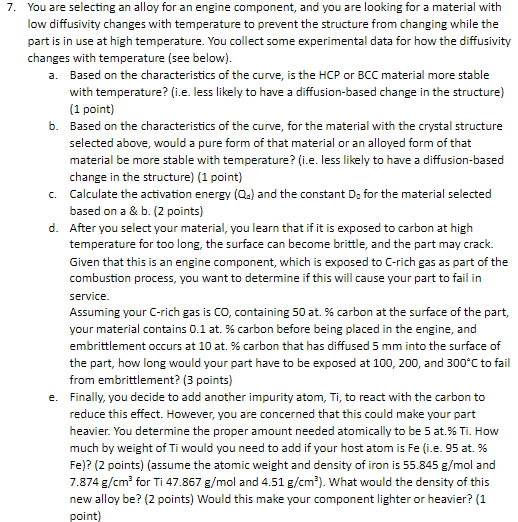
You are selecting an alloy for an engine component, and you are looking for a material with low diffusivity changes with temperature to prevent the structure from changing while the part is in use at high temperature. You collect some experimental data for how the diffusivity changes with temperature see below
a Based on the characteristics of the curve, is the HCP or BCC material more stable with temperature? ie less likely to have a diffusionbased change in the structure
b Based on the characteristics of the curve, for the material with the crystal structure selected above, would a pure form of that material or an alloyed form of that material be more stable with temperature? ie less likely to have a diffusionbased change in the structure
c Calculate the activation energy and the constant for the material selected based on a & b
d After you select your material, you learn that if it is exposed to carbon at high temperature for too long, the surface can become brittle, and the part may crack. Given that this is an engine component, which is exposed to Crich gas as part of the combustion process, you want to determine if this will cause your part to fail in service. Assuming your Crich gas is containing at carbon at the surface of the part,
your material contains at carbon before being placed in the engine, and embrittlement occurs at at carbon that has diffused into the surface of the part, how long would your part have to be exposed at and to fail
from embrittlement?
e Finally, you decide to add another impurity atom, to react with the carbon to reduce this effect. However, you are concerned that this could make your part heavier. You determine the proper amount needed atomically to be at Ti How much by weight of Ti would you need to add if your host atom is Fe ie at pointsassume the atomic weight and density of iron is and for Ti and What would the density of this new alloy be Would this make your component lighter or heavier?
Step by Step Solution
There are 3 Steps involved in it
1 Expert Approved Answer
Step: 1 Unlock

Question Has Been Solved by an Expert!
Get step-by-step solutions from verified subject matter experts
Step: 2 Unlock
Step: 3 Unlock
 Study Help