





Question: You are tasked with developing a job evaluation worksheet, similar to Table 6-9 (page 139) in Martocchio. The purpose of this worksheet is to help

You are tasked with developing a job evaluation worksheet, similar to Table 6-9 (page 139) in Martocchio. The purpose of this worksheet is to help compensation analysts assign point values to different jobs in the firm. Using these point values, you can determine which jobs are worth more than others. What do you use these points for? In Chapter 7, you will see that point values are helpful in ensuring that jobs are competitive with the market.
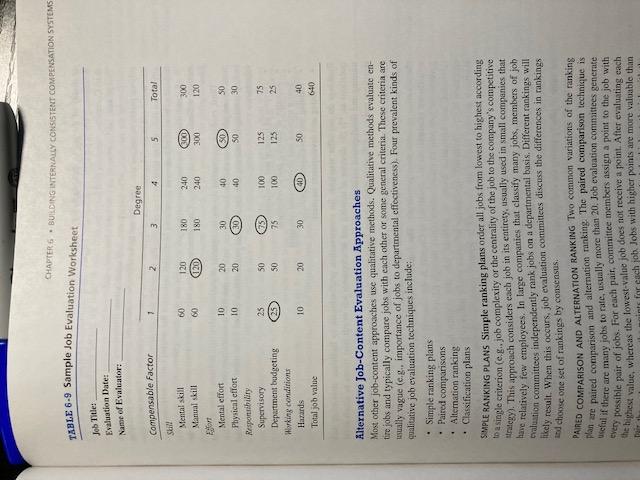
You are tasked with developing a job evaluation

Assume that you will allocate 1,000 points total. The factors you would need to consider are:

  1. Skills:
    1. Experience
    2. Education
  2. Responsibility:
    1. Supervisory
    2. Budget
  3. Complexity of duties
    1. Independent decision making
    2. Using initiative
  4. Consequences of mistakes

The compensation committee decided to use the following weight scheme:

  • Skills: 25%
  • Responsibility: 15%
  • Complexity of duties: 55%
  • Consequences of mistakes: 5%
  1. Create the job evaluation worksheet, assuming 5 levels for each compensable factor. Your task is to allocate point values into the shaded cells. You are tasked with developing a job evaluation
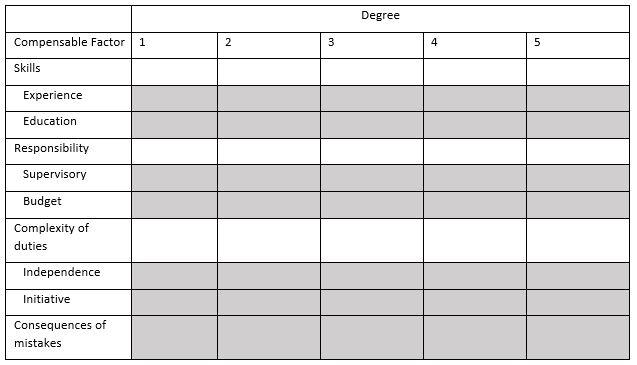
  2. After you create the worksheet above, calculate the total points for someone who is level 5 in experience and education, level 4 in supervisory and budget responsibility, level 3 in independence and initiative, and level 2 in consequences of mistakes. ***Ideally, the system would have clear descriptions for what each level means. For example, education may range from 1 = no degree to 5 = graduate degree. For this activity, you do not need to define levels
CHAPTER 6 BUILDING INTERNALLY CONSISTENT COMPENSATION SYSTEMS TABLE 6-9 Sample Job Evaluation Worksheet Job Title: Evaluation Date: Name of Evaluator: Degree 1 2 3 4 5 Total 120 88 500) 180 180 300 20 240 240 300 120 @aa 10 Compensable Factor SV Mental skill Manual skill sort Mental effort Physical effort Responsibility Supervisory Department budgeting Horking conditions Hazards Totaljob value 40 20 20 30 30 SO SO SO 30 10 40 100 25 25 50 50 35 75 125 125 75 25 100 10 20 30 (40) 50 40 640 . Alternative Job-Content Evaluation Approaches Most other job-content approaches use qualitative methods. Qualitative methods evaluate en- tire jobs and typically compare jobs with each other or some general criteria. These criteria are usually vague (eg. importance of jobs to departmental effectiveness). Four prevalent kinds of qualitative job evaluation techniques include: Simple ranking plans Paired comparisons Alternation ranking Classification plans SIMPLE RANKING PLANS Simple ranking plans order all jobs from lowest to highest according a single criterion (e.g..job complexity or the centrality of the job to the company's competitive rategy). This approach considers each job in its entirety, usually used in small companies that have relatively few employees. In large companies that classify many jobs, members of joh Evaluation committees independently rank jobs on a departmental basis. Different rankings will likely result. When this occurs, job evaluation committees discuss the differences in rankings od choose one set of rankings by consensus. PAIRED COMPARISON AND ALTERNATION RANKING Two common variations of the ranking paired comparison and alternation ranking. The paired comparison technique is useful if there are many jobs to rate, usually more than 20. Joh evaluation committees generate every possible pair of jobs. For each pais, committee members assign a point to the job with the highest value, whereas the lowest-value job does not receive a point. After evaluating each ints for each job Jobs with higher points are more valuable than plan are Degree Compensable Factor 1 2 3 4 5 Skills Experience Education Responsibility Supervisory Budget Complexity of duties Independence Initiative Consequences of mistakes

Step by Step Solution

There are 3 Steps involved in it

1 Expert Approved Answer
Step: 1 Unlock blur-text-image

Question Has Been Solved by an Expert!

Get step-by-step solutions from verified subject matter experts

Step: 2 Unlock
Step: 3 Unlock

Students Have Also Explored These Related General Management Questions!