







Question: You have been asked to use the expected-value model to asses the risk in developing a new product. Each strategy requires a different sum of
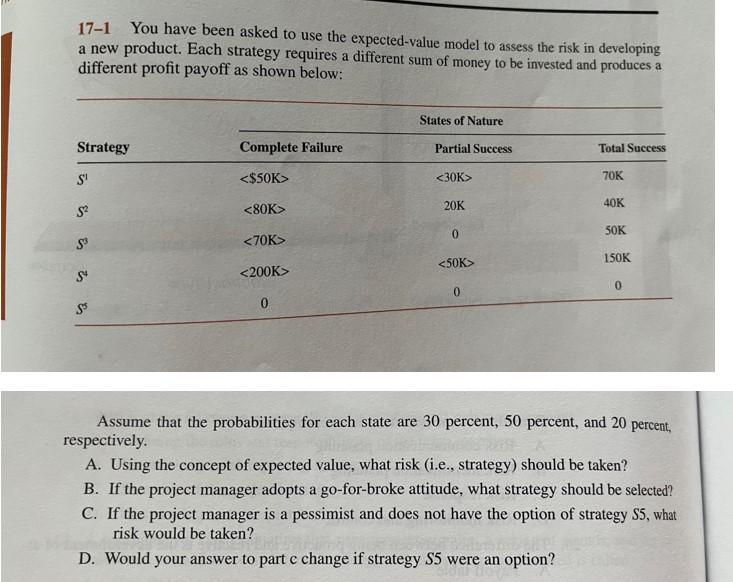 You have been asked to use the expected-value model to asses the risk in developing a new product. Each strategy requires a different sum of money to be invested and produces a different profit as shown below:
17-1 You have been asked to use the expected-value model to assess the risk in developing a new product. Each strategy requires a different sum of money to be invested and produces a different profit payoff as shown below: Assume that the probabilities for each state are 30 percent, 50 percent, and 20 percent, respectively. A. Using the concept of expected value, what risk (i.e., strategy) should be taken? B. If the project manager adopts a go-for-broke attitude, what strategy should be selected? C. If the project manager is a pessimist and does not have the option of strategy S5, what risk would be taken? D. Would your answer to part c change if strategy S5 were an option? 17-1 You have been asked to use the expected-value model to assess the risk in developing a new product. Each strategy requires a different sum of money to be invested and produces a different profit payoff as shown below: Assume that the probabilities for each state are 30 percent, 50 percent, and 20 percent, respectively. A. Using the concept of expected value, what risk (i.e., strategy) should be taken? B. If the project manager adopts a go-for-broke attitude, what strategy should be selected? C. If the project manager is a pessimist and does not have the option of strategy S5, what risk would be taken? D. Would your answer to part c change if strategy S5 were an option
Step by Step Solution
There are 3 Steps involved in it

Get step-by-step solutions from verified subject matter experts
 Study Help