



Question: You have designed a wheeled mobile robot and would like to compute the power drawn by the motors when the robot moves on different
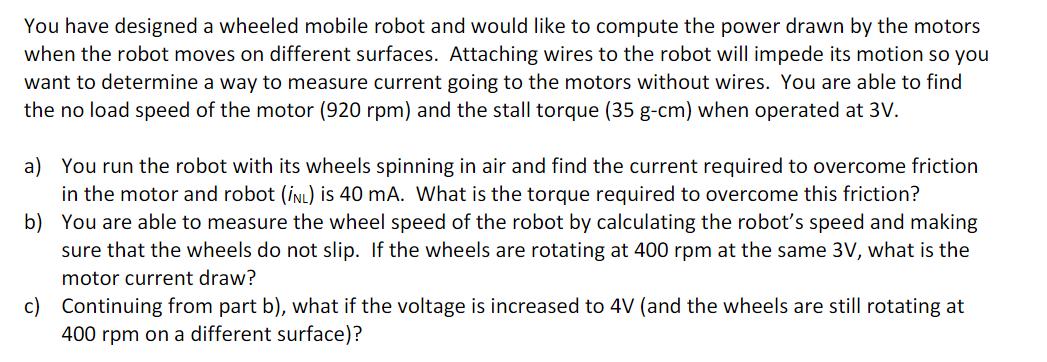
You have designed a wheeled mobile robot and would like to compute the power drawn by the motors when the robot moves on different surfaces. Attaching wires to the robot will impede its motion so you want to determine a way to measure current going to the motors without wires. You are able to find the no load speed of the motor (920 rpm) and the stall torque (35 g-cm) when operated at 3V. a) You run the robot with its wheels spinning in air and find the current required to overcome friction in the motor and robot (/NL) is 40 mA. What is the torque required to overcome this friction? b) You are able to measure the wheel speed of the robot by calculating the robot's speed and making sure that the wheels do not slip. If the wheels are rotating at 400 rpm at the same 3V, what is the motor current draw? c) Continuing from part b), what if the voltage is increased to 4V (and the wheels are still rotating at 400 rpm on a different surface)?
Step by Step Solution
3.51 Rating (158 Votes )
There are 3 Steps involved in it
a To find the torque required to overcome friction Tf we use the formula Tf textINLtextStall Torque ... View full answer

Get step-by-step solutions from verified subject matter experts