







Question: You have two arrays storing unsigned double precision numbers (16 bits each). The first array stretches from locations Ox20 to 0x2F of Bank 0, while
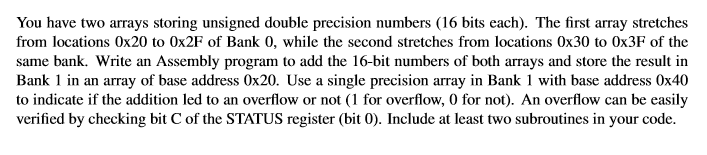
You have two arrays storing unsigned double precision numbers (16 bits each). The first array stretches from locations Ox20 to 0x2F of Bank 0, while the second stretches from locations Ox30 to Ox3F of the same bank. Write an Assembly program to add the 16-bit numbers of both arrays and store the result in Bank 1 in an array of base address 0x20. Use a single precision array in Bank 1 with base address 0x40 to indicate if the addition led to an overflow or not (1 for overflow, 0 for not). An overflow can be easily verified by checking bit C of the STATUS register (bit 0). Include at least two subroutines in your code. You have two arrays storing unsigned double precision numbers (16 bits each). The first array stretches from locations Ox20 to 0x2F of Bank 0, while the second stretches from locations Ox30 to Ox3F of the same bank. Write an Assembly program to add the 16-bit numbers of both arrays and store the result in Bank 1 in an array of base address 0x20. Use a single precision array in Bank 1 with base address 0x40 to indicate if the addition led to an overflow or not (1 for overflow, 0 for not). An overflow can be easily verified by checking bit C of the STATUS register (bit 0). Include at least two subroutines in your code
Step by Step Solution
There are 3 Steps involved in it

Get step-by-step solutions from verified subject matter experts
 Study Help