



Question: You may recall from PHY 111 that the linear drag force is given by D=6, where n is the viscosity of the fluid, r
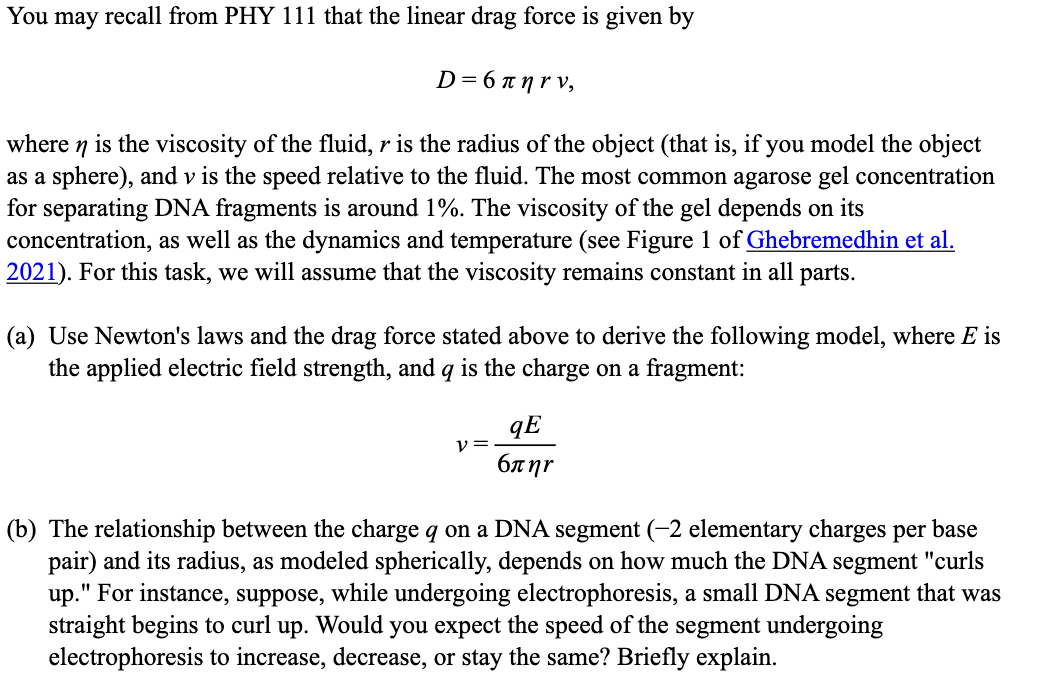
You may recall from PHY 111 that the linear drag force is given by D=6, where n is the viscosity of the fluid, r is the radius of the object (that is, if you model the object as a sphere), and v is the speed relative to the fluid. The most common agarose gel concentration for separating DNA fragments is around 1%. The viscosity of the gel depends on its concentration, as well as the dynamics and temperature (see Figure 1 of Ghebremedhin et al. 2021). For this task, we will assume that the viscosity remains constant in all parts. (a) Use Newton's laws and the drag force stated above to derive the following model, where is the applied electric field strength, and q is the charge on a fragment: v= qE ( (b) The relationship between the charge q on a DNA segment (-2 elementary charges per base pair) and its radius, as modeled spherically, depends on how much the DNA segment "curls up." For instance, suppose, while undergoing electrophoresis, a small DNA segment that was straight begins to curl up. Would you expect the speed of the segment undergoing electrophoresis to increase, decrease, or stay the same? Briefly explain.
Step by Step Solution
There are 3 Steps involved in it

Get step-by-step solutions from verified subject matter experts