



Question: You must use the following data 1mph = 0.447 m/s 1 hp 0.7457 kW sea level air density: 1.2 kg/m acceleration due to gravity:
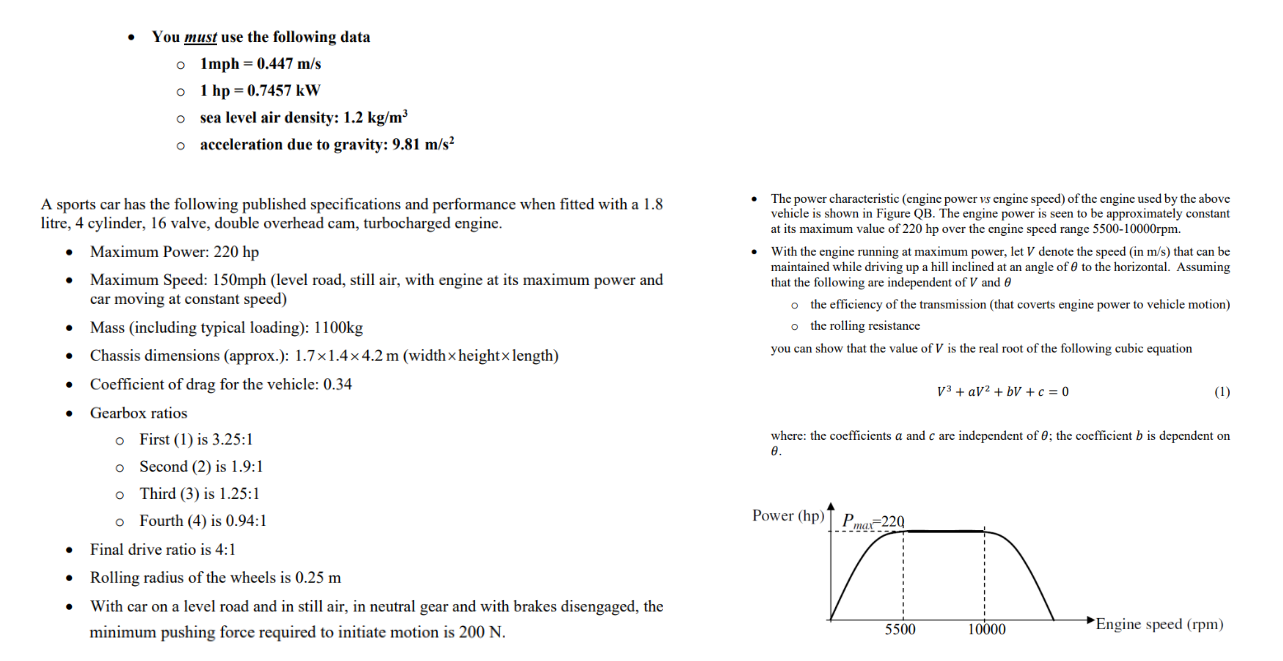
You must use the following data 1mph = 0.447 m/s 1 hp 0.7457 kW sea level air density: 1.2 kg/m acceleration due to gravity: 9.81 m/s A sports car has the following published specifications and performance when fitted with a 1.8 litre, 4 cylinder, 16 valve, double overhead cam, turbocharged engine. Maximum Power: 220 hp Maximum Speed: 150mph (level road, still air, with engine at its maximum power and car moving at constant speed) Mass (including typical loading): 1100kg Chassis dimensions (approx.): 1.71.44.2 m (width x height x length) Coefficient of drag for the vehicle: 0.34 Gearbox ratios First (1) is 3.25:1 o Second (2) is 1.9:1 o Third (3) is 1.25:1 o Fourth (4) is 0.94:1 Final drive ratio is 4:1 Rolling radius of the wheels is 0.25 m With car on a level road and in still air, in neutral gear and with brakes disengaged, the minimum pushing force required to initiate motion is 200 N. The power characteristic (engine power vs engine speed) of the engine used by the above vehicle is shown in Figure QB. The engine power is seen to be approximately constant at its maximum value of 220 hp over the engine speed range 5500-10000rpm. With the engine running at maximum power, let V denote the speed (in m/s) that can be maintained while driving up a hill inclined at an angle of 0 to the horizontal. Assuming that the following are independent of V and o the efficiency of the transmission (that coverts engine power to vehicle motion) the rolling resistance you can show that the value of V is the real root of the following cubic equation V + av + bV+c=0 (1) where: the coefficients a and c are independent of 0; the coefficient b is dependent on 0. Power (hp) Pa 220 max 5500 10000 Engine speed (rpm)
Step by Step Solution
There are 3 Steps involved in it

Get step-by-step solutions from verified subject matter experts