







Question: Assume that a palladium metal foil has been saturated with a homogenous concentration of hydrogen atoms at equilibrium. Assume that at room temperature the
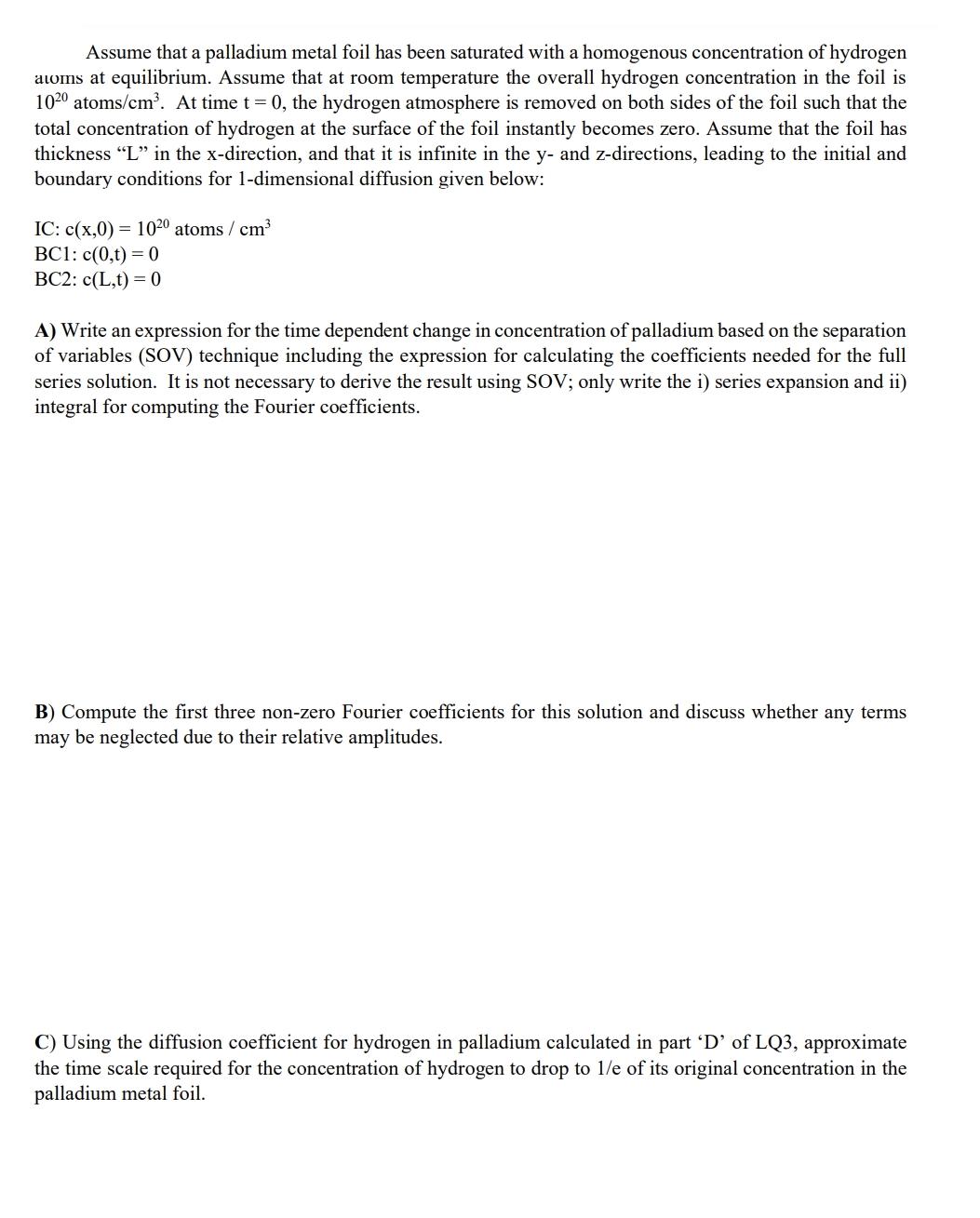
Assume that a palladium metal foil has been saturated with a homogenous concentration of hydrogen atoms at equilibrium. Assume that at room temperature the overall hydrogen concentration in the foil is 1020 atoms/cm. At time t = 0, the hydrogen atmosphere is removed on both sides of the foil such that the total concentration of hydrogen at the surface of the foil instantly becomes zero. Assume that the foil has thickness "L" in the x-direction, and that it is infinite in the y- and z-directions, leading to the initial and boundary conditions for 1-dimensional diffusion given below: 1020 atoms/cm IC: c(x,0) BC1: c(0,t) = 0 BC2: c(L,t)=0 A) Write an expression for the time dependent change in concentration of palladium based on the separation of variables (SOV) technique including the expression for calculating the coefficients needed for the full series solution. It is not necessary to derive the result using SOV; only write the i) series expansion and ii) integral for computing the Fourier coefficients. B) Compute the first three non-zero Fourier coefficients for this solution and discuss whether any terms may be neglected due to their relative amplitudes. C) Using the diffusion coefficient for hydrogen in palladium calculated in part 'D' of LQ3, approximate the time scale required for the concentration of hydrogen to drop to 1/e of its original concentration in the palladium metal foil.
Step by Step Solution
There are 3 Steps involved in it

Get step-by-step solutions from verified subject matter experts
 Study Help