







Question: Youngest H G E K D Oldest Figure 12 Geologic block diagram of a hypothetical area showing igneous intrusive features (K and L), a
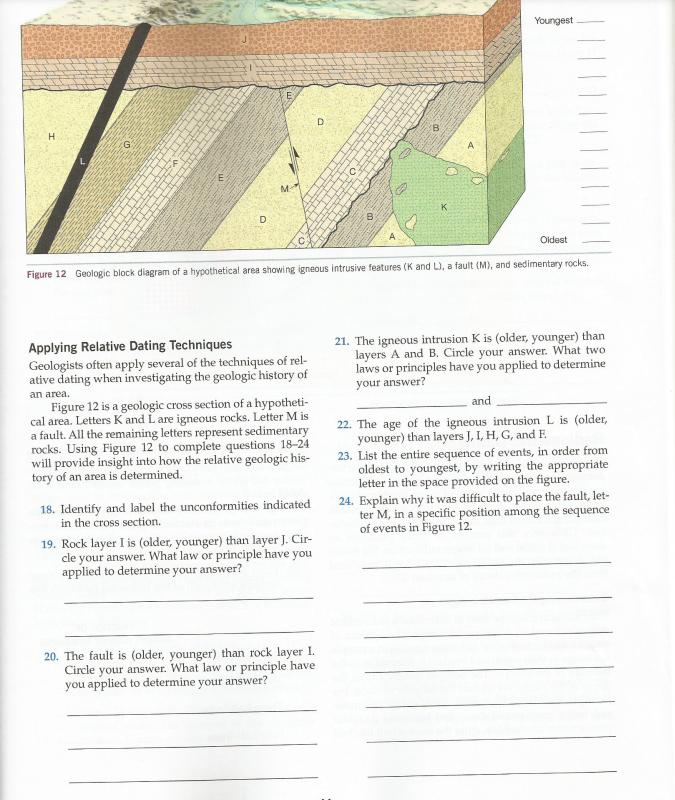
Youngest H G E K D Oldest Figure 12 Geologic block diagram of a hypothetical area showing igneous intrusive features (K and L), a fault (M), and sedimentary rocks. Applying Relative Dating Techniques Geologists often apply several of the techniques of rel- ative dating when investigating the geologic history of 21. The igneous intrusion K is (older, younger) than layers A and B. Circle your answer. What two laws or principles have you applied to determine your answer? an area. and Figure 12 is a geologic cross section of a hypotheti- cal area. Letters K and L are igneous rocks. Letter M is a fault. All the remaining letters represent sedimentary rocks. Using Figure 12 to complete questions 18-24 will provide insight into how the relative geologic his- tory of an area is determined. 22. The age of the igneous intrusion L is (older, younger) than layers J, I, H, G, and F. 23. List the entire sequence of events, in order from oldest to youngest, by writing the appropriate letter in the space provided on the figure. 18. Identify and label the unconformities indicated in the cross section. 24. Explain why it was difficult to place the fault, let- ter M, in a specific position among the sequence of events in Figure 12. 19. Rock layer I is (older, younger) than layer J. Cir- cle your answer. What law or principle have you applied to determine your answer? 20. The fault is (older, younger) than rock layer I. Circle your answer. What law or principle have you applied to determine your answer? E M D 8
Step by Step Solution
3.39 Rating (165 Votes )
There are 3 Steps involved in it
18 Unconformities indicated in the cross section are labeled U1 and U2 U1 is the gap between the igneous intrusion K and the sedimentary rocks A and B ... View full answer

Get step-by-step solutions from verified subject matter experts
 Study Help