



Question: yu 35 approved at the charter review. The program team is free to plan and execute the product development program as long as the program
yu
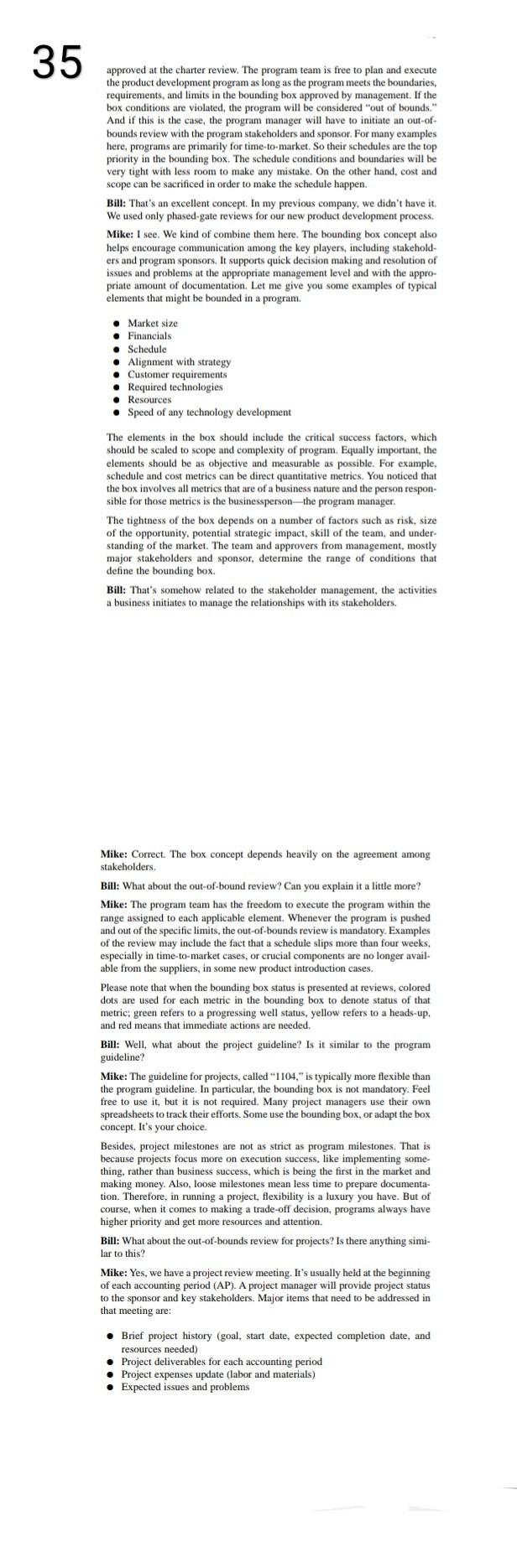
35 approved at the charter review. The program team is free to plan and execute the product development program as long as the program meets the boundaries, requirements, and limits in the bounding box approved by management. If the box conditions are violated, the program will be considered of bounds." And if this is the case, the program manager will have to initiate out-of- bounds review with the program stakeholders and sponsor. For many examples here, programs are primarily for time-to-market. So their schedules are the top priority in the bounding box. The schedule conditions and boundaries will be very tight with less room to make any mistake. On the other hand, cost and scope can be sacrificed in order to make the schedule happen. Bill: That's an excellent concept. In my previous company, we didn't have it. We used only phased-gate reviews for our new product development process. Mike: I see. We kind of combine them here. The bounding box concept also helps encourage communication among the key players, including stakehold- ers and program sponsors. It supports quick decision making and resolution of issues and problems at the appropriate management level and with the appro- priate amount of documentation. Let me give you some examples of typical elements that might be bounded in a program. Market size Financials Schedule Alignment with strategy Customer requirements Required technologies Resources Speed of any technology development The elements in the box should include the critical success factors, which should be scaled to scope and complexity of program, Equally important, the elements should be as objective and measurable as possible. For example, schedule and cost metrics can be direct quantitative metrics. You noticed that the box involves all metrics that are of a business nature and the person respon sible for those metrics is the businessperson the program manager, The tightness of the box depends on a number of factors such as risk, size of the opportunity, potential strategic impact, skill of the team, and under- standing of the market. The team and approvers from management, mostly major stakeholders and sponsor, determine the range of conditions that define the bounding box. Bill: That's somehow related to the stakeholder management, the activities a business initiates to manage the relationships with its stakeholders. Mike: Correct. The box concept depends heavily on the agreement among stakeholders. Bill: What about the out-of-bound review? Can you explain it a little more? Mike: The program team has the freedom to execute the program within the range assigned to each applicable element. Whenever the program is pushed and out of the specific limits, the out-of-bounds review is mandatory. Examples of the review may include the fact that a schedule slips more than four weeks, especially in time-to-market cases, or crucial components are no longer avail- able from the suppliers, in some new product introduction cases. Please note that when the bounding box status is presented at reviews, colored dots are used for each metric in the bounding box to denote status of that metric, green refers to a progressing well status, yellow refers to a heads-up, and red means that immediate actions are needed. Bill: Well, what about the project guideline? Is it similar to the program guideline? Mike: The guideline for projects, called "1104." is typically more flexible than the program guideline. In particular, the bounding box is not mandatory. Feel free to use it, but it is not required. Many project managers use their own spreadsheets to track their efforts. Some use the bounding box, or adapt the box concept. It's your choice. Besides, project milestones are not as strict as program milestones. That is because projects focus more on execution success, like implementing some- thing, rather than business success, which is being the first in the market and making money. Also, loose milestones mean less time to prepare documenta- tion. Therefore, in running a project, flexibility is a luxury you have. But of course, when it comes to making a trade-off decision, programs always have higher priority and get more resources and attention. Bill: What about the out-of-bounds review for projects? Is there anything simi- lar to this? Mike: Yes, we have a project review meeting. It's usually held at the beginning of each accounting period (AP). A project manager will provide project status to the sponsor and key stakeholders. Major items that need to be addressed in that meeting are: Brief project history (goal, start date, expected completion date, and resources needed) Project deliverables for each accounting period Project expenses update (labor and materials) Expected issues and problemsStep by Step Solution
There are 3 Steps involved in it
1 Expert Approved Answer
Step: 1 Unlock

Question Has Been Solved by an Expert!
Get step-by-step solutions from verified subject matter experts
Step: 2 Unlock
Step: 3 Unlock