







Question: zio: Considering Change Through Charisma RANSFORMATION Devon sat there and thought about the next phase of his management plan. It had been a whirlwind experience
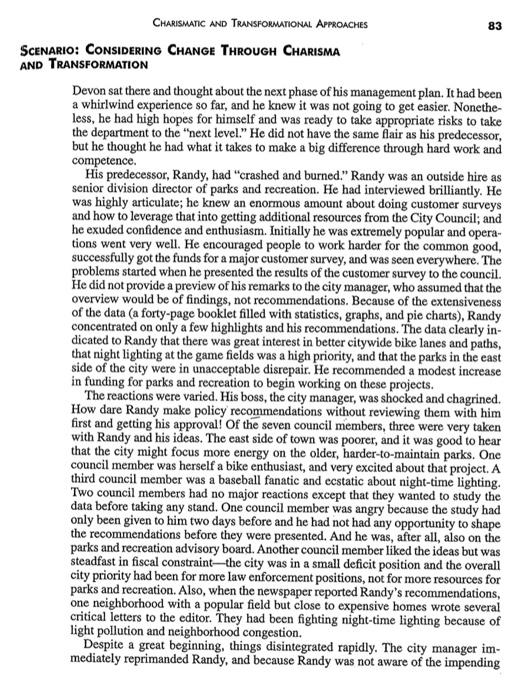
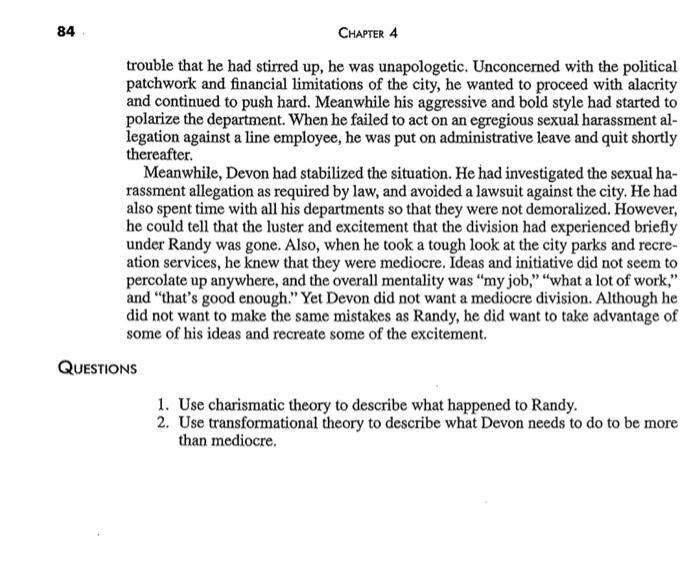
zio: Considering Change Through Charisma RANSFORMATION Devon sat there and thought about the next phase of his management plan. It had been a whirlwind experience so far, and he knew it was not going to get easier. Nonetheless, he had high hopes for himself and was ready to take appropriate risks to take the department to the "next level." He did not have the same flair as his predecessor, but he thought he had what it takes to make a big difference through hard work and competence. His predecessor, Randy, had "crashed and burned." Randy was an outside hire as senior division director of parks and recreation. He had interviewed brilliantly. He was highly articulate; he knew an enormous amount about doing customer surveys and how to leverage that into getting additional resources from the City Council; and he exuded confidence and enthusiasm. Initially he was extremely popular and operations went very well. He encouraged people to work harder for the common good, successfully got the funds for a major customer survey, and was seen everywhere. The problems started when he presented the results of the customer survey to the council. He did not provide a preview of his remarks to the city manager, who assumed that the overview would be of findings, not recommendations. Because of the extensiveness of the data (a forty-page booklet filled with statistics, graphs, and pie charts), Randy concentrated on only a few highlights and his recommendations. The data clearly indicated to Randy that there was great interest in better citywide bike lanes and paths, that night lighting at the game fields was a high priority, and that the parks in the east side of the city were in unacceptable disrepair. He recommended a modest increase in funding for parks and recreation to begin working on these projects. The reactions were varied. His boss, the city manager, was shocked and chagrined. How dare Randy make policy recommendations without reviewing them with him first and getting his approval! of the seven council members, three were very taken with Randy and his ideas. The east side of town was poorer, and it was good to hear that the city might focus more energy on the older, harder-to-maintain parks. One council member was herself a bike enthusiast, and very excited about that project. A third council member was a baseball fanatic and ecstatic about night-time lighting. Two council members had no major reactions except that they wanted to study the data before taking any stand. One council member was angry because the study had only been given to him two days before and he had not had any opportunity to shape the recommendations before they were presented. And he was, after all, also on the parks and recreation advisory board. Another council member liked the ideas but was steadfast in fiscal constraint- the city was in a small deficit position and the overall city priority had been for more law enforcement positions, not for more resources for parks and recreation. Also, when the newspaper reported Randy's recommendations, one neighborhood with a popular field but close to expensive homes wrote several critical letters to the editor. They had been fighting night-time lighting because of light pollution and neighborhood congestion. Despite a great beginning, things disintegrated rapidly. The city manager immediately reprimanded Randy, and because Randy was not aware of the impending trouble that he had stirred up, he was unapologetic. Unconcerned with the political patchwork and financial limitations of the city, he wanted to proceed with alacrity and continued to push hard. Meanwhile his aggressive and bold style had started to polarize the department. When he failed to act on an egregious sexual harassment allegation against a line employee, he was put on administrative leave and quit shortly thereafter. Meanwhile, Devon had stabilized the situation. He had investigated the sexual harassment allegation as required by law, and avoided a lawsuit against the city. He had also spent time with all his departments so that they were not demoralized. However, he could tell that the luster and excitement that the division had experienced briefly under Randy was gone. Also, when he took a tough look at the city parks and recreation services, he knew that they were mediocre. Ideas and initiative did not seem to percolate up anywhere, and the overall mentality was "my job," "what a lot of work," and "that's good enough." Yet Devon did not want a mediocre division. Although he did not want to make the same mistakes as Randy, he did want to take advantage of some of his ideas and recreate some of the excitement
Step by Step Solution
There are 3 Steps involved in it

Get step-by-step solutions from verified subject matter experts
 Study Help