







Question: Suppose that we have two independent samples, say Two models can be fit to these samples, [begin{gathered}y_{i}=beta_{0}+beta_{1} x_{i}+varepsilon_{i}, quad i=1,2, ldots, n_{2} y_{i}=gamma_{0}+gamma_{1} x_{i}+varepsilon_{i}, quad
Suppose that we have two independent samples, say
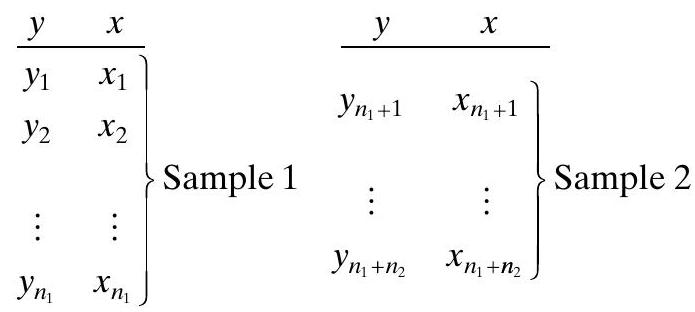
Two models can be fit to these samples,
\[\begin{gathered}y_{i}=\beta_{0}+\beta_{1} x_{i}+\varepsilon_{i}, \quad i=1,2, \ldots, n_{2} \\y_{i}=\gamma_{0}+\gamma_{1} x_{i}+\varepsilon_{i}, \quad i=n_{1}+1, n_{1}+2, \ldots, n_{1}+n_{2}\end{gathered}\]
a. Show how these two separate models can be written as a single model.
b. Using the result in part a, show how the general linear hypothesis can be used to test the equality of slopes $\beta_{1}$ and $\gamma_{1}$.
c. Using the result in part a, show how the general linear hypothesis can be used to test the equality of the two regression lines.
d. Using the result in part a, show how the general linear hypothesis can be used to test that both slopes are equal to a constant $c$.
y x y x X1 Ym+1 Xm+1 Y2 X2 Sample 1 Sample 2 B : Xm
Step by Step Solution
There are 3 Steps involved in it

Get step-by-step solutions from verified subject matter experts
 Study Help