New Semester
Started
Get
50% OFF
Study Help!
--h --m --s
Claim Now
Question Answers
Textbooks
Find textbooks, questions and answers
Oops, something went wrong!
Change your search query and then try again
S
Books
FREE
Study Help
Expert Questions
Accounting
General Management
Mathematics
Finance
Organizational Behaviour
Law
Physics
Operating System
Management Leadership
Sociology
Programming
Marketing
Database
Computer Network
Economics
Textbooks Solutions
Accounting
Managerial Accounting
Management Leadership
Cost Accounting
Statistics
Business Law
Corporate Finance
Finance
Economics
Auditing
Tutors
Online Tutors
Find a Tutor
Hire a Tutor
Become a Tutor
AI Tutor
AI Study Planner
NEW
Sell Books
Search
Search
Sign In
Register
study help
sciences
mathematical methods for physicists
A Course In Mathematical Methods For Physicists 1st Edition Russell L Herman - Solutions
Consider the three-dimensional Euler rotation matrix \(\hat{R}(\phi, \theta, \psi)=\) \(\hat{R}_{z}(\psi) \hat{R}_{x}(\theta) \hat{R}_{z}(\phi)\)a. Find the elements of \(\hat{R}(\phi, \theta, \psi)\).b. Compute \(\operatorname{Tr}(\hat{R}(\phi, \theta, \psi)\).c. Show that \(\hat{R}^{-1}(\phi,
The Pauli spin matrices in quantum mechanics are given by the following matrices: \(\sigma_{1}=\left(\begin{array}{ll}0 & 1 \\ 1 & 0\end{array}\right), \sigma_{2}=\left(\begin{array}{cc}0 & -i \\ i & 0\end{array}\right)\), and \(\sigma_{3}=\left(\begin{array}{cc}1 & 0 \\ 0 & -1\end{array}\right)\).
Use Cramer's Rule to solve the system:\[\begin{align*} 2 x-5 z & =7 \\ x-2 y & =1 \\ 3 x-5 y-z & =4 \tag{3.164} \end{align*}\]
Find the eigenvalue(s) and eigenvector(s) for the following:a. \(\left(\begin{array}{ll}4 & 2 \\ 3 & 3\end{array}\right)\)b. \(\left(\begin{array}{ll}3 & -5 \\ 1 & -1\end{array}\right)\)c. \(\left(\begin{array}{ll}4 & 1 \\ 0 & 4\end{array}\right)\)d. \(\left(\begin{array}{ccc}1 & -1 & 4 \\ 3 & 2 &
For the matrices in the previous problem, compute the determinants and find the inverses, if they exist.
Consider the conic \(5 x^{2}-4 x y+2 y^{2}=30\).a. Write the left side in matrix form.b. Diagonalize the coefficient matrix, finding the eigenvalues and eigenvectors.c. Construct the rotation matrix from the information in part \(\mathrm{b}\). What is the angle of rotation needed to bring the conic
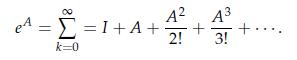
In Equation (3.109), the exponential of a matrix was defined.Data form Equation 3.109a. Let\[A=\left(\begin{array}{ll} 2 & 0 \\ 0 & 0 \end{array}\right)\]Compute \(e^{A}\).b. Give a definition of \(\cos A\) and compute \(\cos \left(\begin{array}{ll}1 & 0 \\ 0 & 2\end{array}\right)\)
Prove the following for matrices \(A, B\), and \(C\).a. \((A B) C=A(B C)\).b. \((A B)^{T}=B^{T} A^{T}\)c. \(\operatorname{tr}(A)\) is invariant under similarity transformations.d. If \(A\) and \(B\) are orthogonal, then \(A B\) is orthogonal.
Add a third spring connected to mass 2 in the coupled system shown in Figure 3. 15 to a wall on the far right. Assume that the masses are the same and the springs are the same.a. Model this system with a set of first-order differential equations.b. If the masses are all \(2.0 \mathrm{~kg}\) and the
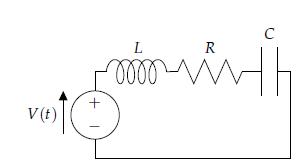
Consider the series circuit in Figure 2. 7 with \(L=1.00 \mathrm{H}, R=1.00 \times 10^{2}\) \(\Omega, C=1.00 \times 10^{-4} \mathrm{~F}\), and \(V_{0}=1.00 \times 10^{3} \mathrm{~V}\).a. Set up the problem as a system of two first-order differential equations for the charge and the current.b.
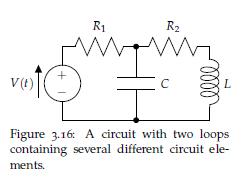
Consider the series circuit in Figure 3. 16 with \(L=1.00 \mathrm{H}, R_{1}=R_{2}=\) \(1.00 \times 10^{2} \Omega, C=1.00 \times 10^{-4} \mathrm{~F}\), and \(V_{0}=1.00 \times 10^{3} \mathrm{~V}\).a. Set up the problem as a system of first order differential equations for the charges and the
Initially, a 200-gallon tank is filled with pure water. At time \(t=0\), a salt concentration with 3 pounds of salt per gallon is added to the container at the rate of 4 gallons per minute, and the well-stirred mixture is drained from the container at the same rate.a. Find the number of pounds of
You make 2 quarts of salsa for a party. The recipe calls for 5 teaspoons of lime juice per quart, but you had accidentally put in 5 tablespoons per quart. You decide to feed your guests the salsa anyway. Assume that the guests take a quarter cup of salsa per minute and that you replace what was
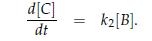
Consider the chemical reaction leading to the system in (3.149). Let the rate constants be \(k_{1}=0.20 \mathrm{~m} / \mathrm{s}, k_{2}=0.05 \mathrm{~m} / \mathrm{s}\), and \(k_{3}=0.10 \mathrm{~m} / \mathrm{s}\). What do the eigenvalues of the coefficient matrix say about the behavior of the
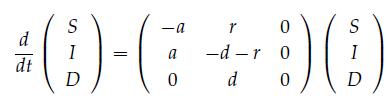
Consider the epidemic model leading to the system in Expression (3.153). Choose the constants as \(a=2.0\) days \(^{-1}, d=3.0\) days \(^{-1}\), and \(r=1.0\) day \(^{-1}\). What are the eigenvalues of the coefficient matrix? Find the solution of the system assuming an initial population of 1,000
Find and classify any equilibrium points in the Romeo and Juliet problem for the following cases. Solve the systems and describe their affections as a function of time.a. \(a=0, b=2, c=-1, d=0, R(0)=1, J(0)=1\).b. \(a=0, b=2, c=1, d=0, R(0)=1, J(0)=1\).c. \(a=-1, b=2, c=-1, d=0, R(0)=1, J(0)=1\).
Find all the solutions of the first-order differential equations. When an initial condition is given, find the particular solution satisfying that condition.a. \(\frac{d y}{d x}=\frac{e^{x}}{2 y}\).b. \(\frac{d y}{d t}=y^{2}\left(1+t^{2}\right), y(0)=1\).c. \(\frac{d y}{d
Find all the solutions of the second-order differential equations. When an initial condition is given, find the particular solution satisfying that condition.a. \(y^{\prime \prime}-9 y^{\prime}+20 y=0\).b. \(y^{\prime \prime}-3 y^{\prime}+4 y=0, \quad y(0)=0, \quad y^{\prime}(0)=1\).c. \(x^{2}
Consider the differential equation\[\frac{d y}{d x}=\frac{x}{y}-\frac{x}{1+y}\]a. Find the 1-parameter family of solutions (general solution) of this equation.b. Find the solution of this equation satisfying the initial condition \(y(0)=1\). Is this a member of the 1-parameter family?
The initial value problem\[\frac{d y}{d x}=\frac{y^{2}+x y}{x^{2}}, \quad y(1)=1\]does not fall into the class of problems considered in this chapter. However, if one substitutes \(y(x)=x z(x)\) into the differential equation, one obtains an equation for \(z(x)\) that can be solved. Use this
Consider the nonhomogeneous differential equation \(x^{\prime \prime}-3 x^{\prime}+2 x=6 e^{3 t}\).a. Find the general solution of the homogenous equation.b. Find a particular solution using the Method of Undetermined Coefficients by guessing \(x_{p}(t)=A e^{3 t}\).c. Use your answers in the
Find the general solution of the given equation by the method given.a. \(y^{\prime \prime}-3 y^{\prime}+2 y=10\). Method of Undetermined Coefficients.b. \(y^{\prime \prime}+y^{\prime}=3 x^{2}\). Variation of Parameters.
Find the general solution of each differential equation. When an initial condition is given, find the particular solution satisfying that condition.a. \(y^{\prime \prime}-3 y^{\prime}+2 y=20 e^{-2 x}, \quad y(0)=0, \quad y^{\prime}(0)=6\).b. \(y^{\prime \prime}+y=2 \sin 3 x\).c. \(y^{\prime
Verify that the given function is a solution and use Reduction of Order to find a second linearly independent solution.a. \(x^{2} y^{\prime \prime}-2 x y^{\prime}-4 y=0, \quad y_{1}(x)=x^{4}\).b. \(x y^{\prime \prime}-y^{\prime}+4 x^{3} y=0, \quad y_{1}(x)=\sin \left(x^{2}\right)\).
Use the Method of Variation of Parameters to determine the general solution for the following problems.a. \(y^{\prime \prime}+y=\tan x\).b. \(y^{\prime \prime}-4 y^{\prime}+4 y=6 x e^{2 x}\).
Instead of assuming that \(c_{1}^{\prime} y_{1}+c_{2}^{\prime} y_{2}=0\) in the derivation of the solution using Variation of Parameters, assume that \(c_{1}^{\prime} y_{1}+c_{2}^{\prime} y_{2}=h(x)\) for an arbitrary function \(h(x)\) and show that one gets the same particular solution.
Find the solution of each initial value problem using the appropriate initial value Green's function.a. \(y^{\prime \prime}-3 y^{\prime}+2 y=20 e^{-2 x}, \quad y(0)=0, \quad y^{\prime}(0)=6\).b. \(y^{\prime \prime}+y=2 \sin 3 x, \quad y(0)=5, \quad y^{\prime}(0)=0\).c. \(y^{\prime \prime}+y=1+2
Use the initial value Green's function for \(x^{\prime \prime}+x=f(t), x(0)=4\), \(x^{\prime}(0)=0\), to solve the following problems.a. \(x^{\prime \prime}+x=5 t^{2}\).b. \(x^{\prime \prime}+x=2 \tan t\).
For the problem \(y^{\prime \prime}-k^{2} y=f(x), y(0)=0, y^{\prime}(0)=1\),a. Find the initial value Green's function.b. Use the Green's function to solve \(y^{\prime \prime}-y=e^{-x}\).c. Use the Green's function to solve \(y^{\prime \prime}-4 y=e^{2 x}\).
Find and use the initial value Green's function to solve\[x^{2} y^{\prime \prime}+3 x y^{\prime}-15 y=x^{4} e^{x}, y(1)=1, y^{\prime}(1)=0\]
A ball is thrown upward with an initial velocity of \(49 \mathrm{~m} / \mathrm{s}\) from \(539 \mathrm{~m}\) high. How high does the ball get, and how long does in take before it hits the ground? [Use results from the simple free fall problem, \(y^{\prime \prime}=-g\).]
Consider the case of free fall with a damping force proportional to the velocity, \(f_{D}= \pm k v\) with \(k=0.1 \mathrm{~kg} / \mathrm{s}\).a. Using the correct sign, consider a \(50-\mathrm{kg}\) mass falling from rest at a height of \(100 \mathrm{~m}\). Find the velocity as a function of time.
A piece of a satellite falls to the ground from a height of \(10,000 \mathrm{~m}\). Ignoring air resistance, find the height as a function of time. [For free fall from large distances,\[\ddot{h}=-\frac{G M}{(R+h)^{2}}\]Multiplying both sides by \(\dot{h}\), show that\[\frac{d}{d t}\left(\frac{1}{2}
The problem of growth and decay is stated as follows: The rate of change of a quantity is proportional to the quantity. The differential equation for such a problem is\[\frac{d y}{d t}= \pm k y\]The solution of this growth and decay problem is \(y(t)=y_{0} e^{ \pm k t}\). Use this solution to
A spring fixed at its upper end is stretched 6 inches by a 10-pound weight attached at its lower end. The spring-mass system is suspended in a viscous medium so that the system is subjected to a damping force of \(5 \frac{d x}{d t}\) lbs. Describe the motion of the system if the weight is drawn
Consider an LRC circuit with \(L=1.00 \mathrm{H}, R=1.00 \times 10^{2} \Omega, C=\) \(1.00 \times 10^{-4} \mathrm{~F}\), and \(V=1.00 \times 10^{3} \mathrm{~V}\). Suppose that no charge is present and no current is flowing at time \(t=0\) when a battery of voltage \(V\) is inserted. Find the
Consider the problem of forced oscillations.a. Derive the general solution in Equation (2.77).b. Plot the solutions in Equation (2.77) for the following cases: Let \(c_{1}=0.5, c_{2}=0, F_{0}=1.0 \mathrm{~N}\), and \(m=1.0 \mathrm{~kg}\) for \(t \in[0,100]\).i. \(\omega_{0}=2.0 \mathrm{rad} /
A certain model of the motion of a light plastic ball tossed into the air is given by\[m x^{\prime \prime}+c x^{\prime}+m g=0, \quad x(0)=0, \quad x^{\prime}(0)=v_{0}\]Here \(m\) is the mass of the ball, \(g=9.8 \mathrm{~m} / \mathrm{s}^{2}\) is the acceleration due to gravity, and \(c\) is a
Use i) Euler's Method and ii) the Midpoint Method to determine the given value of \(y\) for the following problems:a. \(\frac{d y}{d x}=2 y, y(0)=2\). Find \(y(1)\) with \(h=0.1\).b. \(\frac{d y}{d x}=x-y, y(0)=1\). Find \(y(2)\) with \(h=0.2\).c. \(\frac{d y}{d x}=x \sqrt{1-y^{2}}, y(1)=0\). Find
Numerically solve the nonlinear pendulum problem using the EulerCromer Method for a pendulum with length \(L=0.5 \mathrm{~m}\) using initial angles of \(\theta_{0}=10^{\circ}\), and \(\theta_{0}=70^{\circ}\). In each case, run the routines long enough and with an appropriate \(h\) such that you can
For the Baumgartner sky dive we had obtained the results for his position as a function of time. There are other questions that could be asked:a. Find the velocity as a function of time for the model developed in the text.b. Find the velocity as a function of altitude for the model developed in the
Consider the flight of a golf ball with mass \(46 \mathrm{~g}\) and a diameter of 42. 7 \(\mathrm{mm}\). Assume it is projected at \(30^{\circ}\) with a speed of \(36 \mathrm{~m} / \mathrm{s}\) and no spin.a. Ignoring air resistance, analytically find the path of the ball and determine the range,
Consider the flight of a tennis ball with mass \(57 \mathrm{~g}\) and a diameter of \(66.0 \mathrm{~mm}\). Assume the ball is served 6. 40 meters from the net at a speed of \(50.0 \mathrm{~m} / \mathrm{s}\) down the center line from a height of \(2.8 \mathrm{~m}\). It needs to just clear the net
Find numerical solutions for other models of the universe.a. A flat universe with nonrelativistic matter only with \(\Omega_{m, 0}=1\).b. A curved universe with radiation only with curvature of different types.c. A flat universe with nonrelativistic matter and radiation with several values of
Consider the system\[\begin{array}{r} x^{\prime}=-4 x-y \\ y^{\prime}=x-2 y \end{array}\]a. Determine the second-order differential equation satisfied by \(x(t)\).b. Solve the differential equation for \(x(t)\).c. Using this solution, find \(y(t)\).d. Verify your solutions for \(x(t)\) and
Consider the following systems. Determine the families of orbits for each system and sketch several orbits in the phase plane and classify them by their type (stable node, etc.).a.\[\begin{aligned} x^{\prime} & =3 x \\ y^{\prime} & =-2 y \end{aligned}\]b.\[\begin{aligned} x^{\prime} & =-y \\
Use the transformations relating polar and Cartesian coordinates to prove that\[\frac{d \theta}{d t}=\frac{1}{r^{2}}\left[x \frac{d y}{d t}-y \frac{d x}{d t}\right]\]
a. \(\cos 2 x=2 \cos ^{2} x-1\).b. \(\sin 3 x=A \sin ^{3} x+B \sin x\), for what values of \(A\) and \(B\) ?c. \(\sec \theta+\tan \theta=\tan \left(\frac{\theta}{2}+\frac{\pi}{4}\right)\).
Determine the exact values ofa. \(\sin \frac{\pi}{8}\).b. \(\tan 15^{\circ}\).c. \(\cos 105^{\circ}\).
Denest the following, if possible.a. \(\sqrt{3-2 \sqrt{2}}\).b. \(\sqrt{1+\sqrt{2}}\).c. \(\sqrt{5+2 \sqrt{6}}\).d. \(\sqrt[3]{\sqrt{5}+2}-\sqrt[3]{\sqrt{5}-2}\).e. Find the roots of \(x^{2}+6 x-4 \sqrt{5}=0\) in simplified form.
Determine the exact values ofa. \(\sin \left(\cos ^{-1} \frac{3}{5}\right)\).b. \(\tan \left(\sin ^{-1} \frac{x}{7}\right)\).c. \(\sin ^{-1}\left(\sin \frac{3 \pi}{2}\right)\).
Do the following:a. Write \((\cosh x-\sinh x)^{6}\) in terms of exponentials.b. Prove \(\cosh (x-y)=\cosh x \cosh y-\sinh x \sinh y\) using the exponential forms of the hyperbolic functions.c. Prove \(\cosh 2 x=\cosh ^{2} x+\sinh ^{2} x\).d. If \(\cosh x=\frac{13}{12}\) and \(x
Prove that the inverse hyperbolic functions are the following logarithms:a. \(\cosh ^{-1} x=\ln \left(x+\sqrt{x^{2}-1}\right)\).b. \(\tanh ^{-1} x=\frac{1}{2} \ln \frac{1+x}{1-x}\).
Write the following in terms of logarithms:a. \(\cosh ^{-1} \frac{4}{3}\).b. \(\tanh ^{-1} \frac{1}{2}\).c. \(\sinh ^{-1} 2\).
Solve the following equations for \(x\) :a. \(\cosh (x+\ln 3)=3\).b. \(2 \tanh ^{-1} \frac{x-2}{x-1}=\ln 2\).c. \(\sinh ^{2} x-7 \cosh x+13=0\).
Compute the following integrals:a. \(\int x e^{2 x^{2}} d x\).b. \(\int_{0}^{3} \frac{5 x}{\sqrt{x^{2}+16}} d x\).c. \(\int x^{3} \sin 3 x d x\). (Do this using integration by parts, the Tabular Method, and differentiation under the integral sign.)d. \(\int \cos ^{4} 3 x d x\).e. \(\int_{0}^{\pi /
Find the sum for each of the series:a. \(5+\frac{25}{7}+\frac{125}{49}+\frac{625}{343}+\cdots\)b. \(\sum_{n=0}^{\infty} \frac{(-1)^{n} 3}{4^{n}}\).c. \(\sum_{n=2}^{\infty} \frac{2}{5^{n}}\).d. \(\sum_{n=-1}^{\infty}(-1)^{n+1}\left(\frac{e}{\pi}\right)^{n}\).e.
A superball is dropped from a 2.00 m height. After it rebounds, it reaches a new height of 1.65 m. Assuming a constant coefficient of restitution, find the (ideal) total distance the ball will travel as it keeps bouncing.
Here are some telescoping series problems:a. Verify that\[\sum_{n=1}^{\infty} \frac{1}{(n+2)(n+1)}=\sum_{n=1}^{\infty}\left(\frac{n+1}{n+2}-\frac{n}{n+1}\right)\]b. Find the \(n\)th partial sum of the series \(\sum_{n=1}^{\infty}\left(\frac{n+1}{n+2}-\frac{n}{n+1}\right)\) and use it to determine
Determine the radius and interval of convergence of the following infinite series:a. \(\sum_{n=1}^{\infty}(-1)^{n} \frac{(x-1)^{n}}{n}\).b. \(\sum_{n=1}^{\infty} \frac{x^{n}}{2^{n} n!}\).c. \(\sum_{n=1}^{\infty} \frac{1}{n}\left(\frac{x}{5}\right)^{n}\)d. \(\sum_{n=1}^{\infty}(-1)^{n}
Use the partition function \(Z\) for the quantum harmonic oscillator to find the average energy, \(\langle Eangle\).
Find the Taylor series centered at \(x=a\) and its corresponding radius of convergence for the given function. In most cases, you need not employ the direct method of computation of the Taylor coefficients.a. \(f(x)=\sinh x, a=0\).b. \(f(x)=\sqrt{1+x}, a=0\).c. \(f(x)=\ln \frac{1+x}{1-x}, a=0\).d.
Consider Gregory's expansion\[\tan ^{-1} x=x-\frac{x^{3}}{3}+\frac{x^{5}}{5}-\cdots=\sum_{k=0}^{\infty} \frac{(-1)^{k}}{2 k+1} x^{2 k+1}\]a. Derive Gregory's expansion using the definition\[\tan ^{-1} x=\int_{0}^{x} \frac{d t}{1+t^{2}}\]expanding the integrand in a Maclaurin series, and integrating
In the event that a series converges uniformly, one can consider the derivative of the series to arrive at the summation of other infinite series.a. Differentiate the series representation for \(f(x)=\frac{1}{1-x}\) to sum the series \(\sum_{n=1}^{\infty} n x^{n},|x|
Evaluate the integral \(\int_{0}^{\pi / 6} \sin ^{2} x d x\) by doing the following:a. Compute the integral exactly.b. Integrate the first three terms of the Maclaurin series expansion of the integrand and compare with the exact result.
Evaluate the following expressions at the given point. Use your calculator or your computer (such as Maple). Then use series expansions to find an approximation of the value of the expression to as many places as you trust.a. \(\frac{1}{\sqrt{1+x^{3}}}-\cos x^{2}\) at \(x=0.015\).b. \(\ln
Use dimensional analysis to derive a possible expression for the drag force \(F_{D}\) on a soccer ball of diameter \(D\) moving at speed \(v\) through air of density \(ho\) and viscosity \(\mu\). [Assuming viscosity has units \(\frac{[M]}{[L][T]}\), there are two possible dimensionless
Evaluate \(\sin \frac{\pi}{12}\).
Evaluate \(\int \frac{x}{\sqrt{x^{2}+1}} d x\).
Evaluate \(\int_{0}^{2} \frac{x}{\sqrt{x^{2}+1}} d x\).
Evaluate \(\int_{0}^{2} \frac{x}{\sqrt{9+4 x^{2}}} d x\)
Evaluate \(\int \frac{d x}{\cosh x}\).
Use differentiation under the integral sign to evaluate \(\int x e^{x} d x\).
Evaluate \(\int_{0}^{2} \sqrt{x^{2}+4} d x\).
Evaluate \(\int \frac{d x}{\sqrt{x^{2}-1}}, x \geq 1\).
Evaluate \(\int \frac{d x}{x \sqrt{x^{2}-1}}, x \geq 1\).
Evaluate \(\int_{0}^{2} \sqrt{x^{2}+4} d x\) using the substitution \(x=2 \sinh u\).
Evaluate \(\int \sec \theta d \theta\) using hyperbolic function substitution.
Evaluate \(\int \sec ^{3} \theta d \theta\) using hyperbolic function substitution.
Expand \(f(x)=e^{x}\) about \(x=0\).
Expand \(f(x)=e^{x}\) about \(x=1\).
Find the radius of convergence of the series \(e^{x}=\sum_{n=0}^{\infty} \frac{x^{n}}{n!}\).
Find the radius of convergence of the series \(\frac{1}{1-x}=\sum_{n=0}^{\infty} x^{n}\).
Find the radius of convergence of the series \(\sum_{n=1}^{\infty} \frac{3^{n}(x-2)^{n}}{n}\).
Find an expansion of \(f(x)=\frac{1}{x+2}\) about \(x=1\).
Prove Euler's Formula: \(e^{i \theta}=\cos \theta+i \sin \theta\).
Obtain an approximation to \((a+b)^{p}\) when \(a\) is much larger than \(b\), denoted by \(a \gg b\).
Approximate \(f(x)=(a+x)^{p}-a^{p}\) for \(x \ll a\).
Showing 200 - 300
of 288
1
2
3
Step by Step Answers

 Get 50% OFF
Claim Now
Get 50% OFF
Claim Now