







Question: 1.Step 1. Think about a specific behaviour change for example, stop smoking, schedule regular exercise, learn a new skill, adopt a healthier diet, drop
1.Step 1. Think about a specific behaviour change – for example, stop smoking, schedule regular exercise, learn a new skill, adopt a healthier diet, drop a bad habit – you have considered making in your life. With that specific behaviour or habit in mind, carefully answer each item below as Mostly True or Mostly False for you.
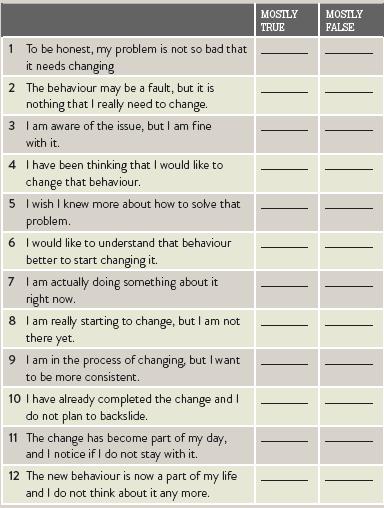
Step 2. Scoring and interpretation: The items above pertain to a person’s stage of readiness to implement a personal change. Each of the four stages is measured by three questions in the scale. Give yourself one point for each item marked Mostly True.
I. Pre-contemplation: Items 1, 2, 3. Score ____________________________ II. Contemplation: Items 4, 5, 6. Score _______________________________ III. Action: Items 7, 8, 9. Score _____________________________________ IV. Maintenance: Items 10, 11, 12. Score ____________________________ You will probably find that you have a higher score for one of the stages, which means you are in that stage for your specific change. If you have the same score for two adjacent stages, then you are probably transitioning from one stage to the next. What does your score imply about your likelihood of success in making the change?
Step 3. In groups of three to five students, take turns describing your desired change and the meaning of the stage you are in. Compare notes and discuss progress on each person’s change.
Step 4. Discuss the answers to the following questions as a group: How likely is it that you will implement your desired change successfully?
Why? To implement a personal change, how important is it to feel a strong need for change? Can you identify driving and restraining forces for the personal changes in your group? Which implementation tactics from this chapter would help your group members make the change?
Why do you think so?
1 To be honest, my problem is not so bad that it needs changing 2 The behaviour may be a fault, but it is nothing that I really need to change. 3 I am aware of the issue, but I am fine with it. 4 I have been thinking that I would like to change that behaviour. 5 I wish I knew more about how to solve that problem. 6 I would like to understand that behaviour better to start changing it. 7 I am actually doing something about it right now. 8 I am really starting to change, but I am not there yet. 9 I am in the process of changing, but I want to be more consistent. 10 I have already completed the change and I do not plan to backslide. 11 The change has become part of my day, and I notice if I do not stay with it. 12 The new behaviour is now a part of my life and I do not think about it any more. MOSTLY TRUE MOSTLY FALSE
Step by Step Solution
There are 3 Steps involved in it

Get step-by-step solutions from verified subject matter experts
 Study Help