







Question: 8.36. An article in Thin Solid Films (504, A Study of Si/SiGe Selective Epitaxial Growth by Experimental Design Approach, 2006, Vol. 504, pp. 95100) describes
8.36. An article in Thin Solid Films (504, “A Study of Si/SiGe Selective Epitaxial Growth by Experimental Design Approach,” 2006, Vol. 504, pp. 95–100) describes the use of a fractional factorial design to investigate the sensitivity of low-temperature (740–760 'C) Si/SiGe selective epitaxial growth to changes in five factors and their two-factor interactions.
The five factors are SiH2Cl2, GeH4, HCl, B2H6 and temperature.
The factor levels studied are:
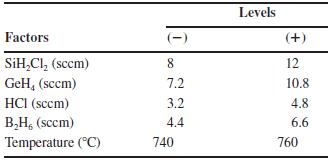
Table P8.8 contains the design matrix and the three measured responses. Bede RADS Mercury software based on the Takagi–Taupin dynamical scattering theory was used to extract the Si cap thickness, SiGe thickness, and Ge concentration of each sample.
(a) What design did the experimenters use? What is the defining relation?
(b) Will the experimenters be able to estimate all main effects and two-factor interactions with this experimental design?
(c) Analyze all three responses and draw conclusions.
(d) Is there any indication of curvature in the responses?
(e) Analyze the residuals and comment on model adequacy.
Factors SiHCl (sccm) GeH, (sccm) (-) 00 8 Levels (+) 12 7.2 10.8 HCI (sccm) 3.2 4.8 BH6 (sccm) 4.4 6.6 Temperature (C) 740 760
Step by Step Solution
There are 3 Steps involved in it

Get step-by-step solutions from verified subject matter experts
 Study Help