



Question: 8.54. An article by L. B. Hare (In the Soup: A Case Study to Identify Contributors to Filling Variability, Journal of Quality Technology, Vol. 20,
8.54. An article by L. B. Hare (“In the Soup: A Case Study to Identify Contributors to Filling Variability,” Journal of Quality Technology, Vol. 20, pp. 36–43) describes a factorial experiment used to study the filling variability of dry soup mix packages. The factors are A $ number of mixing ports through which the vegetable oil was added (1, 2), B $ temperature surrounding the mixer (cooled, ambient), C $ mixing time (60, 80 sec), D $ batch weight (1500, 2000 lb), and E $ number of days of delay between mixing and packaging
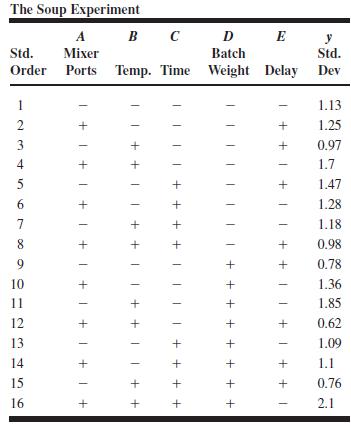
(1, 7). Between 125 and 150 packages of soup were sampled over an 8-hour period for each run in the design, and the standard deviation of package weight was used as the response variable. The design and resulting data are shown in Table P8.17.
(a) What is the generator for this design?
(b) What is the resolution of this design?
(c) Estimate the factor effects. Which effects are large?
(d) Does a residual analysis indicate any problems with the underlying assumptions?
(e) Draw conclusions about this filling process.
The Soup Experiment A B C D E y Std. Mixer Batch Std. Order Ports Temp. Time Weight Delay Dev -234567 1.13. 8 9 10 11 12 13 14 15 16 16 + 1 + 1 + 1+1+1+1+1+ + + ++ 1.25 + + -+- 1.28 + + + + + ++1 1.18 0.98 0.78 + 1.36 1 ++ + - 1.85 + + + - 1 + 0.62 1.09 + + ++ ++ ++ ++1 1.1 0.76 0.97 1.7 1.47 2.1
Step by Step Solution
There are 3 Steps involved in it
To analyze this factorial design lets address each part of the problem separately a What is the generator for this design The design shown is a 251 fractional factorial design which means it has 5 fac... View full answer

Get step-by-step solutions from verified subject matter experts