







Question: For the circuit given in Problem 13.7, replace the circuit elements by their discrete-time equivalent circuits. Use (Delta t=100 mu mathrm{s}=1 times 10^{-4} mathrm{~s}). Determine
For the circuit given in Problem 13.7, replace the circuit elements by their discrete-time equivalent circuits. Use \(\Delta t=100 \mu \mathrm{s}=1 \times 10^{-4} \mathrm{~s}\). Determine and show all resistance values on the discrete-time circuit. Write nodal equations for the discrete-time circuit, giving equations for all dependent sources. Then solve the nodal equations and determine the sending- and receiving-end voltages at the following times: \(t=100,200\), \(300,400,500\), and \(600 \mu\) s.
Problem 13.7
The single-phase, two-wire lossless line in Figure 13.3 has a series inductance \(\mathrm{L}=2 \times 10^{-6} \mathrm{H} / \mathrm{m}\), a shunt capacitance \(\mathrm{C}=1.25 \times 10^{-11} \mathrm{~F} / \mathrm{m}\), and a \(100-\mathrm{km}\) line length. The source voltage at the sending end is a step \(e_{\mathrm{G}}(t)=\) \(100 \mathrm{u}_{-1}(\mathrm{t}) \mathrm{kV}\) with a source impedance equal to the characteristic impedance of the line. The receiving-end load consists of a \(100-\mathrm{mH}\) inductor in series with a \(1-\mu \mathrm{F}\) capacitor. The line and load are initially unenergized. Determine
(a) the characteristic impedance in \(\Omega\), the wave velocity in \(\mathrm{m} / \mathrm{s}\), and the transit time in \(\mathrm{ms}\) for this line;
(b) the sending- and receiving-end voltage reflection coefficients in per-unit;
(c) the receiving-end voltage \(v_{\mathrm{R}}(\mathrm{t})\) as a function of time; and
(d) the steady-state receiving-end voltage.
Figure 13.3
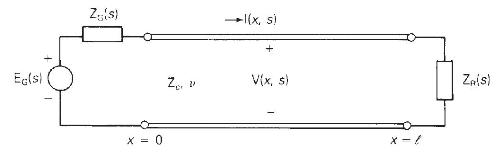
Eg(s) Z(s) X = 0 Za -1(x, s) V(x, s) X-! ZAIS)
Step by Step Solution
3.32 Rating (149 Votes )
There are 3 Steps involved in it

Get step-by-step solutions from verified subject matter experts
 Study Help