



Question: The switch in Figure P7-68 has been in position A for a long time and is moved to position (mathrm{B}) at (t=0) and then to
The switch in Figure P7-68 has been in position A for a long time and is moved to position \(\mathrm{B}\) at \(t=0\) and then to position \(\mathrm{C}\) when \(t=10 \mathrm{~ms}\). For \(0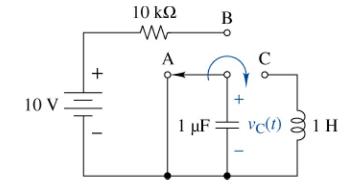 (a) Suppose the resistance is reduced to \(1 \mathrm{k} \Omega\) and the switching sequence repeated.
Will the amplitude of the sinusoid increase, decrease, or stay the same?
Will the frequency of the sinusoid increase, decrease, or stay the same?
(b) Suppose the inductance is reduced to \(100 \mathrm{mH}\) and the switching sequence repeated.
Will the amplitude of the sinusoid increase, decrease, or stay the same?
Will the frequency of the sinusoid increase, decrease, or stay the same?
10 V + 10 kQ2 A B -0 + 1 F = vc(t) 1 H
Step by Step Solution
3.32 Rating (149 Votes )
There are 3 Steps involved in it
a b If the resistance is reduced the time constant to ... View full answer

Get step-by-step solutions from verified subject matter experts