New Semester
Started
Get
50% OFF
Study Help!
--h --m --s
Claim Now
Question Answers
Textbooks
Find textbooks, questions and answers
Oops, something went wrong!
Change your search query and then try again
S
Books
FREE
Study Help
Expert Questions
Accounting
General Management
Mathematics
Finance
Organizational Behaviour
Law
Physics
Operating System
Management Leadership
Sociology
Programming
Marketing
Database
Computer Network
Economics
Textbooks Solutions
Accounting
Managerial Accounting
Management Leadership
Cost Accounting
Statistics
Business Law
Corporate Finance
Finance
Economics
Auditing
Tutors
Online Tutors
Find a Tutor
Hire a Tutor
Become a Tutor
AI Tutor
AI Study Planner
NEW
Sell Books
Search
Search
Sign In
Register
study help
engineering
civil engineering
Engineering Mechanics Statics 12th Edition R. C. Hibbeler - Solutions
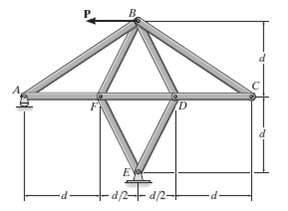
Determine the force in each member of the truss in terms of the load P, and indicate whether the members are in tension orcompression.
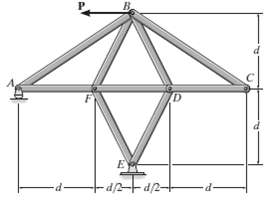
If the maximum force that any member can support is 4 kN in tension and 3 kN in compression, determine the maximum force P that can be applied at joint B. Take d = 1m.
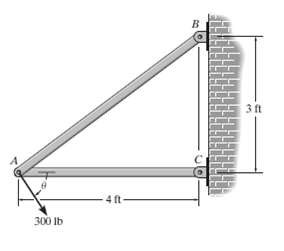
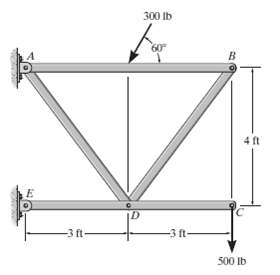
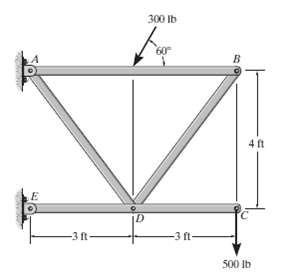
The two-member truss is subjected to the force of 300 lb. Determine the range of for application of the load so that the force in either member does not exceed 400 lb (T) or 200 lb(C).
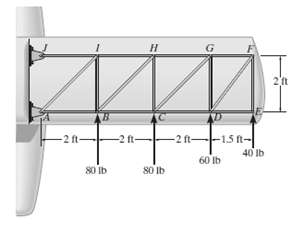
The internal drag truss for the wing of a light airplane is subjected to the forces shown. Determine the force in members BC, BH, and HC, and state if the members are in tension orcompression.
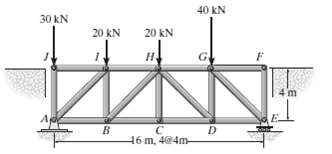
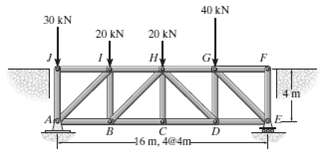
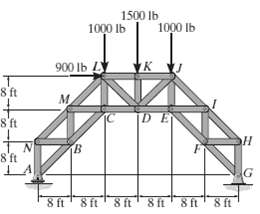
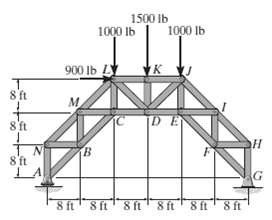
The Howe bridge truss is subjected to the loading shown. Determine the force in members HD, CD, and GD, and state if the members are in tension orcompression.
The Howe bridge truss is subjected to the loading shown. Determine the force in members HI, HB, and BC, and state if the members are in tension orcompression.
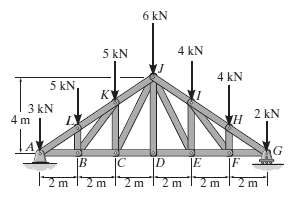
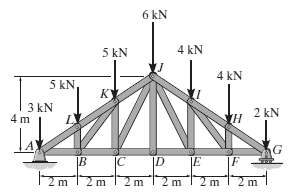
Determine the force in members JK, CJ, and CD of the truss, and state if the members are in tension orcompression.
Determine the force in members HI, FI, and EF of the truss, and state if the members are in tension orcompression.
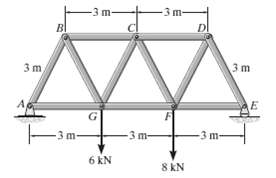
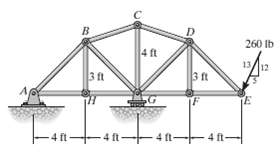
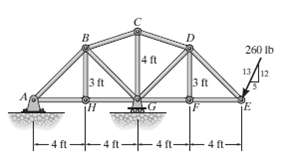
Determine the force in members BC, CG, and GF of the Warren truss. Indicate if the members are in tension orcompression.
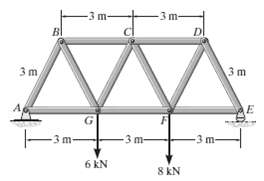
Determine the force in members CD, CF, and FG of the Warren truss. Indicate if the members are in tension orcompression.
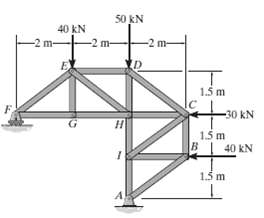
Determine the force in members DC, HC, and HI of the truss, and state if the members are in tension orcompression.
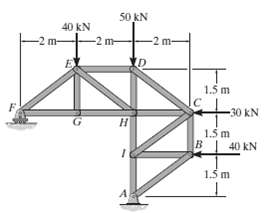
Determine the force in members ED, EH, and GH of the truss, and state if the members are in tension orcompression.
Determine the force in members GF, GD, and CD of the truss and state if the members are in tension orcompression.
Determine the force in members BG, BC, and HG of the truss and state if the members are in tension orcompression.
Determine the force in members JI, EF, EI, and JE of the truss, and state if the members are in tension orcompression.
Determine the force in members CD, LD, and KL of the truss, and state if the members are in tension orcompression.
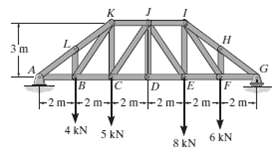
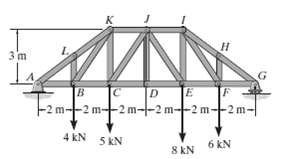
Determine the force in members IJ, EJ, and CD of the Howe truss, and state if the members are in tension orcompression.
Determine the force in members KJ, KC, and BC of the Howe truss, and state if the members are in tension orcompression.
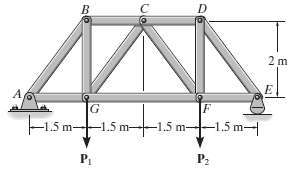
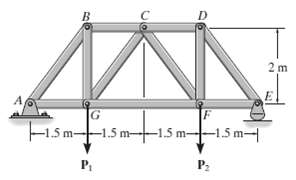
Determine the force in each member of the truss and state if the members are in tension or compression. Set P1 = 20 kN, P2 = 10kN.
Determine the force in each member of the truss and state if the members are in tension or compression. Set P1 = 40 kN, P2 = 20kN.
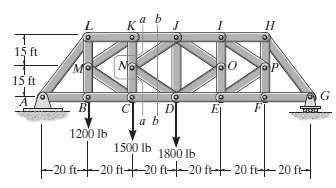
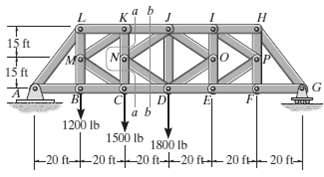
Determine the force in members KJ, NJ, ND, and CD of the K truss. Indicate if the members are in tension or compression.
Determine the force in members JI and DE of the K truss. Indicate if the members are in tension orcompression.
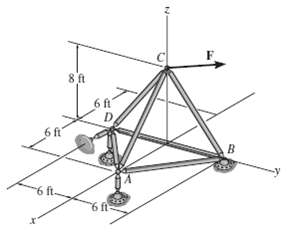
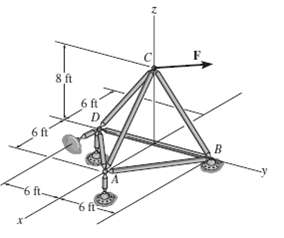
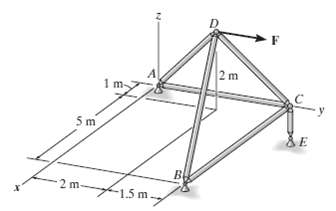
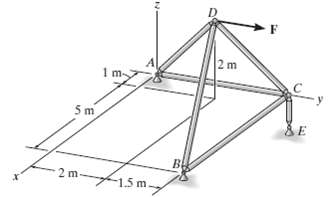
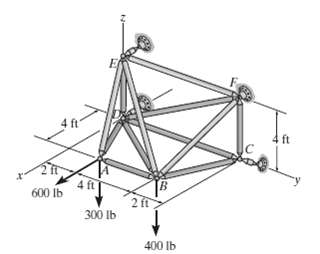
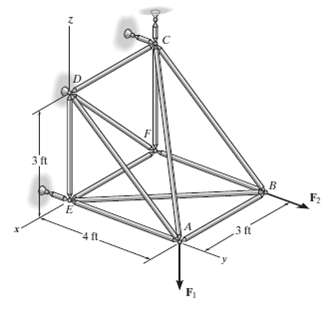
The space truss supports a force F = {-500i + 600j + 400k} lb. Determine the force in each member, and state if the members are in tension orcompression.
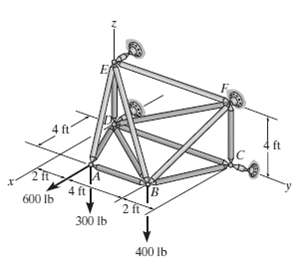
The space truss supports a force F = {600i + 450 ? 750k} lb. Determine the force in each member, and state if the members are in tension or compression.
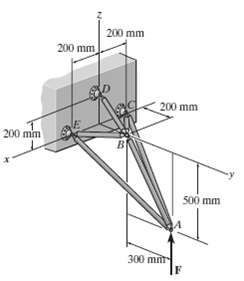
Determine the force in each member of the space truss and state if the members are in tension or compression. The truss is supported by ball-and-socket joints at A, B, and E. Set F = {800j} N.
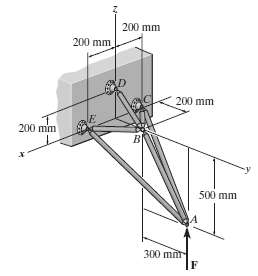
Determine the force in each member of the space truss and state if the members are in tension or compression. The truss is supported by ball-and-socket joints at A, B, and E. Set F = {-200i + 400j} N.
Determine the force in members BE, DF, and BC of the space truss and state if the members are in tension orcompression.
Determine the force in members AB, CD, ED, and CF of the space truss and state if the members are in tension orcompression.
Determine the force in the members AB, AE, BC, BF, BD, and BE of the space truss, and state if the members are in tension orcompression.
Determine the force in the members EF, DF, CF, and CD of the space truss, and state if the members are in tension orcompression.
If the truss supports a force of F = 200 N, determine the force in each member and state if the members are in tension orcompression.
If each member of the space truss can support a maximum force of 600 N in compression and 800 N in tension, determine the greatest force F the truss cansupport.
Determine the force in members FE and ED of the space truss and state if the members are in tension or compression. The truss is supported by a ball-and-socket joint at C and short links at A andB.
Determine the force in members GD, GE, and FD of the space truss and state if the members are in tension orcompression.
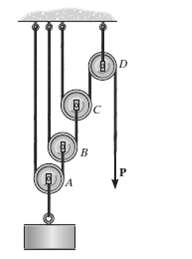
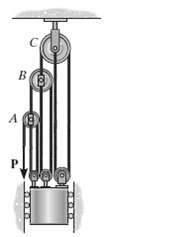
Determine the force P required to hold the 100-lb weight inequilibrium.
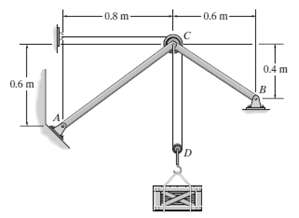
Determine the force P required to hold the 150-kg crate inequilibrium.
Determine the force P required to hold the 50-kg mass inequilibrium.
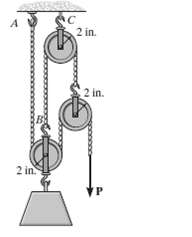
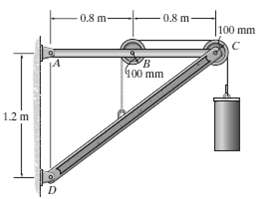
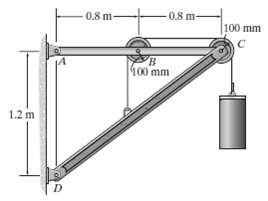
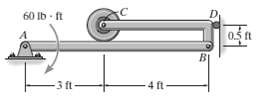
Determine the force P needed to support the 100-lb weight. Each pulley has a weight of 10 lb. Also, what are the cord reactions at A andB?
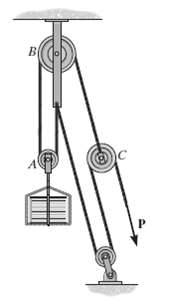
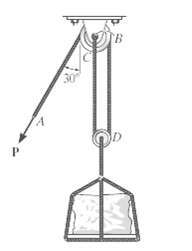
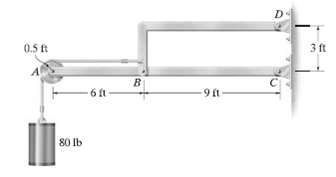
The cable and pulleys are used to lift the 600-lb stone. Determine the force that must be exerted on the cable at A and the corresponding magnitude of the resultant force the pulley at C exerts on pin B when the cables are in the positionshown.
If the peg at B is smooth, determine the components of reaction at the pin A and fixed supportC.
Determine the horizontal and vertical component of reaction at pins A andC.
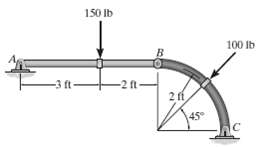
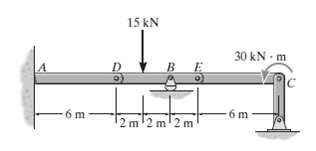
The compound beam is fixed at A and supported by rockers at B and C. There are hinges (pins) at D and E. Determine the components of reaction at thesupports
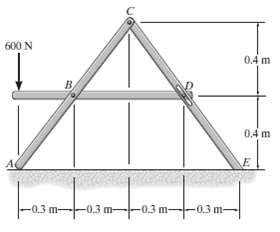
The compound beam is pin-supported at C and supported by rollers at A and B. There is a hinge (pin) at D. Determine the components of reaction at the supports. Neglect the thickness of thebeam.
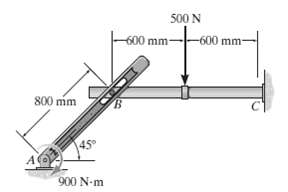
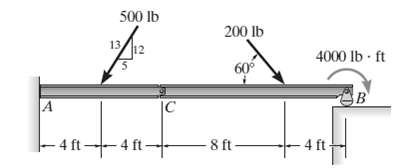
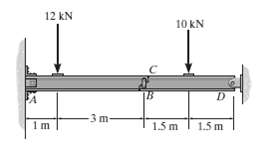
The compound beam is supported by a rocker at B and is fixed to the wall at A. If it is hinged (pinned) together at C, determine the components of reaction at the supports. Neglect the thickness of thebeam.
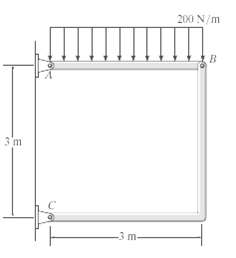
Determine the horizontal and vertical components of reaction at pins A and C of the two-memberframe.
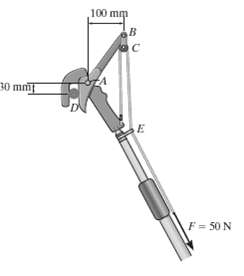
If a force of F = 50 N acts on the rope, determine the cutting force on the smooth tree limb at D and the horizontal and vertical components of force acting on pin A. The rope passes through a small pulley at C and a smooth ring atE.
Two beams are connected together by the short link BC. Determine the components of reaction at the fixed support A and at pinD.
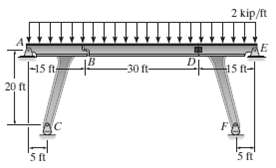
The bridge frame consists of three segments which can be considered pinned at A, D, and E, rocker supported at C and F, and roller supported at B. Determine the horizontal and vertical components of reaction at all these supports due to the loadingshown.
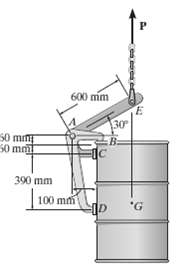
If the 300-kg drum has a center of mass at point G, determine the horizontal and vertical components of force acting at pin A and the reactions on the smooth pads C and D. The grip at B on member DAB resists both horizontal and vertical components of force at the rim of thedrum.
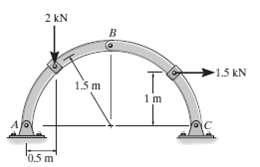
Determine the horizontal and vertical components of reaction that pins A and C exert on the two-memberarch.
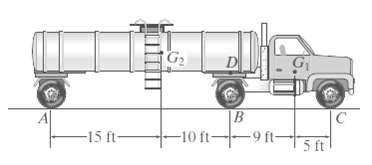
The truck and the tanker have weights of 8000 lb and 20,000 lb respectively. Their respective centers of gravity are located at points G1 and G2. If the truck is at rest, determine the reactions on both wheels at A, at B, and at C. The tanker is connected to the truck at the turntable D which acts
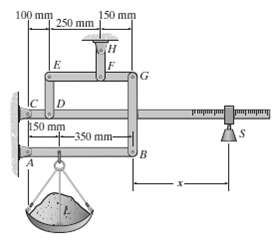
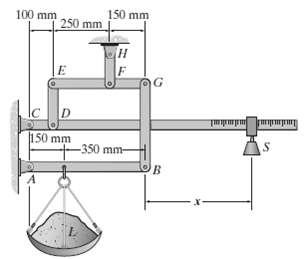
The platform scale consists of a combination of third and first class levers so that the load on one lever becomes the effort that moves the next lever. Through this arrangement, a small weight can balance a massive object. If x = 450 mm, determine the required mass of the counterweight S required
The platform scale consists of a combination of third and first class levers so that the load on one lever becomes the effort that moves the next lever. Through this arrangement, a small weight can balance a massive object. If x = 450 mm and, the mass of the counterweight S is 2 kg, determine the
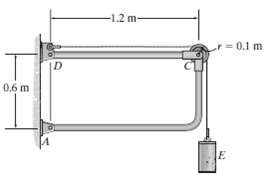
The frame is used to support the 100-kg cylinder E. Determine the horizontal and vertical components of reaction at A andD.
Determine the horizontal and vertical components of reaction which the pins exert on member AB of theframe.
Determine the horizontal and vertical components of reaction which the pins exert on member EDC of theframe.
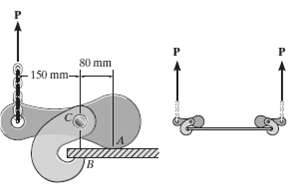
The clamping hooks are used to lift the uniform smooth 500-kg plate. Determine the resultant compressive force that the hook exerts on the plate at A and B, and the pin reaction atC.
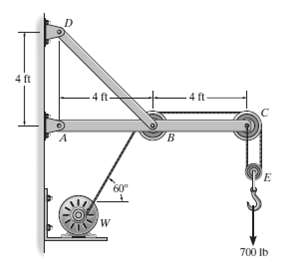
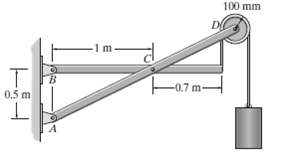
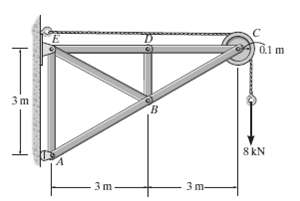
The wall crane supports a load of 700 lb. Determine the horizontal and vertical components of reaction at the pins A and D. Also, what is the force in the cable at the winch W? The jib ABC has a weight of 100 lb and member BD has a weight of 40 lb. Each member is uniform and has a center of gravity
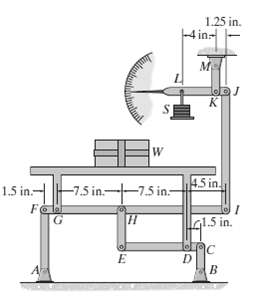
The lever-actuated scale consists of a series of compound levers. If a load of weight is placed on the platform, determine the required weight W = 150 lb of the counterweight S to balance the load. Is it necessary to place the load symmetrically on the platform?Explain.
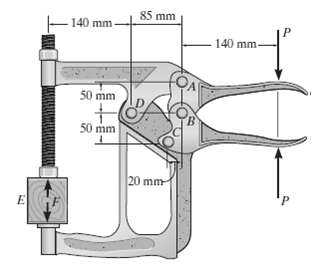
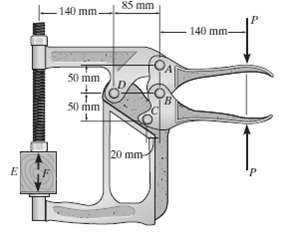
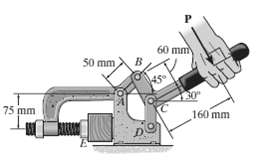
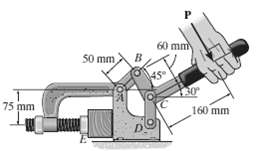
If P = 75 N, determine the force F that the toggle clamp exerts on the woodenblock.
If the wooden block exerts a force of F = 600 N on the toggle clamp, determine the force P applied to thehandle.
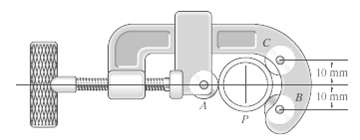
The pipe cutter is clamped around the pipe P. If the wheel at A exerts a normal force of FA = 80 N on the pipe, determine the normal forces of wheels B and C on the pipe. The three wheels each have a radius of 7 mm and the pipe has an outer radius of 10mm.
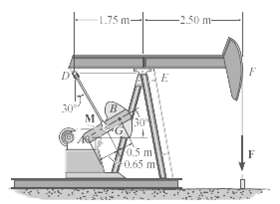
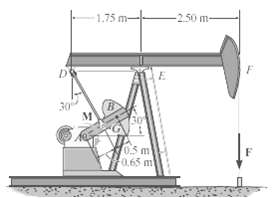
A 300-kg counterweight, with center of mass at G, is mounted on the pitman crank AB of the oil-pumping unit. If a force of F = 5 kN is to be developed in the fixed cable attached to the end of the walking beam DEF, determine the torque M that must be supplied by themotor.
A 300-kg counterweight, with center of mass at G, is mounted on the pitman crank AB of the oil-pumping unit. If the motor supplies a torque of M = 2500 N ? m, determine the force F developed in the fixed cable attached to the end of the walking beamDEF.
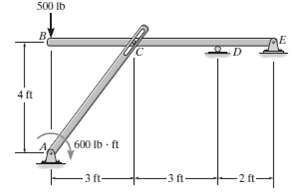
The two-member structure is connected at C by a pin, which is fixed to BDE and passes through the smooth slot in member AC. Determine the horizontal and vertical components of reaction at thesupports.
The frame is used to support the 50-kg cylinder. Determine the horizontal and vertical components of reaction at A andD.
The frame is used to support the 50-kg cylinder. Determine the force of the pin at C on member ABC and on memberCD.
Determine the reactions at the fixed support E and the smooth support A. The pin, attached to member BD, passes through a smooth slot atD.
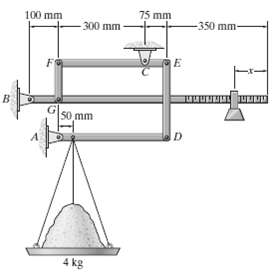
The compound arrangement of the pan scale is shown. If the mass on the pan is 4 kg, determine the horizontal and vertical components at pins A, B, and C and the distance x of the 25-g mass to keep the scale inbalance.
Determine the horizontal and vertical components of reaction that the pins at A, B, and C exert on the frame. The cylinder has a mass of 80kg.
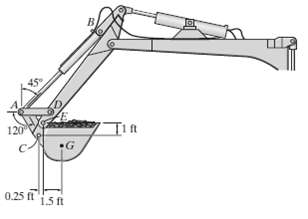
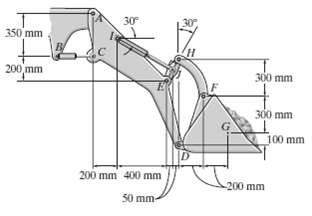
The bucket of the backhoe and its contents have a weight of 1200 lb and a center of gravity at G. Determine the forces of the hydraulic cylinder AB and in links AC and AD in order to hold the load in the position shown. The bucket is pinned atE.
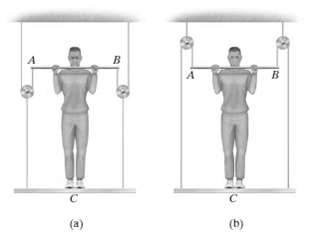
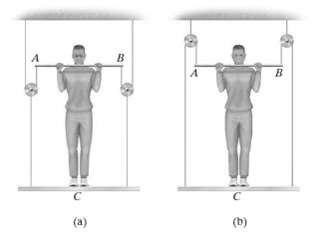
A man having a weight of 175 lb attempts to hold himself using one of the two methods shown. Determine the total force he must exert on bar AB in each case and the normal reaction he exerts on the platform at C. Neglect the weight of theplatform.
A man having a weight of 175 lb attempts to hold himself using one of the two methods shown. Determine the total force he must exert on bar AB in each case and the normal reaction he exerts on the platform at C. The platform has a weight of 30lb.
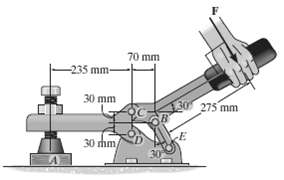
If a clamping force of 300 N is required at A, determine the amount of force F that must be applied to the handle of the toggleclamp.
If a force of F = 350 N is applied to the handle of the toggle clamp, determine the resulting clamping force atA.
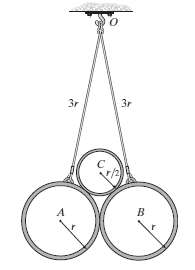
Two smooth tubes A and B, each having the same weight, W, are suspended from a common point O by means of equal-length cords. A third tube, C, is placed between A and B. Determine the greatest weight of C without upsettingequilibrium.
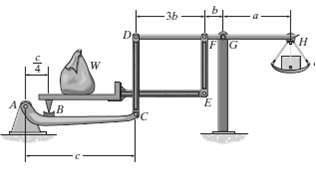
Show that the weight W1 of the counterweight at H required for equilibrium is W1 = (b/a)W, and so it is independent of the placement of the load W on theplatform.
The tractor shovel carries a 500-kg load of soil, having a center of mass at G. Compute the forces developed in the hydraulic cylinders IJ and BC due to thisloading.
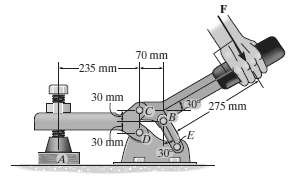
If a force of P = 100 N is applied to the handle of the toggle clamp, determine the horizontal clamping force NE that the clamp exerts on the smooth wooden block at E.
If the horizontal clamping force that the toggle clamp exerts on the smooth wooden block at E is NE = 200 N, determine the force applied to the handle of theclamp.
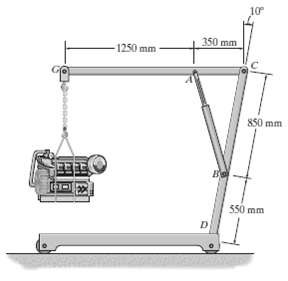
The engine hoist is used to support the 200-kg engine. Determine the force acting in the hydraulic cylinder AB, the horizontal and vertical components of force at the pin C, and the reactions at the fixed supportD.
Determine the force that the smooth roller C exerts on member AB. Also, what are the horizontal and vertical components of reaction at pin A? Neglect the weight of the frame androller.
Determine the horizontal and vertical components of reaction which the pins exert on memberABC.
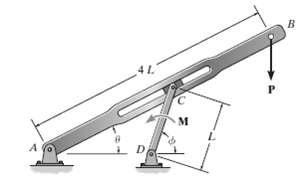
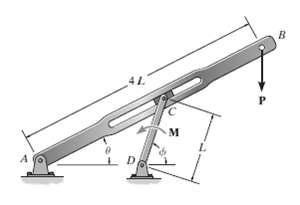
Determine the couple moment M that must be applied to member DC for equilibrium of the quick-return mechanism. Express the result in terms of the angles ? and ?, dimension L, and the applied vertical force P. The block at C is confined to slide within the slot of member AB.
Determine the couple moment M that must be applied to member DC for equilibrium of the quick-return mechanism. Express the result in terms of the angles ? and ?, dimension L, and the applied force P, which should be changed in the figure and instead directed horizontally to the right. The block at
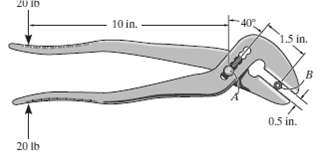
Determine the clamping force exerted on the smooth pipe at B if a force of 20 lb is applied to the handles of the pliers. The pliers are pinned together atA.
Determine the forces which the pins at A and B exert on the two-member frame which supports the 100-kgcrate.
Determine the force in each member of the truss and state if the members are in tension orcompression.
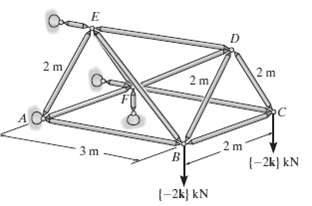
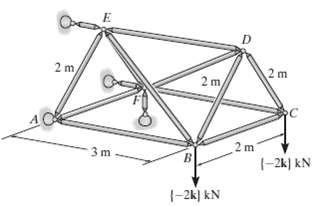
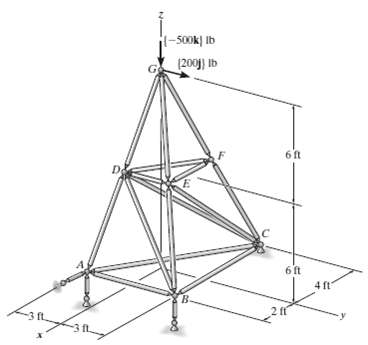
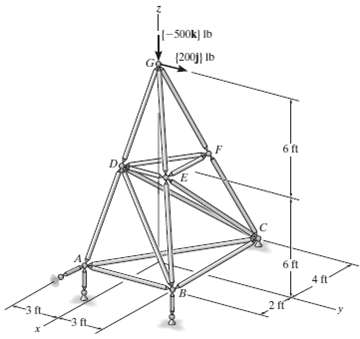
The space truss is supported by a ball-and-socket joint at D and short links at C and E. Determine the force in each member and state if the members are in tension or compression. Take F1 = {-500k} lb and F2 = {400j}lb.
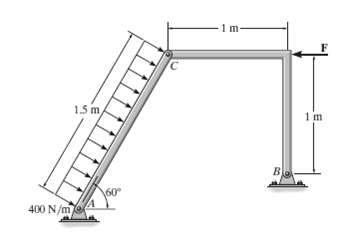
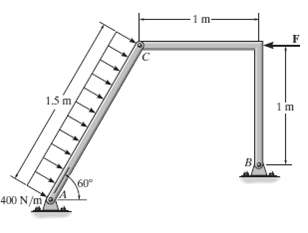
Determine the horizontal and vertical components of reaction that the pins A and B exert on the two-member frame. Set F =0.
Determine the horizontal and vertical components of reaction that pins A and B exert on the two-member frame. Set F = 500N.
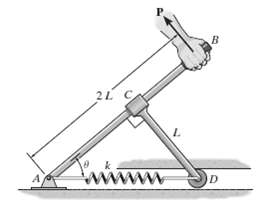
The two-bar mechanism consists of a lever arm AB and smooth link CD, which has a fixed smooth collar at its end C and a roller at the other end D. Determine the force P needed to hold the lever in the position . The spring has a stiffness k and unstretched length 2L. The roller contacts either the
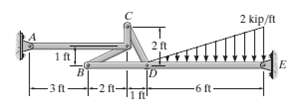
Determine the horizontal and vertical components of reaction at the pin supports A and E of the compound beamassembly.
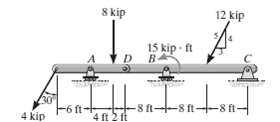
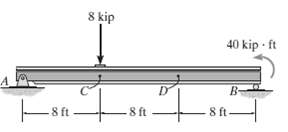
Determine the internal normal force and shear force, and the bending moment in the beam at points C and D. Assume the support at B is a roller. Point C is located just to the right of the 8-kipload.
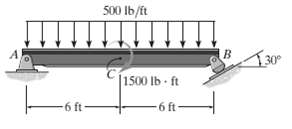
Determine the internal normal force, shear force, and moment at point C in the simply supported beam. Point C is located just to the right of the 1500-lb ? ft couple moment.
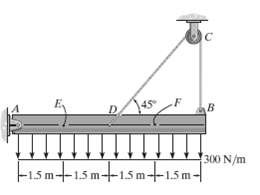
Determine the internal normal force, shear force, and moment at points E and F in thebeam.
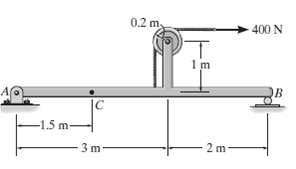
Determine the internal normal force, shear force, and moment at pointC.
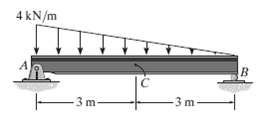
Determine the internal normal force, shear force, and moment at point C in the simply supportedbeam.
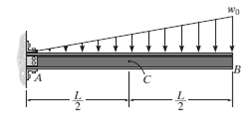
Determine the internal normal force, shear force, and moment at point C in the cantileverbeam.
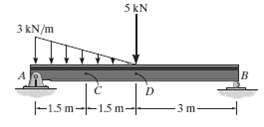
Determine the internal normal force, shear force, and moment at points C and D in the simply supported beam. Point D is located just to the left of the 5-kNforce.
Showing 1900 - 2000
of 2574
First
12
13
14
15
16
17
18
19
20
21
22
23
24
25
26
Step by Step Answers

 Get 50% OFF
Claim Now
Get 50% OFF
Claim Now