New Semester
Started
Get
50% OFF
Study Help!
--h --m --s
Claim Now
Question Answers
Textbooks
Find textbooks, questions and answers
Oops, something went wrong!
Change your search query and then try again
S
Books
FREE
Study Help
Expert Questions
Accounting
General Management
Mathematics
Finance
Organizational Behaviour
Law
Physics
Operating System
Management Leadership
Sociology
Programming
Marketing
Database
Computer Network
Economics
Textbooks Solutions
Accounting
Managerial Accounting
Management Leadership
Cost Accounting
Statistics
Business Law
Corporate Finance
Finance
Economics
Auditing
Tutors
Online Tutors
Find a Tutor
Hire a Tutor
Become a Tutor
AI Tutor
AI Study Planner
NEW
Sell Books
Search
Search
Sign In
Register
study help
engineering
civil engineering
Engineering Mechanics Statics 12th Edition R. C. Hibbeler - Solutions
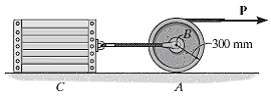
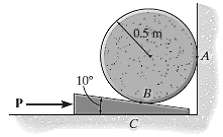
Determine the smallest force P that will cause impending motion. The crate and wheel have a mass of 50 kg and 25 kg, respectively. The coefficient of static friction between the crate and the ground is ?s = 0.2, and between the wheel and the ground ??s = 0.5.
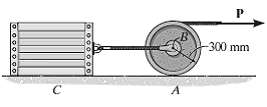
Determine the smallest force P that will cause impending motion. The crate and wheel have a mass of 50 kg and 25 kg, respectively. The coefficient of static friction between the crate and the ground is ?s = 0.5, and between the wheel and the ground ??s = 0.3.
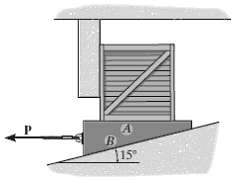
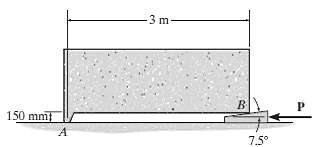
Determine the smallest horizontal force P required to pull out wedge A. The crate has a weight of 300 lb and the coefficient of static friction at all contacting surfaces is ?s = 0.3.Neglect the weight of the wedge.
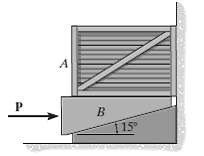
Determine the smallest horizontal force P required to lift the 200-kg crate. The coefficient of static friction at all contacting surfaces is ?s = 0.3. Neglect the mass of the wedge.
Determine the smallest horizontal force P required to lift the 100-kg cylinder. The coefficients of static friction at the contact points A and B are (?s)A = 0.6 and (?s)B = 0.2, respectively; and the coefficient of static friction between the wedge and the ground is ms = 0.3.
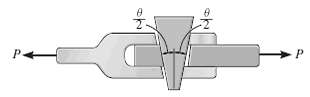
The wedge has a negligible weight and a coefficient of static friction ?s = 0.35 with all contacting surfaces. Determine the largest angle ? so that it is ?self-locking.? This requires no slipping for any magnitude of the force P applied to the joint.
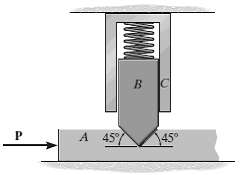
Determine the smallest horizontal force P required to just move block A to the right if the spring force is 600 N and the coefficient of static friction at all contacting surfaces on A is ?s = 0.3. The sleeve at C is smooth. Neglect the mass of A and B.
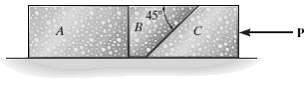
The three stone blocks have weights of WA = 600 lb, WB = 150 lb, and WC = 500 lb. Determine the smallest horizontal force P that must be applied to block C in order to move this block. The coefficient of static friction between the blocks is ?s = 0.3 and between the floor and each block ms ??s =
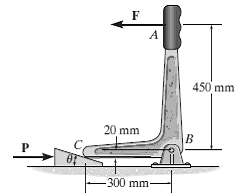
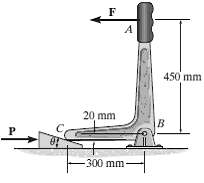
Determine the smallest horizontal force P required to move the wedge to the right. The coefficient of static friction at all contacting surfaces is ?s = 0.3. Set ? = 15o?and F = 400 N. Neglect the weight of the wedge.
If the horizontal force P is removed, determine the largest angle that will cause the wedge to be self-locking regardless of the magnitude of force F applied to the handle. The coefficient of static friction at all contacting surfaces is ?s = 0.3.
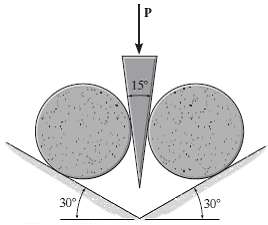
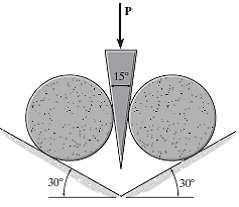
Determine the smallest vertical force P required to hold the wedge between the two identical cylinders, each having a weight of W. The coefficient of static friction at all contacting surfaces is ?s = 0.1.
Determine the smallest vertical force P required to push the wedge between the two identical cylinders, each having a weight of W. The coefficient of static friction at all contacting surfaces is ?s = 0.3.
If the uniform concrete block has a mass of 500 kg, determine the smallest horizontal force P needed to move the wedge to the left. The coefficient of static friction between the wedge and the concrete and the wedge and the floor is ?s = 0.3. The coefficient of static friction between the concrete
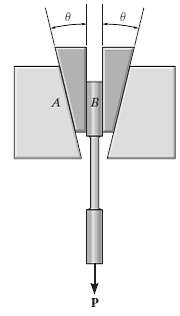
The wedge blocks are used to hold the specimen in a tension testing machine. Determine the largest design angle ? of the wedges so that the specimen will not slip regardless of the applied load. The coefficients of static friction are ?A = 0.1 at A and ?B = 0.6 at B. Neglect the weight of the
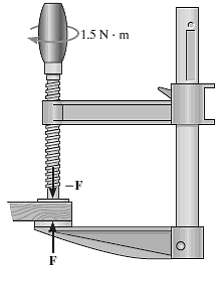
The square threaded screw of the clamp has a mean diameter of 14 mm and a lead of 6 mm. If ?s = 0.2 for the threads, and the torque applied to the handle is 1.5 N ? m, determine the compressive force F on the block.
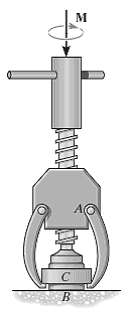
The device is used to pull the battery cable terminal C from the post of a battery. If the required pulling force is 85 lb, determine the torque M that must be applied to the handle on the screw to tighten it. The screw has square threads, a mean diameter of 0.2 in., a lead of 0.08 in., and the
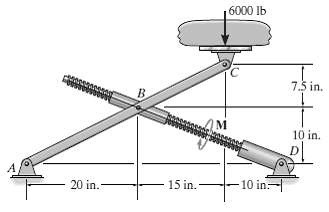
The jacking mechanism consists of a link that has a square-threaded screw with a mean diameter of 0.5 in. and a lead of 0.20 in., and the coefficient of static friction is ?s = 0.4. Determine the torque M that should be applied to the screw to start lifting the 6000-lb load acting at the end of
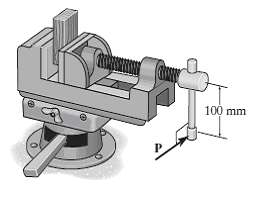
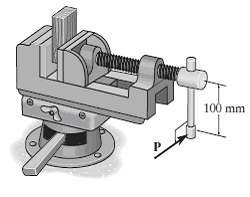
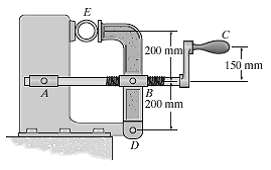
Determine the magnitude of the horizontal force P that must be applied to the handle of the bench vise in order to produce a clamping force of 600 N on the block. The single square-threaded screw has a mean diameter of 25 mm and a lead of 7.5 mm. The coefficient of static friction is ?s = 0.25.
Determine the clamping force exerted on the block if a force of P = 30 N is applied to the lever of the bench vise. The single square-threaded screw has a mean diameter of 25 mm and a lead of 7.5 mm. The coefficient of static friction is ?s = 0.25.
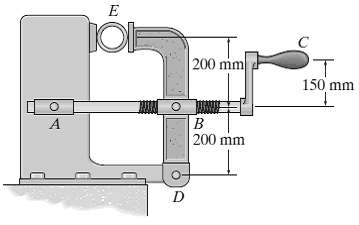
Determine the required horizontal force that must be applied perpendicular to the handle in order to develop a 900-N clamping force on the pipe. The single square-threaded screw has a mean diameter of 25 mm and a lead of 5 mm. The coefficient of static friction is ?s = 0.4. Note: The screw is a
If the clamping force on the pipe is 900 N, determine the horizontal force that must be applied perpendicular to the handle in order to loosen the screw. The single square-threaded screw has a mean diameter of 25 mm and a lead of 5 mm. The coefficient of static friction is ?s = 0.4. Note: The screw
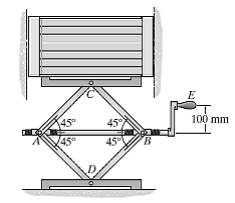
If the jack supports the 200-kg crate, determine the horizontal force that must be applied perpendicular to the handle at E to lower the crate. Each single square-threaded screw has a mean diameter of 25 mm and a lead of 7.5 mm. The coefficient of static friction is ?s = 0.25.
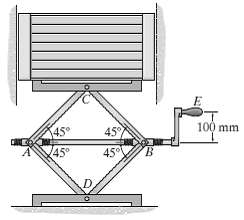
If the jack is required to lift the 200-kg crate, determine the horizontal force that must be applied perpendicular to the handle at E. Each single square-threaded screw has a mean diameter of 25 mm and a lead of 7.5 mm. The coefficient of static friction is ?s = 0.25.
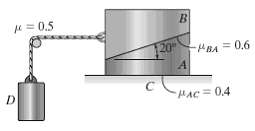
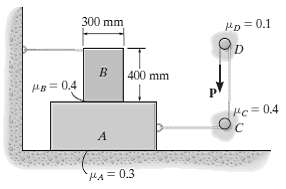
Blocks A and B weigh 75 lb each, and D weighs 30 lb. Using the coefficients of static friction indicated, determine the frictional force between blocks A and B and between block A and the floorC.
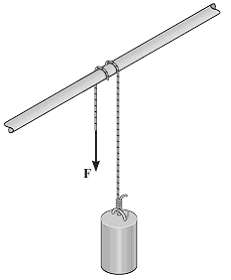
A cylinder having a mass of 250 kg is to be supported by the cord which wraps over the pipe. Determine the smallest vertical force F needed to support the load if the cord passes (a) Once over the pipe, ? = 180o, and (b) Two times over the pipe, ? = 540?.Take ?s = 0.2.
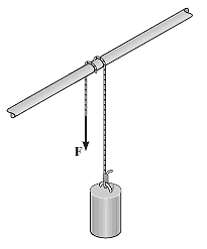
A cylinder having a mass of 250 kg is to be supported by the cord which wraps over the pipe. Determine the largest vertical force F that can be applied to the cord without moving the cylinder. The cord passes (a) Once over the pipe, ? = 180o, and (b) Two times over the pipe, ? = 540?.Take ?s = 0.2.
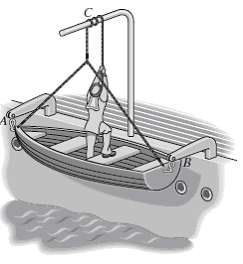
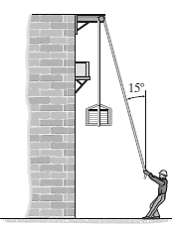
The boat has a weight of 500 lb and is held in position off the side of a ship by the spars at A and B.A man having a weight of 130 lb gets in the boat, wraps a rope around an overhead boom at C, and ties it to the end of the boat as shown. If the boat is disconnected from the spars, determine the
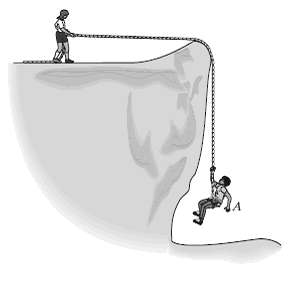
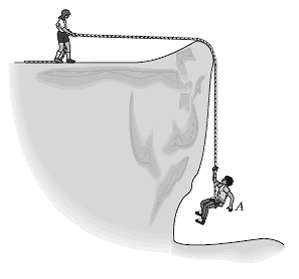
The 100-lb boy at A is suspended from the cable that passes over the quarter circular cliff rock. Determine if it is possible for the 185-lb woman to hoist him up; and if this is possible, what smallest force must she exert on the horizontal cable? The coefficient of static friction between the
The 100-lb boy at A is suspended from the cable that passes over the quarter circular cliff rock. What horizontal force must the woman at A exert on the cable in order to let the boy descend at constant velocity? The coefficients of static and kinetic friction between the cable and the rock are ?s
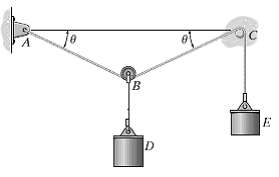
A 10-kg cylinder D, which is attached to a small pulley B, is placed on the cord as shown. Determine the smallest angle so that the cord does not slip over the peg at C. The cylinder at E has a mass of 10 kg, and the coefficient of static friction between the cord and the peg is ?s = 0.1.
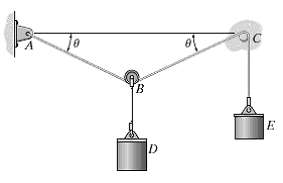
A 10-kg cylinder D, which is attached to a small pulley B, is placed on the cord as shown. Determine the largest angle so that the cord does not slip over the peg at C. The cylinder at E has a mass of 10 kg, and the coefficient of static friction between the cord and the peg is ?s = 0.1.
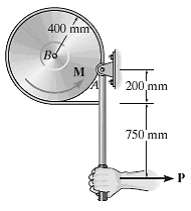
Determine the smallest lever force P needed to prevent the wheel from rotating if it is subjected to a torque of M = 250N ? m. The coefficient of static friction between the belt and the wheel is ?s = 0.3. The wheel is pin connected at its center, B.
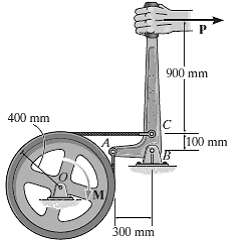
If a force of P = 200 N is applied to the handle of the bell crank, determine the maximum torque M that can be resisted so that the flywheel is not on the verge of rotating clockwise. The coefficient of static friction between the brake band and the rim of the wheel is ?s = 0.3.
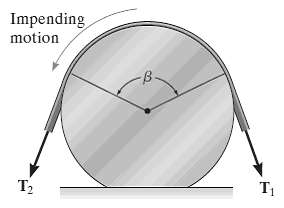
Show that the frictional relationship between the belt tensions, the coefficient of friction ?, and the angular contacts ? and ? for the V-belt is T2 = T1e?B/sin(?/2).
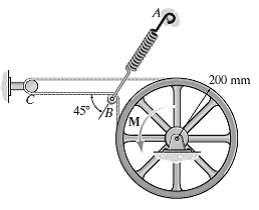
Determine the force developed in spring AB in order to hold the wheel from rotating when it is subjected to a couple moment of M = 200 N ? m. The coefficient of static friction between the belt and the rim of the wheel is ?s = 0.2, and between the belt and peg C, ??s = 0.4. The pulley at B is free
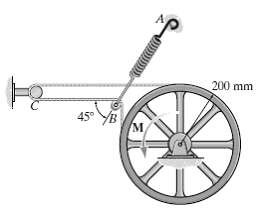
If the tension in the spring is FAB = 2.5kN, determine the largest couple moment that can be applied to the wheel without causing it to rotate. The coefficient of static friction between the belt and the wheel is ?s = 0.2, and between the belt the peg ??s = 0.4.The pulley B free to rotate.
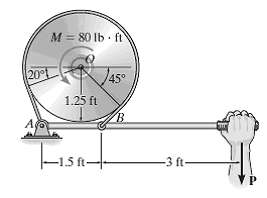
The simple band brake is constructed so that the ends of the friction strap are connected to the pin at A and the lever arm at B. If the wheel is subjected to a torque of M = 80lb ? ft, determine the smallest force P applied to the lever that is required to hold the wheel stationary. The
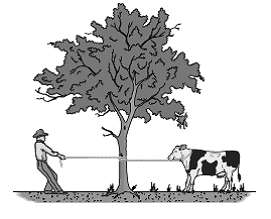
A 180-lb farmer tries to restrain the cow from escaping by wrapping the rope two turns around the tree trunk as shown. If the cow exerts a force of 250 lb on the rope, determine if the farmer can successfully restrain the cow. The coefficient of static friction between the rope and the tree trunk
The uniform 50-lb beam is supported by the rope which is attached to the end of the beam, wraps over the rough peg, and is then connected to the 100-lb block. If the coefficient of static friction between the beam and the block, and between the rope and the peg, is ?s = 0.4, determine the maximum
The 80-kg man tries to lower the 150-kg crate using a rope that passes over the rough peg. Determine the least number of full turns in addition to the basic wrap (165?) around the peg to do the job. The coefficients of static friction between the rope and the peg and between the man?s shoes and the
If the rope wraps three full turns plus the basic wrap (165?) around the peg, determine if the 80-kg man can keep the 300-kg crate from moving. The coefficients of static friction between the rope and the peg and between the man?s shoes and the ground are ?s = 0.1 and ??s = 0.4, respectively.
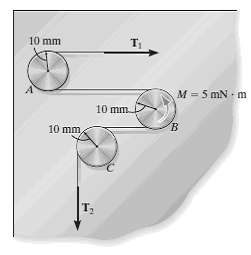
The drive pulley B in a video tape recorder is on the verge of slipping when it is subjected to a torque of M = 0.005 N ? m. If the coefficient of static friction between the tape and the drive wheel and between the tape and the fixed shafts A and C is ?s = 0.1, determine the tensions T1?and T2
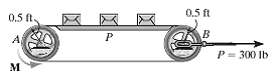
Determine the maximum number of 50-lb packages that can be placed on the belt without causing the belt to slip at the drive wheel A which is rotating with a constant angular velocity. Wheel B is free to rotate. Also, find the corresponding torsional moment M that must be supplied to wheel A. The
Blocks A and B have a mass of 7 kg and 10 kg, respectively. Using the coefficients of static friction indicated, determine the largest vertical force P which can be applied to the cord without causingmotion.
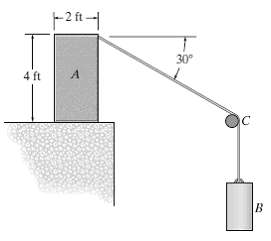
Block A has a weight of 100 lb and rests on a surface for which ?s = 0.25. If the coefficient of static friction between the cord and the fixed peg at C is ?s = 0.3, determine the greatest weight of the suspended cylinder B without causing motion.
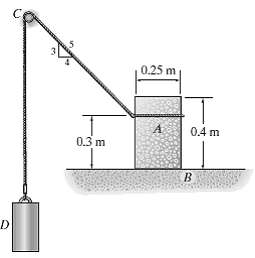
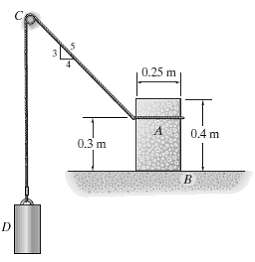
Block A has a mass of 50 kg and rests on surface B for which ?s = 0.25. If the coefficient of static friction between the cord and the fixed peg at C is ??s = 0.3, determine the greatest mass of the suspended cylinder D without causing motion.
Block A has a mass of 50 kg and rests on surface B for which ?s = 0.25. If the mass of the suspended cylinder D is 4 kg, determine the frictional force acting on A and check if motion occurs. The coefficient of static friction between the cord and the fixed peg at C is ??s = 0.3.
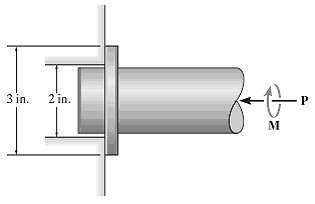
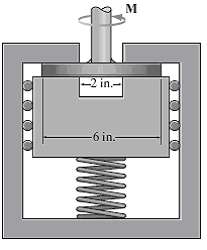
The collar bearing uniformly supports an axial force of P = 500lb. If a torque of M = 3 lb ? ft is applied to the shaft and causes it to rotate at constant velocity, determine the coefficient of kinetic friction at the surface of contact.
If the spring exerts a force of 900 lb on the block, determine the torque M required to rotate the shaft. The coefficient of static friction at all contacting surfaces is ?s = 0.3.
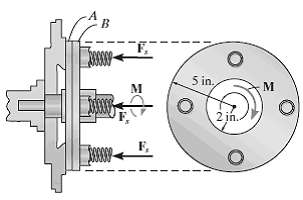
The disk clutch is used in standard transmissions of automobiles. If four springs are used to force the two plates A and B together, determine the force in each spring required to transmit a moment of M = 600 lb ? ft across the plates. The coefficient of static friction between A and B is ?s = 0.3.
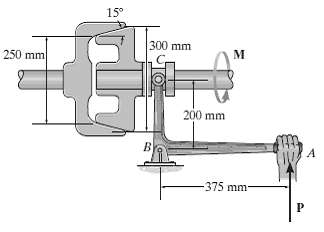
If P = 900 N is applied to the handle of the bell crank, determine the maximum torque M the cone clutch can transmit. The coefficient of static friction at the contacting surface is ?s = 0.3.
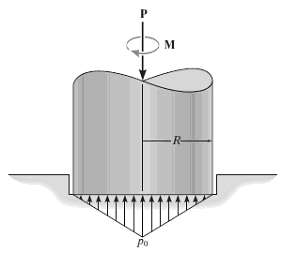
Because of wearing at the edges, the pivot bearing is subjected to a conical pressure distribution at its surface of contact. Determine the torque M required to overcome friction and turn the shaft, which supports an axial force P. The coefficient of static friction is ?s. For the solution, it is
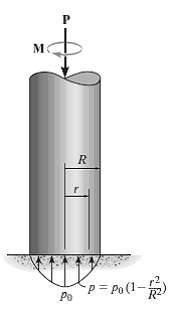
The pivot bearing is subjected to a parabolic pressure distribution at its surface of contact. If the coefficient of static friction is ?s, determine the torque M required to overcome friction and turn the shaft if it supports an axial force P.
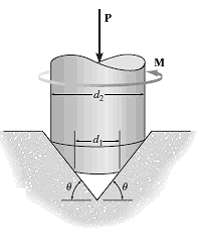
The shaft is subjected to an axial force P. If the reactive pressure on the conical bearing is uniform, determine the torque M that is just sufficient to rotate the shaft. The coefficient of static friction at the contacting surface is ?s.
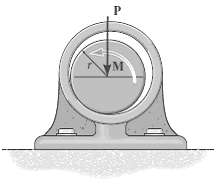
The shaft of radius r fits loosely on the journal bearing. If the shaft transmits a vertical force P to the bearing and the coefficient of kinetic friction between the shaft and the bearing is ?k, determine the torque M required to turn the shaft with constant velocity.
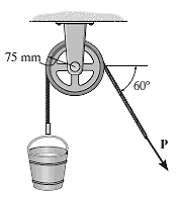
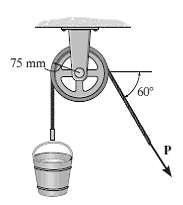
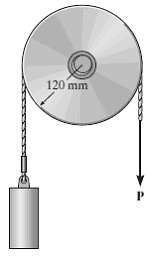
The pulley is supported by a 25-mm-diameter pin. If the pulley fits loosely on the pin, determine the smallest force P required to raise the bucket. The bucket has a mass of 20 kg and the coefficient of static friction between the pulley and the pin is ?s = 0.3. Neglect the mass of the pulley and
The pulley is supported by a 25-mm-diameter pin. If the pulley fits loosely on the pin, determine the largest force P that can be applied to the rope and yet lower the bucket. The bucket has a mass of 20 kg and the coefficient of static friction between the pulley and the pin is ?s = 0.3. Neglect
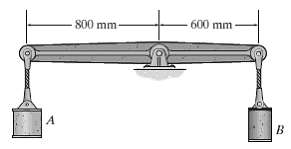
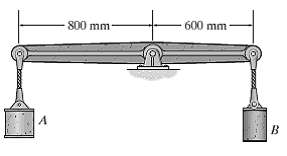
The cylinders are suspended from the end of the bar which fits loosely into a 40-mm-diameter pin. If A has a mass of 10 kg, determine the required mass of B which is just sufficient to keep the bar from rotating clockwise. The coefficient of static friction between the bar and the pin is ?s = 0.3.
The cylinders are suspended from the end of the bar which fits loosely into a 40-mm-diameter pin. If A has a mass of 10 kg, determine the required mass of B which is just sufficient to keep the bar from rotating counterclockwise. The coefficient of static friction between the bar and the pin is ?s
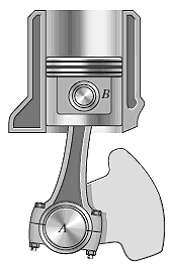
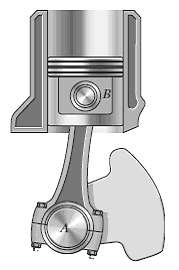
The connecting rod is attached to the piston by a 0.75-in.-diameter pin at B and to the crank shaft by a 2-in.-diameter bearing A. If the piston is moving downwards, and the coefficient of static friction at the contact points is ?s = 02, determine the radius of the friction circle at each
The connecting rod is attached to the piston by a 20-mm-diameter pin at B and to the crank shaft by a 50-mm-diameter bearing A. If the piston is moving upwards, and the coefficient of static friction at the contact points is ?s = 0.3, determine the radius of the friction circle at each connection.
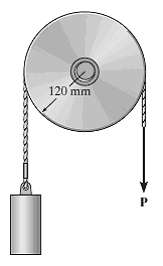
The 5-kg pulley has a diameter of 240 mm and the axle has a diameter of 40 mm. If the coefficient of kinetic friction between the axle and the pulley is ?k = 0.15 determine the vertical force P on the rope required to lift the 80-kg block at constant velocity.
Solve Prob. 8?132 if the force P is applied horizontally to the right.
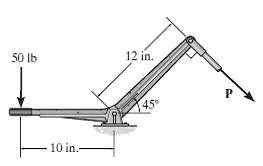
The bell crank fits loosely into a 0.5-in-diameter pin. Determine the required force P which is just sufficient to rotate the bell crank clockwise. The coefficient of static friction between the pin and the bell crank is ?s = 0.3.
The bell crank fits loosely into a 0.5-in-diameter pin. If P = 41 lb, the bell crank is then on the verge of rotating counterclockwise. Determine the coefficient of static friction between the pin and the bellcrank.
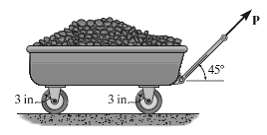
The wagon together with the load weighs 150 lb. If the coefficient of rolling resistance is a = 0.03 in., determine the force P required to pull the wagon with constantvelocity.
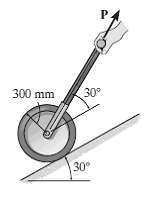
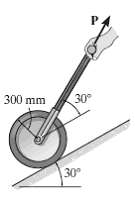
Determine the force P required to overcome rolling resistance and pull the 50-kg roller up the inclined plane with constant velocity. The coefficient of rolling resistance is a = 15mm.
Determine the force P required to overcome rolling resistance and support the 50-kg roller if it rolls down the inclined plane with constant velocity. The coefficient of rolling resistance is a = 15mm.
The 1.2-Mg steel beam is moved over a level surface using a series of 30-mm-diameter rollers for which the coefficient of rolling resistance is 0.4 mm at the ground and 0.2 mm at the bottom surface of the beam. Determine the horizontal force P needed to push the beam forward at a constantspeed.
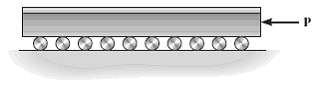
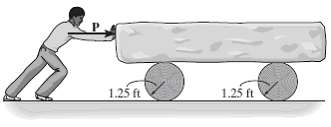
Determine the smallest horizontal force P that must be exerted on the 200-lb block to move it forward. The rollers each weigh 50 lb, and the coefficient of rolling resistance at the top and bottom surfaces is a = 0.2in.
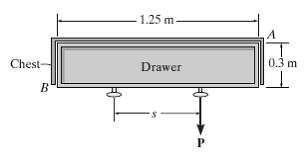
A single force P is applied to the handle of the drawer. If friction is neglected at the bottom and the coefficient of static friction along the sides is ?s = 0.4, determine the largest spacing s between the symmetrically placed handles so that the drawer does not bind at the corners A and B when
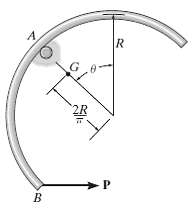
The semicircular thin hoop of weight W and center of gravity at G is suspended by the small peg at A.A horizontal force P is slowly applied at B. If the hoop begins to slip at A when ? = 30o, determine the coefficient of static friction between the hoop and the peg.
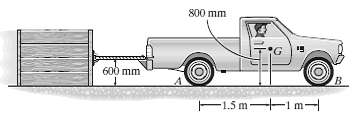
Solve Prob. 8?145 if the truck and crate are traveling up a 10? incline.
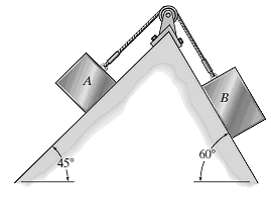
If block A has a mass of 1.5 kg, determine the largest mass of block B without causing motion of the system. The coefficient of static friction between the blocks and inclined planes is ?s = 0.2.
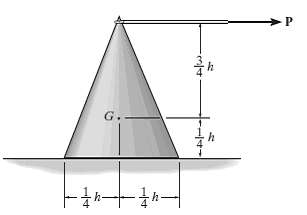
The cone has a weight W and center of gravity at G. If a horizontal force P is gradually applied to the string attached to its vertex, determine the maximum coefficient of static friction for slipping tooccur.
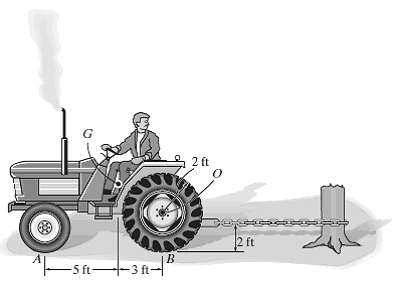
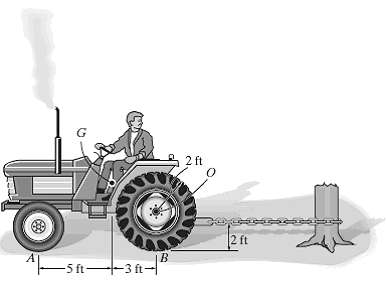
The tractor pulls on the fixed tree stump. Determine the torque that must be applied by the engine to the rear wheels to cause them to slip. The front wheels are free to roll. The tractor weighs 3500 lb and has a center of gravity at G. The coefficient of static friction between the rear wheels and
The tractor pulls on the fixed tree stump. If the coefficient of static friction between the rear wheels and the ground is ?s = 0.6, determine if the rear wheels slip or the front wheels lift off the ground as the engine provides torque to the rear wheels. What is the torque needed to cause this
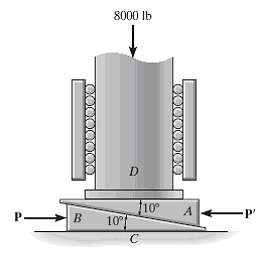
Column D is subjected to a vertical load of 8000 lb. It is supported on two identical wedges A and B for which the coefficient of static friction at the contacting surfaces between A and B and between B and C is ?s = 0.4. Determine the force P? needed to raise the column and the equilibrium force
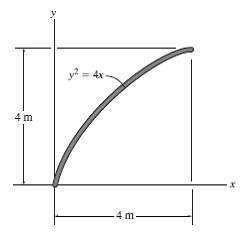
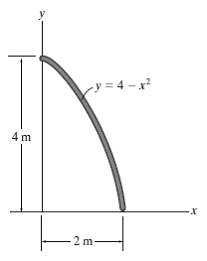
Determine the mass and the location of the center of mass (x, y) of the uniform parabolic-shaped rod. The mass per unit length of the rod is 2kg>m.
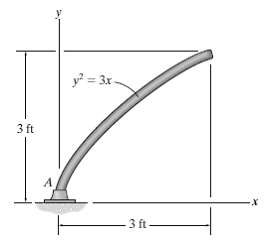
The uniform rod is bent into the shape of a parabola and has a weight per unit length of 6 lb/ft. Determine the reactions at the fixed supportA.
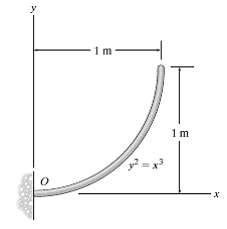
Determine the distance to the center of mass of the homogeneous rod bent into the shape shown. If the rod has a mass per unit length of 0.5 kg/m, determine the reactions at the fixed supportO.
Determine the mass and locate the center of mass (x, y) of the uniform rod. The mass per unit length of the rod is 3kg>m.
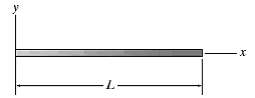
Determine the mass and the location of the center of mass x of the rod if its mass per unit length is m = m0(1 +x/L).
Determine the location (x, y) of the centroid of the wire.
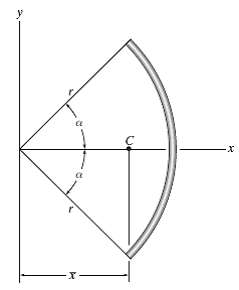
Locate the centroid of the circular rod. Express the answer in terms of the radius r and semiarc anglea.
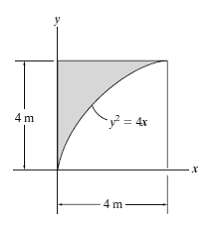
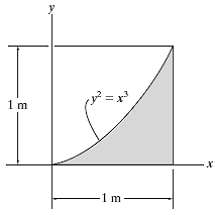
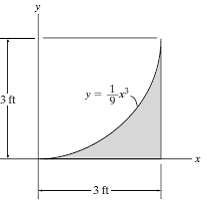
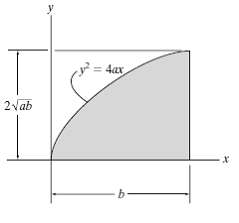
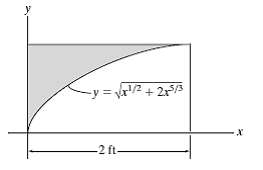
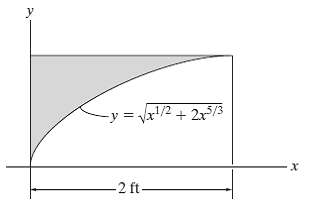
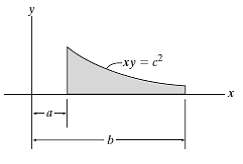
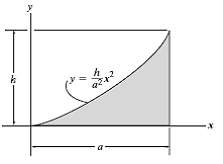
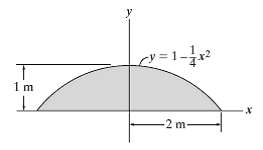
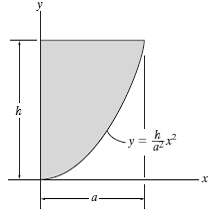
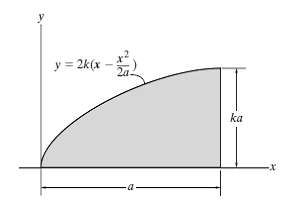
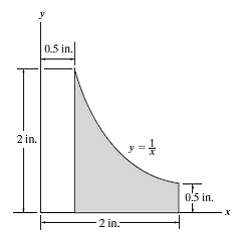
Determine the area and the centroid (x, y) of thearea.
Determine the area and the centroid (x, y) of thearea.
Determine the area and the centroid (x, y) of thearea.
Determine the area and the centroid (x, y) of thearea.
Locate the centroid x of thearea.
Locate the centroid y of thearea.
Determine the area and the centroid (x, y) of thearea.
Determine the area and the centroid (x, y) of thearea.
Locate the centroid (x, y) of thearea.
Determine the area and the centroid (x, y) of thearea.
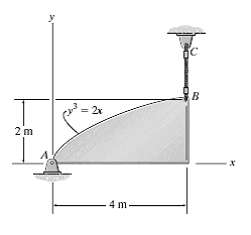
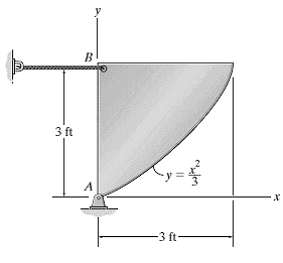
The plate is made of steel having a density of 7850 kg/m3. If the thickness of the plate is 10 mm, determine the horizontal and vertical components of reaction at the pin A and the tension in cableBC.
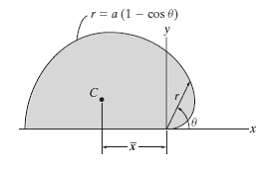
Determine the location x to the centroid C of the upper portion of the cardioid, r = a(1 - cos ?).
The plate has a thickness of 0.5 in. and is made of steel having a specific weight of 490 lb/ft3. Determine the horizontal and vertical components of reaction at the pin A and the force in the cord atB.
Locate the centroid x of the shadedarea.
Locate the centroid x of thearea.
Showing 2200 - 2300
of 2574
First
12
13
14
15
16
17
18
19
20
21
22
23
24
25
26
Step by Step Answers

 Get 50% OFF
Claim Now
Get 50% OFF
Claim Now