New Semester
Started
Get
50% OFF
Study Help!
--h --m --s
Claim Now
Question Answers
Textbooks
Find textbooks, questions and answers
Oops, something went wrong!
Change your search query and then try again
S
Books
FREE
Study Help
Expert Questions
Accounting
General Management
Mathematics
Finance
Organizational Behaviour
Law
Physics
Operating System
Management Leadership
Sociology
Programming
Marketing
Database
Computer Network
Economics
Textbooks Solutions
Accounting
Managerial Accounting
Management Leadership
Cost Accounting
Statistics
Business Law
Corporate Finance
Finance
Economics
Auditing
Tutors
Online Tutors
Find a Tutor
Hire a Tutor
Become a Tutor
AI Tutor
AI Study Planner
NEW
Sell Books
Search
Search
Sign In
Register
study help
engineering
civil engineering
Engineering Mechanics Statics 11 Edition Russell C. Hibbeler - Solutions
The uniform pole has a weight W and length L. Its end B is tied to a supporting cord, and end A is placed against the wall, for which the coefficient of static friction is μs . Determine the largest angle θ at which the pole can be placed without slipping.
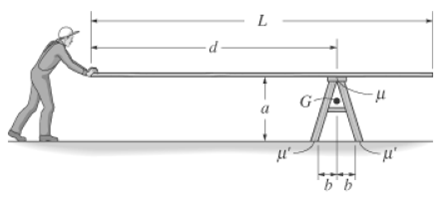
The carpenter slowly pushes the uniform board horizontally over the top of the saw horse. The board has a uniform weight density γ and the saw horse has a weight W and a center of gravity at G. Determine if the saw horse will stay in position, slip, or tip if the board is pushed forward at the
The carpenter slowly pushes the uniform board horizontally over the top of the saw horse. The board has a uniform weight density γ and the saw horse has a weight W and a center of gravity at G. Determine if the saw horse will stay in position, slip, or tip if the board is pushed forward at the
The disk of mass mo rests on the surface for which the coefficient of static friction is μA Determine the largest couple moment M that can be applied to the bar without causing motion. Given:mo = 45 kgμ A = 0.2a = 300 mmb = 400 mmr = 125 mm
The disk of mass m0 rests on the surface for which the coefficient of static friction is μA Determine the friction force at A.Given:M 50 = N ∙ mmo = 45 kgμA = 0.2a = 300 mmb = 400 mmr = 125 mm
A block of weight W is attached to a light rod AD that pivots at pin A. If the coefficient of static friction between the plane and the block is μs , determine the minimum angle θ at which the block may be placed on the plane without slipping. Neglect the size of the block in the
Determine the force P needed to lift the load of weight W. Smooth rollers are placed between the wedges. The coefficient of static friction between A and C and between B and D is μs. Neglect the weight of each wedge.Given:θ = 10 degW = 100 lbμ s = 0.3
The wedge is used to level the floor of a building. For the floor loading shown, determine the horizontal force P that must be applied to move the wedge forward. The coefficient of static friction between the wedge and the two surfaces of contact is μs. Neglect the size and weight of the wedge and
The three stone blocks have weights WA, WB, and WC. Determine the smallest horizontal force P that must be applied to block C in order to move this block. The coefficient of static friction between the blocks is μs, and between the floor and each block μs.Given:WA = 600 lbWB = 150 lbWC = 500 lbμ
If the spring is compressed a distance δ and the coefficient of static friction between the tapered stub S and the slider A is μsA, determine the horizontal force P needed to move the slider forward. The stub is free to move without friction within the fixed collar C. The coefficient of static
The coefficient of static friction between wedges B and C is μs1 and between the surfaces of contact B and A and C and D, μs2. If the spring is compressed to a distance δ when in the position shown, determine the smallest force P needed to move wedge C to the left. Neglect the weight of the
The coefficient of static friction between the wedges B and C is μs1 and between the surfaces of contact B and A and C and D, μs2. Determine the smalls allowable compression of the spring δ without causing wedge C to move to the left. Neglect the weight of the wedges.Given:μ s1 = 0.6 θ = 15
The wedge blocks are used to hold the specimen in a tension testing machine. Determine the design angle θ of the wedges so that the specimen will not slip regardless of the applied load. The coefficients of static friction are μA at A and μB at B. Neglect the weight of the blocks.Given:μA =
The wedge is used to level the member. Determine the reversed horizontal force -P that must be applied to pull the wedge out to the left. The coefficient of static friction between the wedge and the two surfaces of contact is μs. Neglect the weight of the wedge.Units Used:kN = 103 NGiven:μ s =
If the coefficient of static friction between all the surfaces of contact is μs, determine the force P that must be applied to the wedge in order to lift the brace that supports the load F.
The column is used to support the upper floor. If a force F is applied perpendicular to the handle to tighten the screw, determine the compressive force in the column. The square-threaded screw on the jack has a coefficient of static friction μs, mean diameter d, and a lead h.Units Used:kN = 103
The column is used to support the upper floor. If the force F is removed from the handle of the jack, determine if the screw is self-locking.. The square-threaded screw on the jack has a coefficient of static friction μs, mean diameter d, and a lead h.Given:F = 80 N μ s = 0.4 d = 25 mmh = 3 mm a
The vise is used to grip the pipe. If a horizontal force F1 is applied perpendicular to the end of the handle of length l, determine the compressive force F developed in the pipe. The square threads have a mean diameter d and a lead a. How much force must be applied perpendicular to the handle to
Determine the couple forces F that must be applied to the handle of the machinist's vise in order to create a compressive force FA in the block Neglect friction at the bearing A. The guide at B is smooth so that the axial force on the screw is FA. The single square-threaded screw has a mean radius
If couple forces F are applied to the handle of the machinist’s vise, determine the compressive force developed in the block Neglect friction at the bearing A. The guide at B is smooth. The single square-threaded screw has a mean radius of r1 and a lead of r2, and the coefficient of static
The machine part is held in place using the double-end clamp. The bolt at B has square threads with a mean radius r and a lead r1, and the coefficient of static friction with the nut is μs. If a torque M is applied to the nut to tighten it, determine the normal force of the clamp at the smooth
Determine the clamping force on the board A if the screw of the “C” clamp is tightened with a twist M. The single square-threaded screw has a mean radius r, a lead h, and the coefficient of static friction is μs.Units Used:kN = 103 NGiven:M = 8 N ∙ mr = 10 mmh = 3 mmμ s = 0.35
If the required clamping force at the board A is to be P, determine the torque M that must be applied to the handle of the “C” clamp to tighten it down. The single square-threaded screw has a mean radius r, a lead h, and the coefficient of static friction is μs.Given:P = 50 Nr = 10 mmh = 3
Determine the clamping force on the board at A if the screw of the hold-down clamp is tightened with a twist M. The single square-threaded screw has a mean radius of r and a lead of rl, and the coefficient of static friction is μs.Given:M = 0.2 N mr = 8 mmrl = 2 mmμ s = 0.38
If the required clamping force at the board A is to be F, determine the torque M that must be applied to the handle of the hold-down clamp to tighten it down. The single square-threaded screw has a mean radius r and a lead r1, and the coefficient of static friction is μs.Given:F = 70 Nr = 8 mmrl =
The fixture clamp consists of a square-threaded screw having a coefficient of static friction μs mean diameter d, and a lead h. The five points indicated are pin connections. Determine the clamping force at the smooth blocks D and E when a torque M is applied to the handle of the screw.Given:μ s
The clamp provides pressure from several directions on the edges of the board. If the square-threaded screw has a lead h, radius r, and the coefficient of static friction is μs, determine the horizontal force developed on the board at A and the vertical forces developed at B and C if a torque M is
The two blocks under the double wedge are brought together using a left and right square-threaded screw. If the mean diameter is d, the lead is rl, and the coefficient of static friction is μs , determine the torque needed to draw the blocks together. The coefficient of static friction between
The two blocks under the double wedge are brought together using a left and right square-threaded screw. If the mean diameter is d, the lead is rl, and the coefficient of static friction is μs , determine the torque needed to spread the blocks apart. The coefficient of static friction between each
The cord supporting the cylinder of mass M passes around three pegs, A, B, C, where the coefficient of friction is μs. Determine the range of values for the magnitude of the horizontal force P for which the cylinder will not move up or down.Given:M = 6 kgθ = 45 degμ s = 0.2g = 9.81m/s2
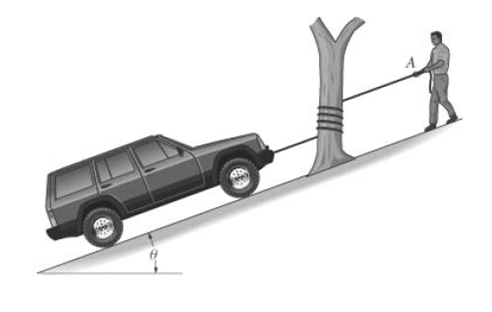
The truck, which has mass mt , is to be lowered down the slope by a rope that is wrapped around a tree. If the wheels are free to roll and the man at A can resist a pull P, determine the minimum number of turns the rope should be wrapped around the tree to lower the truck at a constant speed. The
The wheel is subjected to a torque M. If the coefficient of kinetic friction between the band brake and the rim of the wheel is μk, determine the smallest horizontal force P that must be applied to the lever to stop the wheel.Given:a = 400 mm d = 25 mmb = 100 mm r = 150 mmc = 50 mm M = 50 N ∙
A cylinder A has a mass M. Determine the smallest force P applied to the handle of the lever required for equilibrium. The coefficient of static friction between the belt and the wheel is μs. The drum is pin connected at its center, B.Given:M = 75 kga = 700 mmb = 25 mmc = 300 mmd = 200 mme1 = 60
Determine the largest mass of cylinder A that can be supported from the drum if a force P is applied to the handle of the lever. The coefficient of static friction between the belt and the wheel is μs. The drum is pin supported at its center, B.Given:P = 20 Na = 700 mmb = 25 mmc = 300 mmd = 200
The uniform bar AB is supported by a rope that passes over a frictionless pulley at C and a fixed peg at D. If the coefficient of static friction between the rope and the peg is μD, determine the smallest distance x from the end of the bar at which a force F may be placed and not cause the bar to
Determine the smallest lever force P needed to prevent the wheel from rotating if it is subjected to a torque M. The coefficient of static friction between the belt and the wheel is μs. The wheel is pin-connected at its center, B.Given:M = 250 N mμ s = 0.3r = 400 mma = 200 mmb = 750 mm
Determine the torque M that can be resisted by the band brake if a force P is applied to the handle of the lever. The coefficient of static friction between the belt and the wheel is μs. The wheel is pin-connected at its center, B.Given:P = 30 Nμ s = 0.3r = 400 mma = 200 mmb = 750 mm
Blocks A and B weigh WA and WB and respectively. Using the coefficients of static friction indicated; determine the greatest weight of block D without causing motion.Given:WA = 50 lbWB = 30 lbμ = 0.5μ BA = 0.6μAC = 0.4θ = 20 deg
Blocks A and B have weight W, and D weighs WD. Using the coefficients of static friction indicated, determine the frictional force between blocks A and B and between block A and the floor C.Given:W = 75 lb μBA = 0.6WD = 30 lb μAC = 0.4μ = 0.5 θ = 20 deg
Show that the frictional relationship between the belt tensions, the coefficient of friction μ, and the angular contacts α and β for the V-belt is T2=T1eμβ/sin(α/2) when the belt is on the verge of slipping.
A V-fan-belt (V-angle θ) of an automobile engine passes around the hub H of a generator G and over the housing F to a fan. If the generator locks, and the maximum tension the belt can sustain is Tmax, determine the maximum possible torque M resisted by the axle as the belt slips over the hub.
A cable is attached to the plate B of mass MB, passes over a fixed peg at C, and is attached to the block at A. Using the coefficients of static friction shown, determine the smallest mass of block A so that it will prevent sliding motion of B down the plane.Given:MB = 20 kg μA = 0.2θ = 30 deg
The simple band brake is constructed so that the ends of the friction strap are connected to the pin at A and the lever arm at B. If the wheel is subjected to a torque M, determine the smallest force P applied to the lever that is required to hold the wheel stationary. The coefficient of static
The uniform beam of weight W1 is supported by the rope which is attached to the end of the beam, wraps over the rough peg, and is then connected to the block of weight W2. If the coefficient of static friction between the beam and the block, and between the rope and the peg, is μs, determine the
The uniform concrete pipe has weight W and is unloaded slowly from the truck bed using the rope and skids shown. If the coefficient of kinetic friction between the rope and pipe is μk, determine the force the worker must exert on the rope to lower the pipe at constant speed. There is a pulley at
A cord having a weight density γ and a total length L is suspended over a peg P as shown. If the coefficient of static friction between the peg and cord is μs, determine the longest length h which one side of the suspended cord can have without causing motion. Neglect the size of the peg and the
Granular material, having a density ρ is transported on a conveyor belt that slides over the fixed surface, having a coefficient of kinetic friction of μk. Operation of the belt is provided by a motor that supplies a torque M to wheel A. The wheel at B is free to turn, and the coefficient of
Blocks A and B have a mass MA and MB, respectively. If the coefficient of static friction between A and B and between B and C is μs and between the ropes and the pegs D and E μs, determine the smallest force F needed to cause motion of block B .Units Used:kN = 103 NGiven:θ = 45 deg μs = 0.25MA
Blocks A and B weigh W1 and W2, respectively. Using the coefficients of static friction indicated, determine the greatest weight W of block E without causing motion.Given:W1 = 50 lb d = 12W2 = 30 lb μ A = 0.3a = 1.5 ft μ B = 0.5b = 2 ft μC = 0.2c = 5 μD = 0.3
Block A has mass mA and rests on surface B for which the coefficient of static friction is μsAB. If the coefficient of static friction between the cord and the fixed peg at C is μsC, determine the greatest mass mD of the suspended cylinder D without causing motion.Given:mA = 50 kgμsAB = 0.25μ
Block A rests on the surface for which the coefficient of friction is μsAB. If the mass of the suspended cylinder is mD, determine the smallest mass mA of block A so that it does not slip or tip. The coefficient of static friction between the cord and the fixed peg at C is μsC.Units Used:g =
The collar bearing uniformly supports an axial force P. If the coefficient of static friction is μs, determine the torque M required to overcome friction.Given:a = 2 inb = 3 inP = 800 lbμ s = 0.3
The collar bearing uniformly supports an axial force P. If a torque M is applied to the shaft and causes it to rotate at constant velocity, determine the coefficient of kinetic friction at the surface of contact.Given:a = 2 inb = 3 inP = 500 lbM = 3 lb ft
The double-collar bearing is subjected to an axial force P. Assuming that collar A supports kP and collar B supports (1 − k)P, both with a uniform distribution of pressure, determine the maximum frictional moment M that may be resisted by the bearing.Units Used:kN = 103 NGiven:P = 4 kNa = 20 mmb
The annular ring bearing is subjected to a thrust P. If the coefficient of static friction is μs, determine the torque M that must be applied to overcome friction.Given:P = 800 lbμ s = 0.35a = 0.75 inb = 1 inc = 2 in
The floor-polishing machine rotates at a constant angular velocity. If it has weight W, determine the couple forces F the operator must apply to the handles to hold the machine stationary. The coefficient of kinetic friction between the floor and brush is μk. Assume the brush exerts a uniform
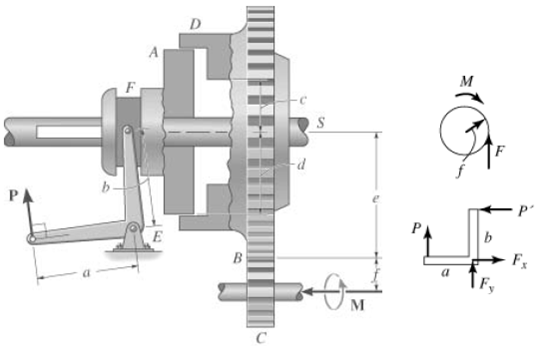
The plate clutch consists of a flat plate A that slides over the rotating shaft S. The shaft is fixed to the driving plate gear B. If the gear C, which is in mesh with B, is subjected to a torque M, determine the smallest force P, that must be applied via the control arm, to stop the rotation. The
The shaft of diameter b is held in the hole such that the normal pressure acting around the shaft varies linearly with its depth as shown. Determine the frictional torque that must be overcome to rotate the shaft.Given:a = 6 inp0 = 60lb/in2b = 4 inμ s = 0.2
Because of wearing at the edges, the pivot bearing is subjected to a conical pressure distribution at its surface of contact. Determine the torque M required to overcome friction and turn the shaft, which supports an axial force P. The coefficient of static friction is μs. For the solution, it is
The conical bearing is subjected to a constant pressure distribution at its surface of contact. If the coefficient of static friction is μs, determine the torque M required to overcome friction if the shaft supports an axial force P.
The tractor is used to push the pipe of weight W. To do this it must overcome the frictional forces at the ground, caused by sand. Assuming that the sand exerts a pressure on the bottom of the pipe as shown, and the coefficient of static friction between the pipe and the sand is μs, determine the
Assuming that the variation of pressure at the bottom of the pivot bearing is defined as p = p0(R2/r), determine the torque M needed to overcome friction if the shaft is subjected to an axial force P. The coefficient of static friction is μs. For the solution, it is necessary to determine p0 in
A disk having an outer diameter a fits loosely over a fixed shaft having a diameter b, if the coefficient of static friction between the disk and the shaft is μs, determine the smallest vertical force P, acting on the rim, which must be applied to the disk to cause it to slip over the shaft. The
The pulley has a radius r and fits loosely on the shaft of diameter d. If the loadings acting on the belt cause the pulley to rotate with constant angular velocity, determine the frictional force between the shaft and the pulley and compute the coefficient of kinetic friction. The pulley has weight
The pulley has a radius r and fits loosely on the shaft of diameter d. If the loadings acting on the belt cause the pulley to rotate with constant angular velocity, determine the frictional force between the shaft and the pulley and compute the coefficient of kinetic friction. Neglect the weight of
A pulley of mass M has radius a and the axle has a diameter D. If the coefficient of kinetic friction between the axle and the pulley is μk determine the vertical force P on the rope required to lift the block of mass MB at constant velocity.Given:a = 120 mmM = 5 kgD = 40 mmμk = 0.15MB = 80 kg
A pulley of mass M has radius a and the axle has a diameter D. If the coefficient of kinetic friction between the axle and the pulley is μk determine the force P on the rope required to lift the block of mass MB at constant velocity. Apply the force P horizontally to the right (not as shown in the
A wheel on a freight car carries a load W. If the axle of the car has a diameter D, determine the horizontal force P that must be applied to the axle to rotate the wheel. The coefficient of kinetic friction is μk.Units Used:kip = 1000 lbGiven:W = 20 kipD = 2 inμ k = 0.05r = 16 in
The trailer has a total weight W and center of gravity at G which is directly over its axle. If the axle has a diameter D, the radius of the wheel is r, and the coefficient of kinetic friction at the bearing is μk, determine the horizontal force P needed to pull the trailer.Given:W = 850 lbr = 1.5
The collar fits loosely around a fixed shaft that has radius r. If the coefficient of kinetic friction between the shaft and the collar is μk, determine the force P on the horizontal segment of the belt so that the collar rotates counterclockwise with a constant angular velocity. Assume that the
The collar fits loosely around a fixed shaft that has radius r. If the coefficient of kinetic friction between the shaft and the collar is μk, determine the force P on the horizontal segment of the belt so that the collar rotates clockwise with a constant angular velocity. Assume that the belt
The connecting rod is attached to the piston by a pin at B of diameter d1 and to the crank shaft by a bearing A of diameter d2. If the piston is moving downwards, and the coefficient of static friction at these points is μs, determine the radius of the friction circle at each connection.Given:d1 =
The connecting rod is attached to the piston by a pin at B of diameter d1 and to the crank shaft by a bearing A of diameter d2. If the piston is moving upwards, and the coefficient of static friction at these points is μs, determine the radius of the friction circle at each connection.Given:d1 =
The lawn roller has mass M. If the arm BA is held at angle θ from the horizontal and the coefficient of rolling resistance for the roller is r, determine the force P needed to push the roller at constant speed. Neglect friction developed at the axle, A, and assume that the resultant force P acting
The handcart has wheels with a diameter D. If a crate having a weight W is placed on the cart, determine the force P that must be applied to the handle to overcome the rolling resistance. The coefficient of rolling resistance is μ. Neglect the weight of the cart.Given:W = 1500 lbD = 6 ina = 0.04
The cylinder is subjected to a load that has a weight W. If the coefficients of rolling resistance for the cylinder's top and bottom surfaces are aA and aB respectively, show that a force having a magnitude of P = [W(aA + aB)]/2r is required to move the load and thereby roll the cylinder forward.
A steel beam of mass M is moved over a level surface using a series of rollers of diameter D for which the coefficient of rolling resistance is age at the ground and as at the bottom surface of the beam. Determine the horizontal force P needed to push the beam forward at a constant speed. Hint: Use
A machine of mass M is to be moved over a level surface using a series of rollers for which the coefficient of rolling resistance is ag at the ground and am at the bottom surface of the machine. Determine the appropriate diameter of the rollers so that the machine can be pushed forward with a
A single force P is applied to the handle of the drawer. If friction is neglected at the bottom and the coefficient of static friction along the sides is μs determine the largest spacing s between the symmetrically placed handles so that the drawer does not bind at the corners A and B when the
The truck has mass M and a center of mass at G. Determine the greatest load it can pull if.(a) The truck has rear-wheel drive while the front wheels are free to roll, and?(b) The truck has four-wheel drive. The coefficient of static friction between the wheels and the ground is μst and between the
The truck has M and a center of mass at G. The truck is traveling up an incline of angle θ. Determine the greatest load it can pull if (a) The truck has rear-wheel drive while the front wheels are free to roll, and (b) The truck has four-wheel drive. The coefficient of static friction between the
A roofer, having a mass M, walks slowly in an upright position down along the surface of a dome that has a radius of curvature ρ. If the coefficient of static friction between his shoes and the dome is μs determine the angle θ at which he first begins to slip.Given:M = 70 kgρ = 20 mμs = 0.7
A man attempts to lift the uniform ladder of weight W to an upright position by applying a force P perpendicular to the ladder at rung R. Determine the coefficient of static friction between the ladder and the ground at A if the ladder begins to slip on the ground when his hands reach height
Column D is subjected to a vertical load W. It is supported on two identical wedges A and B for which the coefficient of static friction at the contacting surfaces between A and B and between B and C is μs. Determine the force P needed to raise the column and the equilibrium force P' needed to
Column D is subjected to a vertical load W. It is supported on two identical wedges A and B for which the coefficient of static friction at the contacting surfaces between A and B and between B and C is μs. If the forces P and P' are removed, are the wedges self-locking? The contacting surface
Locate the center of mass of the homogeneous rod bent in the form of a parabola.Given:a = 1 mb = 2 m
Locate the center of gravity xc of the homogeneous rod. If the rod has a weight per unit length γ, determine the vertical reaction at A and the x and y components of reaction at the pin B.Given:γ = 0.5lb/fta = 1 ftb = 2 ft
Locate the center of mass of the homogeneous rod bent into the shape of a circular arc.Given:r = 300 mmθ = 30 deg
Locate the center of gravity xc of the homogeneous rod bent in the form of a semicircular arc. The rod has a weight per unit length γ. Also, determine the horizontal reaction at the smooth support B and the x and y components of reaction at the pin A.Given:γ = 0.5lb/ftr = 2 ft
Determine the distance xc to the center of gravity of the homogeneous rod bent into the parabolic shape. If the rod has a weight per unit length γ determine the reactions at the fixed support O.Given:γ = 0.5lb/fta = 1 ftb = 0.5 ft
Determine the distance yc to the center of gravity of the homogeneous rod bent into the parabolic shape.Given:a = 1 ftb = 0.5 ft
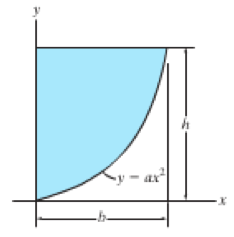
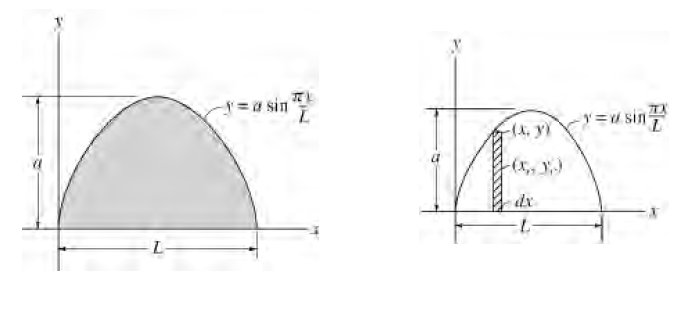
Locate the centroid of the parabolic area.
Locate the centroid yc of the shaded area.Given:a = 100 mmb = 100 mm
Locate the centroid xc of the shaded area.
Determine the location (xc, yc) of the centroid of the triangular area.
Determine the location (xc, yc) of the center of gravity of the quarter circular plate. Also determine the force in each of the supporting wires. The plate has a weight per unit area of γ.Given:γ = 5lb/ft2a = 4 ft
Locate the centroid of the shaded area.
Locate the center of gravity of the homogeneous cantilever beam and determine the reactions at the fixed support. The material has a density of ρ.Units Used: Mg = 103 kg kN = 103 NGiven: ρ = 8 Mg/m3 a = 1 mb = 4 mg = 9.81m/s2c = 0.5 m
Locate the centroid (xc, yc) of the exparabolic segment of area.
Locate the centroid of the shaded area.
Showing 800 - 900
of 2574
First
2
3
4
5
6
7
8
9
10
11
12
13
14
15
16
Last
Step by Step Answers

 Get 50% OFF
Claim Now
Get 50% OFF
Claim Now


.PNG)
.PNG)
.PNG)
.PNG)
.PNG)
.PNG)
.PNG)
.PNG)
.PNG)
.PNG)
.PNG)
.PNG)
.PNG)
.PNG)
.PNG)
.PNG)
.PNG)
.PNG)
.PNG)
.PNG)
.PNG)
.PNG)
.PNG)
.PNG)
.PNG)
.PNG)
.PNG)
.PNG)
.PNG)
.PNG)
.PNG)
.PNG)
.PNG)
.PNG)
.PNG)
.PNG)
.PNG)
.PNG)
.PNG)
.PNG)
.PNG)
.PNG)
.PNG)
.PNG)
.PNG)
.PNG)
.PNG)
.PNG)
.PNG)
.PNG)
.PNG)
.PNG)
.PNG)
.PNG)
.PNG)
.PNG)
.PNG)
.PNG)
.PNG)
.PNG)
.PNG)
.PNG)
.PNG)
.PNG)
.PNG)
.PNG)
.PNG)
.PNG)
.PNG)
.PNG)
.PNG)
.PNG)
.PNG)
.PNG)
.PNG)
.PNG)
.PNG)
.PNG)
.PNG)
.PNG)
.PNG)
.PNG)
.PNG)
.PNG)
.PNG)
.PNG)
.PNG)
.PNG)
.PNG)
.PNG)
.PNG)
.PNG)
.PNG)
.PNG)


