







Question: For a function g = R C, set Îg (u) = g(u + h) - g(u - h),h R and define Î (n) g(u) recursively.
(i) Show that

(ii) From part (i), and by expanding f(t) around 0 up to terms of order 2n, obtain
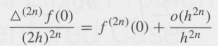
(where o(t)/t †’ = as t †’ 0) so that

Part (i) is proved by induction in m. In the process of doing so, the relation

will be needed. In proving part (ii), the following relation is required (which you may use here without proof; see, however, the next exercise):

g(u) = E(-1y(" )e(u- (m) g(u + (m 2r)h). r=0
Step by Step Solution
3.36 Rating (168 Votes )
There are 3 Steps involved in it
i By definition gu gu h gu h call it g1u Then so that the formula is true ... View full answer

Get step-by-step solutions from verified subject matter experts
Document Format (1 attachment)

742-M-S-P (6991).docx
120 KBs Word File
 Study Help