New Semester
Started
Get
50% OFF
Study Help!
--h --m --s
Claim Now
Question Answers
Textbooks
Find textbooks, questions and answers
Oops, something went wrong!
Change your search query and then try again
S
Books
FREE
Study Help
Expert Questions
Accounting
General Management
Mathematics
Finance
Organizational Behaviour
Law
Physics
Operating System
Management Leadership
Sociology
Programming
Marketing
Database
Computer Network
Economics
Textbooks Solutions
Accounting
Managerial Accounting
Management Leadership
Cost Accounting
Statistics
Business Law
Corporate Finance
Finance
Economics
Auditing
Tutors
Online Tutors
Find a Tutor
Hire a Tutor
Become a Tutor
AI Tutor
AI Study Planner
NEW
Sell Books
Search
Search
Sign In
Register
study help
mathematics
calculus
Modeling the Dynamics of Life Calculus and Probability for Life Scientists 3rd edition Frederick R. Adler - Solutions
The result of Section 2.10, Exercise 23 gives the derivative of sin-1(x). Use integration by parts and a substitution to find ∫ sin-1(x)dx. Integration by parts along with substitution can be used to integrate some of the inverse trigonometric functions.
Find the indefinite integral ∫ xexdx as in Example 4.3.9. In Examples 4.3.9 and 4.3.10, we chose the constant c = 0 when finding v(x). Follow the steps for integration by parts, but leave c as an arbitrary constant. Do you get the same answer?
Find the indefinite integral ∫ ln(x)dx as in Example 4.3.10. In Examples 4.3.9 and 4.3.10, we chose the constant c = 0 when finding v(x). Follow the steps for integration by parts, but leave c as an arbitrary constant. Do you get the same answer?
Find the indefinite integral ex sin (x) using integration by parts twice. Sometimes integrating by parts seems to lead in a circle, but the answer can still be found. Try the above.
Find the indefinite integral ln(x)/x using integration by parts. Sometimes integrating by parts seems to lead in a circle, but the answer can still be found. Try the above.
Integrate the Taylor series for ex term by term, and find the value of the constant for which the integral matches the function ex. When a function has a well-behaved Taylor series, we can find a Taylor series for some integrals by integrating term by term (proving that these integrals converge to
Integrate the Taylor series for 1/1 - x term by term, and check if the answer matches the Taylor series for - ln(l - x) (use the results of Section 3.7, Exercise 32). When a function has a well-behaved Taylor series, we can find a Taylor series for some integrals by integrating term by term
Integrate the Taylor series for ex/x term by term. Does this look like a familiar series? When a function has a well-behaved Taylor series, we can find a Taylor series for some integrals by integrating term by term (proving that these integrals converge to the correct answer requires methods from
Integrate the Taylor series for ex2 term by term. Does this look like a familiar series? When a function has a well-behaved Taylor series, we can find a Taylor series for some integrals by integrating term by term (proving that these integrals converge to the correct answer requires methods from
Find the integral of f(x) = x / (x + 1)(x + 2). Integration by partial fractions works on many more cases than presented in the main text. We here look at functions with a linear function, rather than a constant, as the numerator.
Find the indefinite integrals of the following function. 2/t + t/2
Find the integral of g(z) = z - 1 / (z + 1)(z + 3). Integration by partial fractions works on many more cases than presented in the main text. We here look at functions with a linear function, rather than a constant, as the numerator.
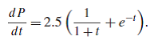
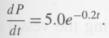
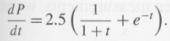
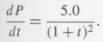
The following differential equations for the production of a chemical P share the properties that the rate of change at t = 0 is 5.0, and the limit as t †’ ˆž is 0. For each, find the solution starting from the initial condition P(0) = 0, sketch the solution, and say what happens to P(t) as t
The following differential equations for the production of a chemical P share the properties that the rate of change at t = 0 is 5.0, and the limit as t → ∞ is 0. For each, find the solution starting from the initial condition P(0) = 0, sketch the solution, and say what happens to P(t) as t →
The following differential equations for the production of a chemical P share the properties that the rate of change at t = 0 is 5.0, and the limit as t → ∞ is 0. For each, find the solution starting from the initial condition P(0) = 0, sketch the solution, and say what happens to P(t) as t →
The following differential equations for the production of a chemical P share the properties that the rate of change at t = 0 is 5.0, and the limit as t → ∞ is 0. For each, find the solution starting from the initial condition P(0) = 0, sketch the solution, and say what happens to P(t) as t →
Suppose the mass M of a toad grows according to the differential equation dM/dt = (t + t2)e-2t with M(0) = 0. When does this toad grow fastest? Find M(1). How much larger would the toad be if it always grew at the maximum rate?
Suppose the mass W of a worm grows according to the differential equation dW/dt = (4t - t2)e-3t with W(0) = 0. When does this worm grow fastest? Find W(2). How much larger would the worm be if it always grew at the maximum rate?
In Texas, where α = 64.3 and β = 1.19.The following problems give the parameters for Walleye in a variety of locations. For each location, the differential equation has the form dL/dt = αe–βt. Finda. The solution of the differential equation if L(0) = 0.b. Find the limit of size as t
In Saskatchewan, where α = 6.48 and β = 0.06.The following problems give the parameters for Walleye in a variety of locations. For each location, the differential equation has the form dL/dt = αe–βt. Finda. The solution of the differential equation if L(0) = 0.b. Find the limit of size as t
The population of lemmings L(t) at the top of a cliff is increasing with the given formula. However, lemmings leap off the cliff at a rate equal to 0.1 L and pile up at the bottom.a. Write a pure-time differential equation for the number of lemmings B(t) piled up at the bottom of the cliff.b. Solve
Find the indefinite integrals of the following function. 2sin(x) + 3cos(x)
The population of lemmings L(t) at the top of a cliff is increasing with the given formula. However, lemmings leap off the cliff at a rate equal to 0.1 L and pile up at the bottom.a. Write a pure-time differential equation for the number of lemmings B(t) piled up at the bottom of the cliff.b. Solve
The population of lemmings L(t) at the top of a cliff is increasing with the given formula. However, lemmings leap off the cliff at a rate equal to 0.1 L and pile up at the bottom. a. Write a pure-time differential equation for the number of lemmings B(t) piled up at the bottom of the cliff. b.
The population of lemmings L(t) at the top of a cliff is increasing with the given formula. However, lemmings leap off the cliff at a rate equal to 0.1 L and pile up at the bottom.a. Write a pure-time differential equation for the number of lemmings B(t) piled up at the bottom of the cliff.b. Solve
Growth rates of insects depend on the temperature T. Suppose that the length of an insect L follows the differential equationdL/dt = 0.001T(t)with t measured in days starting from January 1 and temperature measured in °C. Insects hatch with an initial size of 0.1 cm. For each of the following
Growth rates of insects depend on the temperature T. Suppose that the length of an insect L follows the differential equationdL/dt = 0.001T(t)with t measured in days starting from January 1 and temperature measured in °C. Insects hatch with an initial size of 0.1 cm. For each of the following
Growth rates of insects depend on the temperature T. Suppose that the length of an insect L follows the differential equationdL/dt = 0.001T(t)with t measured in days starting from January 1 and temperature measured in °C. Insects hatch with an initial size of 0.1 cm. For each of the following
Growth rates of insects depend on the temperature T. Suppose that the length of an insect L follows the differential equationdL/dt = 0.001T(t)with t measured in days starting from January 1 and temperature measured in °C. Insects hatch with an initial size of 0.1 cm. For each of the following
Find the indefinite integrals of the following function. x2 - 20sin(x)
Use substitution, if needed, to find the indefinite integrals of the following functions. Check with the chain rule.3ex/5
Use substitution, if needed, to find the indefinite integrals of the following functions. Check with the chain rule. Cos[2π(x - 2)]
Use substitution, if needed, to find the indefinite integrals of the following functions. Check with the chain rule. (1 + t/2)4
Find the left-hand and right-hand estimates for the definite integrals of the following function. f(t) = 2t, limits of integration 0 to 2, n = 5.
Find the left-hand and right-hand estimates for the definite integrals of the following function. f(t) = 1 + t3, limits of integration 0 to 2, n = 5.
Find the left-hand and right-hand estimates for the definite integrals of the following function. f(t) = 1 + t3, limits of integration 0 to 1, n = 5.
Another way to think about the column Ia in Table 4.4.1 is to think that the value of the function is approximated by the average of the values at the beginning and the end of the time interval. We pretend that the rate of change is f(ti+1) + f(ti) / 2 during the interval from ti to ti+1. Use this
Another way to think about the column Ia in Table 4.4.1 is to think that the value of the function is approximated by the average of the values at the beginning and the end of the time interval. We pretend that the rate of change is f(ti+1) + f(ti) / 2 during the interval from ti to ti+1. Use this
Another way to think about the column Ia in Table 4.4.1 is to think that the value of the function is approximated by the average of the values at the beginning and the end of the time interval. We pretend that the rate of change is f(ti+1) + f(ti) / 2 during the interval from ti to ti+1. Use this
Another way to think about the column Ia in Table 4.4.1 is to think that the value of the function is approximated by the average of the values at the beginning and the end of the time interval. We pretend that the rate of change is f(ti+1) + f(ti) / 2 during the interval from ti to ti+1. Use this
One other estimate of the integral, called Im, can be computed by pretending that the value during the interval from ti to ti+1 is the value of the function at the midpoint, or f[(ti+1 + ti)/2]. Use this method to estimate the following integrals. In each case, a. Draw a graph illustrating this
One other estimate of the integral, called Im, can be computed by pretending that the value during the interval from ti to ti+1 is the value of the function at the midpoint, or f[(ti+1 + ti)/2]. Use this method to estimate the following integrals. In each case, a. Draw a graph illustrating this
One other estimate of the integral, called Im, can be computed by pretending that the value during the interval from ti to ti+1 is the value of the function at the midpoint, or f[(ti+1 + ti)/2]. Use this method to estimate the following integrals. In each case, a. Draw a graph illustrating this
One other estimate of the integral, called Im, can be computed by pretending that the value during the interval from ti to ti+1 is the value of the function at the midpoint, or f[(ti+1 + ti)/2]. Use this method to estimate the following integrals. In each case, a. Draw a graph illustrating this
The organism has 2 offspring in year 1, 3 offspring in year 2, 5 offspring in year 3, 4 offspring in year 4, and 1 offspring in year 5. Use summation notation and find the total number of offspring for each of the above organism.
The organism has 0 offspring in year 1, 8 offspring in year 2, 15 offspring in year 3, 24 offspring in year 4, 31 offspring in year 5, 11 offspring in year 6, and 3 offspring in year 7. Use summation notation and find the total number of offspring for each of the above organism.
The organism has Bi = i(6 - i) offspring in years 0 through 6. Use summation notation and find the total number of offspring for each of the above organism.
The organism has Bi = i(i + 1) / 2 + 4 offspring in years 0 through 7. Use summation notation and find the total number of offspring for each of the above organism.
Use Euler's method to estimate the solutions of the following differential equations with the following parameters. Suppose that V(0) = 0 in each case. Your answer should exactly match one of the estimates in Exercise 12. dV/dt = 2t, estimate V(l) using Δt = 0.2.
Use Euler's method to estimate the solutions of the following differential equations with the following parameters. Suppose that V(0) = 0 in each case. Your answer should exactly match one of the estimates in Exercise 12. dV/dt = 2t, estimate V(2) using Δt = 0.4.
Use Euler's method to estimate the solutions of the following differential equations with the following parameters. Suppose that V(0) = 0 in each case. Your answer should exactly match one of the estimates in Exercise 12. dV/dt = l + t3, estimate V(2) using Δt = 0.4.
Use Euler's method to estimate the solutions of the following differential equations with the following parameters. Suppose that V(0) = 0 in each case. Your answer should exactly match one of the estimates in Exercise 12. dV/dt = l + t3, estimate V(l) using Δt = 0.2.
Using the measurements on even-numbered seconds, find the left-hand and right-hand estimates for the distance the bee moved during the experiment.Suppose the speed of a bee is given in the following table.Time (s)Speed (cm/s)0.0 ..................127.01.0 ..................122.02.0
Using all the measurements, find the left-hand and right-hand estimates for the distance the bee moved during the experiment.Suppose the speed of a bee is given in the following table.Time (s)Speed (cm/s)0.0 ..................127.01.0 ..................122.02.0 ..................118.03.0
Figure out a way to use the measurements on odd-numbered seconds to estimate the distance the bee moved during the experiment. Think about the method in Exercises 21-24. Suppose the speed of a bee is given in the following table. Time (s) Speed (cm/s) 0.0 .................. 127.0 1.0
In site 1, estimate the total number of aspen using a modification of the left-hand estimate.Biologists measure the number of aspen that germinate in four sites over eight years, but can only measure two sites per year. In the following table, NA indicates that no measurement was made in that year.
In site 2, estimate the total number of aspen using a modification of the left-hand estimate.Biologists measure the number of aspen that germinate in four sites over eight years, but can only measure two sites per year. In the following table, NA indicates that no measurement was made in that year.
In site 3, estimate the total number of aspen using a modification of the right-hand estimate.Biologists measure the number of aspen that germinate in four sites over eight years, but can only measure two sites per year. In the following table, NA indicates that no measurement was made in that
In site 4, the first and last years are both NA's. Come up with some variation on the left-hand or right-hand estimate to estimate the total number of aspen.Biologists measure the number of aspen that germinate in four sites over eight years, but can only measure two sites per year. In the
Find the value of Δt and the values of t0, t1, ... tn when the interval from t = a to t = b is broken into n equal intervals of width Δt. a = 0, b = 2, n = 5.
Find the value of Δt and the values of t0, t1, ... tn when the interval from t = a to t = b is broken into n equal intervals of width Δt. a = 0, b = 2, n = 10.
Find the value of Δt and the values of t0, t1, ... tn when the interval from t = a to t = b is broken into n equal intervals of width Δt. a = 2, b = 3, n = 5.
Find the value of Δt and the values of t0, t1, ... tn when the interval from t = a to t = b is broken into n equal intervals of width Δt. a = 2, b = 3, n = 100.
Find the left-hand and right-hand estimates for the definite integrals of the following function. f(t) = 2t, limits of integration 0 to 1, n = 5.
Compute the following definite integrals and compare with your answer from the earlier problem.Compare with Section 4.4, Exercises 9 and 17.
Compute the following definite integral.
Compute the following definite integral.
Compute the definite integrals of the following functions from t = 1 to t = 2, from t = 2 to t = 3, and finally from t = 1 to t = 3 to check the summation property of definite integrals. g(t) = t2.
Compute the following definite integrals and compare with your answer from the earlier problem.Compare with Section 4.4, Exercises 10 and 18.
Compute the definite integrals of the following functions from t = 1 to t = 2, from t = 2 to t = 3, and finally from t = 1 to t = 3 to check the summation property of definite integrals. h(t) = l + t3.
Compute the definite integrals of the following functions from t = 1 to t = 2, from t = 2 to t = 3, and finally from t = 1 to t = 3 to check the summation property of definite integrals. L(t) = 5/t3.
Compute the definite integrals of the following functions from t = 1 to t = 2, from t = 2 to t = 3, and finally from t = 1 to t = 3 to check the summation property of definite integrals. B(t) = 3t3/7.
Compute the definite integrals of the following functions from t = 1 to t = 2, from t = 2 to t = 3, and finally from t = 1 to t = 3 to check the summation property of definite integrals. F(t) = et + 1/t.
Compute the definite integrals of the following functions from t = 1 to t = 2, from t = 2 to t = 3, and finally from t = 1 to t = 3 to check the summation property of definite integrals. G(t) = 2/t + t/2.
Another way to write the Fundamental Theorem of Calculus (sometimes called the First Fundamental Theorem of Calculus) relates the definite integral and the derivative. It states that if we treat the definite integral ˆ«xa f(s)ds as a function of x, thenfor any value of a. Check this in the
Another way to write the Fundamental Theorem of Calculus (sometimes called the First Fundamental Theorem of Calculus) relates the definite integral and the derivative. It states that if we treat the definite integral ˆ«xa f(s)ds as a function of x, thenfor any value of a. Check this in the
Another way to write the Fundamental Theorem of Calculus (sometimes called the First Fundamental Theorem of Calculus) relates the definite integral and the derivative. It states that if we treat the definite integral ˆ«xa f(s)ds as a function of x, thenfor any value of a. Check this in the
Another way to write the Fundamental Theorem of Calculus (sometimes called the First Fundamental Theorem of Calculus) relates the definite integral and the derivative. It states that if we treat the definite integral ˆ«xa f(s)ds as a function of x, thenfor any value of a. Check this in the
The change of position by a rock between times t = 1 and t = 5 with position following the differential equation dp/dt = -9.8t - 5.0 and initial condition p(0) = 200. Find the change in the state variable between the given times first by solving the differential equation with the given initial
Compute the following definite integrals and compare with your answer from the earlier problem.Compare with Section 4.4, Exercises 11 and 19.
The amount a fish grows between ages t = 1 and t = 5 if it follows the differential equation dL/dt = 6.48e-0.09t with initial condition L(0) = 5.0. Find the change in the state variable between the given times first by solving the differential equation with the given initial conditions and then by
The amount a fish grows between ages t = 0.5 and t = 1.5 if it follows the differential equation dL/dt = 64.3e-1.19t with initial condition L(0) = 5.0. Find the change in the state variable between the given times first by solving the differential equation with the given initial conditions and then
The number of new AIDS cases between 1985 and 1987 if the number of AIDS cases follows dA/dt = 523.8t2 with initial condition A(0) = 13, 400 and t measured in years since 1981. Find the change in the state variable between the given times first by solving the differential equation with the given
The amount of chemical produced between times t = 5 and t = 10 if the amount P follows dP/dt = 5/1 + 2.0t with initial condition P(0.0) = 2.0, and t is measured in minutes and P in moles. Find the change in the state variable between the given times first by solving the differential equation with
The amount of chemical produced between times t = 5 and t = 10 if the amount P follows dP/dt = 5.0e-2.0t with initial condition 7(0.0) = 2.0, and t is measured in minutes and P in moles. Find the change in the state variable between the given times first by solving the differential equation with
The position of a rock obeys the differential equation dp/dt = -9.8t - 5.0 with initial condition p(0) = 200. Show that the distance moved between times t = 1 and t = 5 is equal to the sum of the distance moved between t = 1 and t = 3 and the distance moved between t = 3 and t = 5.
The growth of a fish obeys the differential equation dL/dt = 6.48e-0.09t with initial condition L(0) = 5.0. Show that the growth between times t = 1 and t = 5 is equal to the sum of the growth between t = 1 and t = 3 and the growth between t = 3 and t = 5.
The upward acceleration is 12.0 m/s2 and it has 10 seconds worth of fuel.Two rockets are shot from the ground. Each has a different upward acceleration, and a different amount of fuel. After the fuel runs out, each rocket falls with an acceleration of -9.8 m/s2. For each rocket,a. Write down and
Compute the following definite integrals and compare with your answer from the earlier problem.Compare with Section 4.4, Exercises 12 and 20.
The upward acceleration is 2.0 m/s2 and it has 60 seconds worth of fuel.Two rockets are shot from the ground. Each has a different upward acceleration, and a different amount of fuel. After the fuel runs out, each rocket falls with an acceleration of -9.8 m/s2. For each rocket,a. Write down and
Compute the following definite integral.
Compute the following definite integral.
Compute the following definite integral.
Compute the following definite integral.
Use substitution to evaluate the following definite integrals.
Find the areas under the following curves. If you use substitution, draw a graph to compare the original area with that in transformed variables. Area under f(t) = (1 + 3t)3 from t = 0 to t = 2.
Find the areas under the following curves. If you use substitution, draw a graph to compare the original area with that in transformed variables. Area under G(y) = (3 + 4y)-2 from y = 0 to y = 2.
Find the areas under the following curves. If you use substitution, draw a graph to compare the original area with that in transformed variables. Area under s(z) = sin(z + π) from z = 0 to z = π.
The definite integral can be used to find the area between two curves. In each case, a. Sketch the graphs of the two functions over the given range, and shade the area between the curves. b. Sketch the graph of the difference between the two curves. The area under this curve matches the area
The definite integral can be used to find the area between two curves. In each case, a. Sketch the graphs of the two functions over the given range, and shade the area between the curves. b. Sketch the graph of the difference between the two curves. The area under this curve matches the area
Showing 5200 - 5300
of 14230
First
46
47
48
49
50
51
52
53
54
55
56
57
58
59
60
Last
Step by Step Answers

 Get 50% OFF
Claim Now
Get 50% OFF
Claim Now


.png)
.png)
.png)
.png)
.png)
.png)
.png)
.png)
.png)
.png)
.png)
.png)
.png)
.png)
.png)
.png)
.png)
.png)
.png)
.png)
.png)


