New Semester
Started
Get
50% OFF
Study Help!
--h --m --s
Claim Now
Question Answers
Textbooks
Find textbooks, questions and answers
Oops, something went wrong!
Change your search query and then try again
S
Books
FREE
Study Help
Expert Questions
Accounting
General Management
Mathematics
Finance
Organizational Behaviour
Law
Physics
Operating System
Management Leadership
Sociology
Programming
Marketing
Database
Computer Network
Economics
Textbooks Solutions
Accounting
Managerial Accounting
Management Leadership
Cost Accounting
Statistics
Business Law
Corporate Finance
Finance
Economics
Auditing
Tutors
Online Tutors
Find a Tutor
Hire a Tutor
Become a Tutor
AI Tutor
AI Study Planner
NEW
Sell Books
Search
Search
Sign In
Register
study help
mathematics
statistics
Introduction To Mathematical Statistics And Its Applications 5th Edition Richard J. Larsen, Morris L. Marx - Solutions
An entrepreneur owns six corporations, each with more than $10 million in assets. The entrepreneur consults the U.S. Internal Revenue Data Book and discovers that the IRS audits 15.3% of businesses of that size. What is the probability that two or more of these businesses will be audited?
The probability is 0.10 that ball bearings in a machine component will fail under certain adverse conditions of load and temperature. If a component containing eleven ball bearings must have a least eight of them functioning to operate under the adverse conditions, what is the probability that it
Suppose that since the early 1950s some ten-thousand independent UFO sightings have been reported to civil authorities. If the probability that any sighting is genuine is on the order of one in one hundred thousand, what is the probability that at least one of the ten-thousand was genuine?
Doomsday Airlines (“Come Take the Flight of Your Life”) has two dilapidated airplanes, one with two engines, and the other with four. Each plane will land safely only if at least half of its engines are working. Each engine on each aircraft operates independently and each has probability p =
Two lighting systems are being proposed for an employee work area. One requires fifty bulbs, each having a probability of 0.05 of burning out within a month’s time. The second has one hundred bulbs, each with a 0.02 burnout probability. Whichever system is installed will be inspected once a month
The great English diarist Samuel Pepys asked his friend Sir Isaac Newton the following question: Is it more likely to get at least one 6 when six dice are rolled, at least two 6’s when twelve dice are rolled or at least three 6’s when eighteen dice are rolled? After considerable correspondence.
An urn contains five balls numbered 1 to 5. Two balls are drawn simultaneously.(a) Let X be the larger of the two numbers drawn. Find pX (k).(b) Let V be the sum of the two numbers drawn. Find pV (k).
Urn I and urn II each have two red chips and two white chips. Two chips are drawn simultaneously from each urn. Let X1 be the number of red chips in the first sample and X2 the number of red chips in the second sample. Find the pdf of X1 + X2.
Suppose X is a binomial random variable with n =4 and p = 2/3 . What is the pdf of 2X +1?
Find the cdf for the random variable X in Question 3.3.3. In Question 3.3.3 Suppose a fair die is tossed three times. Let X be the largest of the three faces that appear. Find pX (k).
A fair die is rolled four times. Let the random variable X denote the number of 6’s that appear. Find and graph the cdf for X.
At the points x = 0, 1. . . 6, the cdf for the discrete random variable X has the value FX (x) =x(x +1)/42. Find the pdf for X.
Find the pdf for the discrete random variable X whose cdf at the points x =0, 1. . . 6 is given by FX (x)= x3/216.
Repeat Question 3.3.1 for the case where the two balls are drawn with replacement.In Question 3.3.1 an urn contains five balls numbered 1 to 5. Two balls are drawn simultaneously.(a) Let X be the larger of the two numbers drawn. Find pX (k).(b) Let V be the sum of the two numbers drawn. Find pV (k).
Suppose a fair die is tossed three times. Let X be the largest of the three faces that appear. Find pX (k).
Suppose a fair die is tossed three times. Let X be the number of different faces that appear (so X = 1, 2, or 3). Find pX (k).
A fair coin is tossed three times. Let X be the number of heads in the tosses minus the number of tails. Find pX (k).
Suppose die one has spots 1, 2, 2, 3, 3, 4 and die two has spots 1, 3, 4, 5, 6, 8. If both dice are rolled, what is the sample space? Let X = total spots showing. Show that the pdf for X is the same as for normal dice.
Suppose a particle moves along the x-axis beginning at 0. It moves one integer step to the left or right with equal probability. What is the pdf of its position after four steps?
How would the pdf asked for in Question 3.3.7 be affected if the particle was twice as likely to move to the right as to the left? In Question 3.37 suppose a particle moves along the x-axis beginning at 0. It moves one integer step to the left or right with equal probability. What is the pdf of its
Suppose that five people, including you and a friend, line up at random. Let the random variable X denote the number of people standing between you and your friend. What is pX (k)?
Suppose fY (y) =4y3, 0≤ y ≤1. Find P (0≤Y ≤ 1/2).
A continuous random variable Y has a cdf given byFind P (1/2
A random variable Y has cdfFind(a) P(Y < 2)(b) P (2< Y ≤ 2 1/2)(c) P (2< Y < 2 1/2)(d) fY (y)
The cdf for a random variable Y is defined by FY (y) = 0 for y < 0; FY (y) = 4y3 − 3y4 for 0 ≤ y ≤ 1; and FY (y) =1 for y>1. Find P (1/4 ≤Y ≤ 3 4) by integrating fY (y).
Suppose FY (y) = 1/12 (y2 + y3), 0≤ y ≤2. Find fY (y).
In a certain country, the distribution of a family’s disposable income, Y, is described by the pdf fY (y) = ye−y, y ≥0. Find FY (y).
The logistic curveVerify these three assertions and also find the associated pdf.
Let Y be the random variable described in Question 3.4.1. Define W = 2Y. Find fW (w). For which values of w is fW (w) =0?
Suppose that fY (y) is a continuous and symmetric pdf, where symmetry is the property that fY (y) = fY (−y) for all y. Show that P (−a ≤Y ≤a) =2FY (a) −1.
Let Y be a random variable denoting the age at which a piece of equipment fails. In reliability theory, the probability that an item fails at time y given that it has survived until time y is called the hazard rate, h(y). In terms of the pdf and cdf,Find h(y) if Y has an exponential pdf (see
For the random variable Y with pdf fY (y) = 2/3 + 2/3 y, 0≤ y ≤1, find P (3/4 ≤Y ≤1).
Let fY (y) = 3/2 y2, −1 ≤ y ≤ 1. Find P (|Y – 1/2 | < 1/4). Draw a graph of fY (y) and show the area representing the desired probability.
For persons infected with a certain form of malaria, the length of time spent in remission is described by the continuous pdf fY (y) = 1/9 y2, 0≤ y≤3, where Y is measured in years. What is the probability that a malaria patient’s remission lasts longer than one year?
The length of time, Y, that a customer spends in line at a bank teller’s window before being served is described by the exponential pdf fY (y) =0.2e−0.2y, y ≥0. (a) What is the probability that a customer will wait more than ten minutes? (b) Suppose the customer will leave if the wait is more
Let n be a positive integer. Show that fY (y) = (n +2) (n +1) yn (1− y), 0≤ y ≤1, is a pdf.
Find the cdf for the random variable Y given in Question 3.4.1. Calculate P (0≤Y ≤ 1/2) using FY (y).
If Y is an exponential random variable, fY (y) = λe−λy, y ≥0, find FY (y).
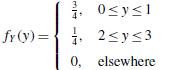
If the pdf for Y isFind and graph FY (y).
Recall the game of Keno described in Question 3.2.26. The following are all the payoffs on a $1 wager where the player has bet on ten numbers. Calculate E(X), where the random variable X denotes the amount of money won.
Let the random variable Y have the uniform distribution over [a, b]; that is, fY (y) = 1/ b−a for a ≤ y ≤ b. Find E(Y) using Definition 3.5.1. Also, deduce the value of E(Y), knowing that the expected value is the center of gravity of fY (y).
Show that the expected value associated with the exponential distribution, fY (y) =λe −λy, y>0, is 1/λ, where λ is a positive constant.
Show thatIs a valid pdf but that Y does not have a finite expected value.
Based on recent experience, ten-year-old passenger cars going through a motor vehicle inspection station have an 80% chance of passing the emissions test. Suppose that two hundred such cars will be checked out next week. Write two formulas that show the number of cars that are expected to pass.
Suppose that fifteen observations are chosen at random from the pdf fY (y) =3y2, 0≤ y ≤1. Let X denote the number that lie in the interval (1/2, 1). Find E(X).
A city has 74,806 registered automobiles. Each is required to display a bumper decal showing that the owner paid an annual wheel tax of $50. By law, new decals need to be purchased during the month of the owner’s birthday. How much wheel tax revenue can the city expect to receive in November?
Regulators have found that twenty-three of the sixty-eight investment companies that filed for bankruptcy in the past five years failed because of fraud, not for reasons related to the economy. Suppose that nine additional firms will be added to the bankruptcy rolls during the next quarter. How
An urn contains four chips numbered 1 through 4. Two are drawn without replacement. Let the random variable X denote the larger of the two. Find E(X).
A fair coin is tossed three times. Let the random variable X denote the total number of heads that appear times the number of heads that appear on the first and third tosses. Find E(X).
How much would you have to ante to make the St. Petersburg game “fair” (recall Example 3.5.5) if the most you could win was $1000? That is, the payoffs are $2k for 1≤k ≤9, and $1000 for k ≥10.
The roulette wheels in Monte Carlo typically have a 0 but not a 00. What is the expected value of betting on red in this case? If a trip to Monte Carlo costs $3000, how much would a player have to bet to justify gambling there rather than Las Vegas?
For the St. Petersburg problem (Example 3.5.5), find the expected payoff if(a) The amounts won are ck instead of 2k, where 0<c < 2.(b)The amounts won are log 2k. [This was a modification suggested by D. Bernoulli (a nephew of James Bernoulli) to take into account the decreasing marginal
A fair die is rolled three times. Let X denote the number of different faces showing, X = 1, 2, 3. Find E(X).
Two distinct integers are chosen at random from the first five positive integers. Compute the expected value of the absolute value of the difference of the two numbers.
Suppose that two evenly matched teams are playing in the World Series. On the average, how many games will be played? (The winner is the first team to get four victories.) Assume that each game is an independent event.
An urn contains one white chip and one black chip. A chip is drawn at random. If it is white, the “game” is over; if it is black, that chip and another black one are put into the urn. Then another chip is drawn at random from the “new” urn and the same rules for ending or continuing the
A random sample of size n is drawn without replacement from an urn containing r red chips and w white chips. Define the random variable X to be the number of red chips in the sample. Use the summation technique described in Theorem 3.5.1 to prove that E(X) = rn/(r +w).
Given that X is a nonnegative, integer-valued random variable, show that
Find the median for each of the following pdfs: (a) fY (y)=(θ +1)yθ , 0≤ y ≤1, where θ >0 (b) fY (y)= y + 1/2 , 0≤ y ≤1
Suppose X is a binomial random variable with n =10 and p = 2/5. What is the expected value of 3X −4?
The pdf describing the daily profit, X, earned by Acme Industries was derived in Example 3.3.7. Find the company’s average daily profit.
Let Y have probability density functionfY (y)=2(1ˆ’ y), 0‰¤ y ‰¤1Suppose that W =Y 2, in which caseFind E (W) in two different ways.
A tool and die company makes castings for steel stress-monitoring gauges. Their annual profit, Q, in hundreds of thousands of dollars, can be expressed as a function of product demand, y: Q(y) =2(1−e−2y) Suppose that the demand (in thousands) for their castings follows an exponential pdf, fY
A box is to be constructed so that its height is five inches and its base is Y inches by Y inches, where Y is a random variable described by the pdf, fY (y) = 6y (1− y), 0< y
Grades on the last Economics 301 exam were not very good. Graphed, their distribution had a shape similar to the pdfAs a way of “curving” the results, the professor announces that he will replace each person’s grade, Y, with a new grade, g(Y), where g(Y) = 10 √ Y. Will the professor’s
If Y has probability density function fY (y)=2y, 0≤ y ≤1 then E(Y) = 2/3 . Define the random variable W to be the squared deviation of Y from its mean, that is, W = (Y – 2/3) 2. Find E (W).
The hypotenuse, Y, of the isosceles right triangle shown is a random variable having a uniform pdf over the interval [6, 10]. Calculate the expected value of the triangle€™s area. Do not leave the answer as a function of a.
An urn contains n chips numbered 1 through n. Assume that the probability of choosing chip i is equal to ki, i = 1, 2. . . n. If one chip is drawn, calculate E (1 X), where the random variable X denotes the number showing on the chip selected. [Hint/ Recall that the sum of the first n integers is
In the game of red ball, two drawings are made without replacement from a bowl that has four white ping pong balls and two red ping-pong balls. The amount won is determined by how many of the red balls are selected. For a $5 bet, a player can opt to be paid under either Rule A or Rule B, as shown.
Suppose a life insurance company sells a $50,000, five-year term policy to a twenty-five-year-old woman. At the beginning of each year the woman is alive, the company collects a premium of $P. The probability that the woman dies and the company pays the $50,000 is given in the table below. So, for
A manufacturer has one hundred memory chips in stock, 4% of which are likely to be defective (based on past experience). A random sample of twenty chips is selected and shipped to a factory that assembles laptops. Let X denote the number of computers that receive faulty memory chips. Find E(X).
Records show that 642 new students have just entered a certain Florida school district. Of those 642, a total of 125 are not adequately vaccinated. The district’s physician has scheduled a day for students to receive whatever shots they might need. On any given day, though, 12% of the
Calculate E(Y) for the following pdfs:(a) fY (y)=3(1− y)2, 0≤ y ≤1(b) fY (y)=4ye−2y , y ≥0(c)(d) fY (y)=sin y, 0≤ y ≤ π/2
Recall Question 3.4.4, where the length of time Y (in years) that a malaria patient spends in remission has pdf fY (y) = 1/9 y2, 0 ≤ y ≤ 3. What is the average length of time that such a patient spends in remission?
Find Var(X) for the urn problem of Example 3.6.1 if the sampling is done with replacement.
Let Y be a random variable whose pdf is given by fY (y) =5y4, 0≤ y ≤1. Use Theorem 3.6.1 to find Var(Y).
Suppose that Y is an exponential random variable, so fY (y) =λe−λy, y ≥0. Show that the variance of Y is 1/λ2.
Suppose that Y is an exponential random variable with λ = 2 (recall Question 3.6.11). Find P[Y > E(Y) + 2 √Var(Y)].
Let X be a random variable with finite mean μ. Define for every real number a, g(a)= E [(X −a)2]. Show Thatg (a)= E[(X −μ)2]+(μ−a)2.What is another name for min g(a)?
If Y denotes a temperature recorded in degrees Fahrenheit, then 5/9 (Y −32) is the corresponding temperature in degrees Celsius. If the standard deviation for a set of temperatures is 15.7◦F, what is the standard deviation of the equivalent Celsius temperatures?
If E (W) =μ and Var (W) =σ2, show that
Suppose U is a uniform random variable over [0, 1]. (a) Show that Y =(b−a)U +a is uniform over [a, b]. (b) Use part (a) and Question 3.6.4 to find the variance of Y .
Recovering small quantities of calcium in the presence of magnesium can be a difficult problem for an analytical chemist. Suppose the amount of calcium Y to be recovered is uniformly distributed between 4 and 7 mg. The amount of calcium recovered by one method is the random variable W1 =0.2281+
Let Y be a uniform random variable defined over the interval (0, 2). Find an expression for the rth moment of Y about the origin. Also, use the binomial expansion as described in the Comment to find E [(Y −μ) 6].
Find the variance of Y if
Find the coefficient of skewness for an exponential random variable having the pdf fY (y)=e−y , y >0
Calculate the coefficient of kurtosis for a uniform random variable defined over the unit interval, fY (y) =1, for 0≤ y ≤1.
Suppose that W is a random variable for which E [(W −μ) 3] =10 and E (W3) =4. Is it possible that μ=2?
If Y = aX + b, a > 0, show that Y has the same coefficients of skewness and kurtosis as X.
Let Y be the random variable of Question 3.4.6, where for a positive integer n, fY (y) = (n + 2) (n + 1)yn (1− y), 0≤ y ≤1. (a) Find Var(Y). (b) For any positive integer k, find the kth moment around the origin.
Suppose that the random variable Y is described by the pdf fY (y)=c · y−6, y >1 (a) Find c. (b) What is the highest moment of Y that exists?
Ten equally qualified applicants, six men and four women, apply for three lab technician positions. Unable to justify choosing any of the applicants over all the others, the personnel director decides to select the three at random. Let X denote the number of men hired. Compute the standard
Compute the variance for a uniform random variable defined on the unit interval.
Use Theorem 3.6.1 to find the variance of the random variable Y, where fY (y)=3(1− y)2, 0< y
IfFor what value of k does Var(Y)=2?
Calculate the standard deviation, σ, for the random variable Y whose pdf has the graph shown below:
Consider the pdf defined byShow that (a) ʃ1 ˆž 1 fY (y) dy=1, (b) E(Y) =2, (c) Var(Y) is not finite.
If p X,Y (x, y) = cxy at the points (1, 1), (2, 1), (2, 2), and (3, 1), and equals 0 elsewhere, find c.
Suppose that X and Y have a bivariate uniform density over the unit square:(a) Find c.(b) Find P (0
Let X and Y have the joint pdf f X,Y (x, y) = 2e−(x+y), 0
Showing 50800 - 50900
of 88243
First
502
503
504
505
506
507
508
509
510
511
512
513
514
515
516
Last
Step by Step Answers

 Get 50% OFF
Claim Now
Get 50% OFF
Claim Now


.png)
.png)
-1.png)
-2.png)
.png)
.png)
.png)
.png)
.png)
.png)

.png)
.png)
.png)
.png)
.png)
.png)
.png)
.png)


