







Question: By the principles used in modeling the string it can be shown that small free vertical vibrations of a uniform elastic beam (Fig. 292) are
By the principles used in modeling the string it can be shown that small free vertical vibrations of a uniform elastic beam (Fig. 292) are modeled by the fourth-order PDE
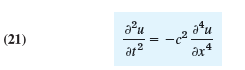
where c2 = EI/ÏA (E = Young€™s modulus of elasticity, I = moment of intertia of the cross section with respect to the y-axis in the figure, Ï = density, A = cross-sectional area).
Compare the results of Probs. 17 and 7. What is the basic difference between the frequencies of the normal modes of the vibrating string and the vibrating beam?
Data from Prob. 17
By the principles used in modeling the string it can be shown that small free vertical vibrations of a uniform elastic beam (Fig. 292) are modeled by the fourth-order PDE
where c2 = EI/ÏA (E = Young€™s modulus of elasticity, I = moment of intertia of the cross section with respect to the y-axis in the figure, Ï = density, A = cross-sectional area).
Find the solution of (21) that satisfies the conditions in Prob. 16 as well as the initial condition
u(x, 0) = f(x) = x(L - x).
Data from Prob 17
By the principles used in modeling the string it can be shown that small free vertical vibrations of a uniform elastic beam (Fig. 292) are modeled by the fourth-order PDE
where c2 = EI/ÏA (E = Young€™s modulus of elasticity, I = moment of intertia of the cross section with respect to the y-axis in the figure, Ï = density, A = cross-sectional area).
Find the solution of (21) that satisfies the conditions in Prob. 16 as well as the initial condition
u(x, 0) = f(x) = x(L - x).
Data from Prob. 16
By the principles used in modeling the string it can be shown that small free vertical vibrations of a uniform elastic beam (Fig. 292) are modeled by the fourth-order PDE
where c2 = EI/ÏA (E = Young€™s modulus of elasticity, I = moment of intertia of the cross section with respect to the y-axis in the figure, Ï = density, A = cross-sectional area).
Find solutions un = Fn(x)Gn(t) of (21) corresponding to zero initial velocity and satisfying the boundary conditions

u(0, t) = 0, u(L, t) = 0
(ends simply supported for all times t),
uxx = (0, t) = 0, uxx (L, t) = 0
(zero moments, hence zero curvature, at the ends).
, at2 a .4 |(21) , at2 a .4 |(21)
Step by Step Solution
3.40 Rating (162 Votes )
There are 3 Steps involved in it
For the string the fre... View full answer

Get step-by-step solutions from verified subject matter experts
 Study Help