







Question: Make the given changes in the indicated examples of this section, and then solve the resulting problems. In Example 6, change 2.00 s to 2.50s.
Make the given changes in the indicated examples of this section, and then solve the resulting problems.
In Example 6, change 2.00 s to 2.50s.
Data from Example 6
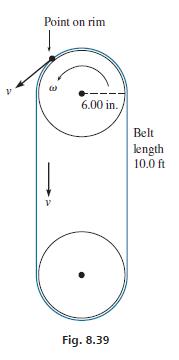
A pulley belt 10.0 ft long takes 2.00 s to make one complete revolution. The radius of the pulley is 6.00 in. What is the angular velocity (in revolutions per minute) of a point on the rim of the pulley? See Fig. 8.39.
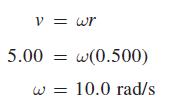
Because the linear velocity of a point on the rim of the pulley is the same as the velocity of the belt, v = 10.0ft/2.00s = 5.00ft/s. The radius of the pulley is r = 6.00 in. = 0.500 ft, and we can find ω by substituting into Eq. (8.11). This gives us
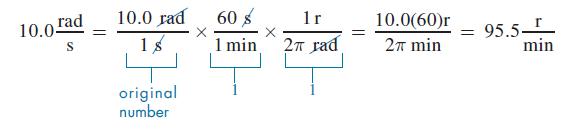
To convert this answer to revolutions per minute, we use the procedure described in Section 1.4:
V v = wr 5.00 || W= w(0.500) 10.0 rad/s
Step by Step Solution
3.39 Rating (152 Votes )
There are 3 Steps involved in it
In Example 6 we have Length of the pulley belt L 100 ft Time for one complete revoluti... View full answer

Get step-by-step solutions from verified subject matter experts
 Study Help