New Semester
Started
Get
50% OFF
Study Help!
--h --m --s
Claim Now
Question Answers
Textbooks
Find textbooks, questions and answers
Oops, something went wrong!
Change your search query and then try again
S
Books
FREE
Study Help
Expert Questions
Accounting
General Management
Mathematics
Finance
Organizational Behaviour
Law
Physics
Operating System
Management Leadership
Sociology
Programming
Marketing
Database
Computer Network
Economics
Textbooks Solutions
Accounting
Managerial Accounting
Management Leadership
Cost Accounting
Statistics
Business Law
Corporate Finance
Finance
Economics
Auditing
Tutors
Online Tutors
Find a Tutor
Hire a Tutor
Become a Tutor
AI Tutor
AI Study Planner
NEW
Sell Books
Search
Search
Sign In
Register
study help
business
accounting information systems
Basic System Analysis 2nd Edition S. Palani - Solutions
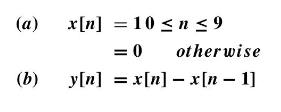
Find the \(z\)-transform of (a) (b) x[n] =10 n9 = 0 otherwise y[n] =x[n] - x[n 1]
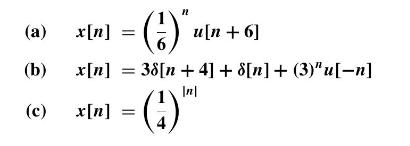
Find the unilateral \(z\)-transform and the \(\mathrm{ROC}\) for the following sequences: (a) (b) (c) (..)" x[n] = 38[n+4] + 8[n] + (3)" u[-n] |n| u[n + 6] ()
By applying properties of \(z\)-transform find the \(z\)-transform of the following sequences given \(x[n] \stackrel{Z}{\longleftrightarrow} \frac{z}{\left(z^{2}+2ight)}\)(a) \(y[n]=x[n-3]\)(b) \(y[n]=n x[n]\)(c) \(\quad y[n]=x[n+1]+x[n-1]\)(d) \(x[n]=2^{n} x[n]\)(e) \(x[n]=(n-2) x[n-1]\)(f)
Using partial function find the inverse \(z\)-transform H[z]= = (1-z-+z) (1-z-) (1 - 2z-) (1 - 4z-) ROC: 2 |z| < 4
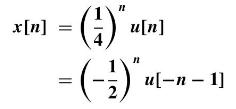
Find the \(z\)-transform of the following sequence? x[n] (-:-) = (-1)" u[n] u[-n - 1]
Find the \(z\)-transform of(a) \(\quad x[n]=2^{n} u[n-2]\)(b) \(\quad x[n]=\left(\frac{1}{4}ight)^{n} u[-n]\)
Find the \(z\)-transform of(a) \(\quad x[n]=(n-4) u[n-4]\)(b) \(\quad x[n]=u[n]-u[n-4]\)(c) \(\quad x[n]=(n-4) u[n]\)(d) \(\quad x[n]=n[u[n]-u[n-4]]\)
Consider the algebraic expression for the \(z\)-transform of \(x[n]\)How many different ROCs could correspond the \(X[z]\) ? (1-z-) x[n] = (1 + z) (1 z + z)
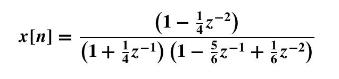
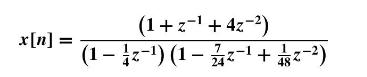
Consider the algebraic expression for the zz-transform of x[n]x[n]ROC: \(|z|>\frac{1}{4}\). Find whether the system is causal and stable. x[1]= = (1+z+ 4z-) 7 (1-z-) (1-z- + 2-2) zzz-1+z-)
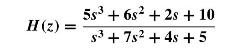
Consider the following T.F. of continuous-time system. Form the state space equation in canonical form II model. H (2) = 5s+68 +2s + 10 s3 +7s + 4s +5
A system with impulse response \(h[n]=5(3)^{n} u[n-1]\) produces on output \(y[n]=(-4)^{n} u[n-1]\).Determine the input \(x[n]\).
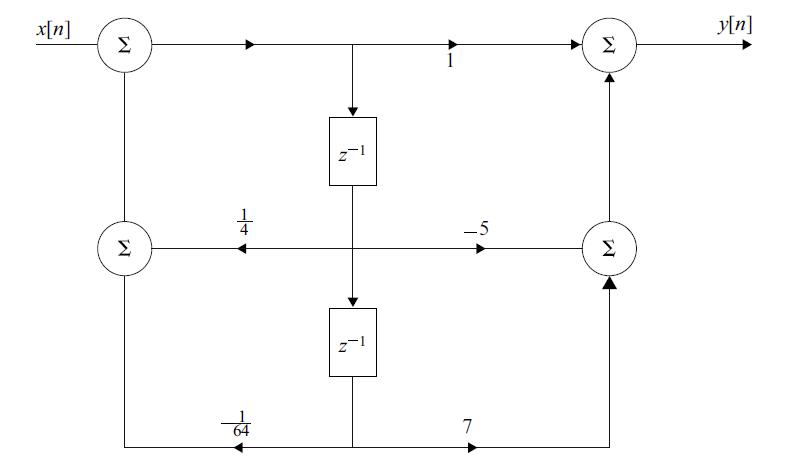
Consider the causal LTID system represented in block diagram shown in Fig. 5.19. (a) Determine the difference equation relating the output \(\boldsymbol{y}[\boldsymbol{n}]\) and input \(\boldsymbol{x}[\boldsymbol{n}]\) and (b) Is the system stable?Figure 5.19(a)\[y[n]-\frac{1}{4}
Consider the following difference equation.\[y[n]-y[n-1]-2 y[n-2]=x[n]+2 x[n-1]\]The initial conditions are \(y[-1]=1\) and \(y[-2]=2\). The input \(x[n]=u[n]\). Find (a) Zero input response, (b) Zero state response, (c) Natural response, (d) Forced response, and (e) Total response.
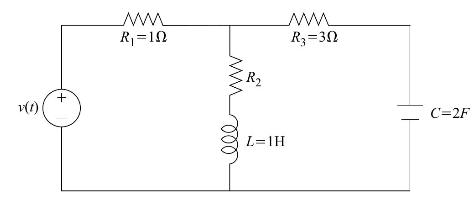
Consider the electrical circuit shown in Fig. 6.22. Form the state space equation. + ww R = 10 ww ele R L=1H ww R=30 C=2F
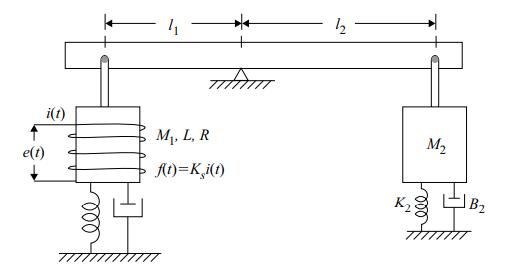
Consider the mechanical system shown in Fig. 6.21. Form the state space equation. i (t) e (t) K 4 M, L, R f(t) = Kgi(t) b M2 K2gHB2
For each of the following difference equations determine the output response \(y[n]\) ?(a) \(y[n]-4 y[n-1]=x[n]\) with \(y[-1]=2\) and \(x[n]=\left(\frac{1}{3}ight)^{n} u[n]\)(b) \(y[n]+\frac{1}{3} y[n-1]=x[n]-\frac{1}{3} x[n-1]\) with \(y[-1]=1\) and \(x[n]=u[n]\)
Define the state of a system?
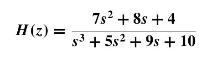
Consider the following T.F. of a certain continuous-time system. Form the state space equations in canonical form I model. H(z) = 7s +8s +4 s3 +55 + 9s + 10
What do you understand by state vector?
What is state space?
What is state-space equations?
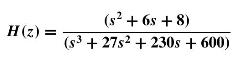
Consider the following T.F. of continuous-time system. Form the state space equation in diagonal form model. H(z) = (s +65 + 8) (s3+27s +230s + 600)
What is vector-matrix differential/difference equation?
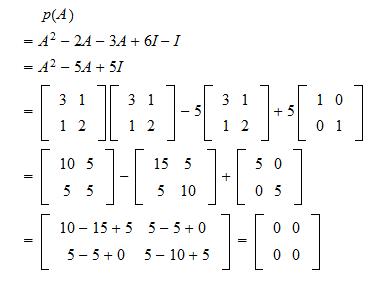
What is Cayley-Hamilton theorem? p(A) = A - 24-34 + 6I - I = A - 5A +5I || || || 3 1 3 1 12 12 HI H 10 5 5 5 15 5 5 10 3 1 12 50 05 H ]-[:] 00 = 00 10 + [ 11 +5 01 10-15+5 5-5+0 5-5+0 5-10+5
What is state transition matrix STM?
Consider the following differential equation\[\frac{d^{3} y}{d t^{3}}-5 \frac{d^{2} y}{d t^{2}}+6 \frac{d y}{d t}+7 y=2 \frac{d x}{d t}+5 x(t)\]Form the state space equation in canonical form II model.
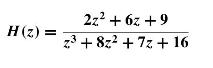
Consider the following T.F. of a certain discrete system given below. Form the state space equation of canonical form I model. H(z) = 2z + 6z +9 z + 8z +7z+ 16
Consider the following T.F. of a certain discrete-time system\[H(z)=\frac{4 z^{2}-5 z+10}{z^{3}+2 z^{2}-7 z+9}\]Form the state variable equation in canonical form II model.
What physical variables are chosen as state variables in electrical circuit and mechanical systems?
What are the advantages of state space model over that of transfer function model?
A certain discrete-time system is described by the following difference equation.\[\begin{aligned}& y[n]-\frac{1}{12} y[n-1]-\frac{1}{6} y[n-2]+\frac{1}{48} y[n-3] \\& \quad=x[n-1]-\frac{3}{8} x[n-2]+\frac{1}{32} x[n-3]\end{aligned}\]Determine the system T.F. Form the state space equation in the
For a particular system, the \(\boldsymbol{A}\) matrix is represented in more than one form. What is the nature of characteristic equation?
Find the state equation of a continuous-time LTI system described by\[\ddot{y}(t)+3 \dot{y}(t)+2 y(t)=x(t)\]
How are signals classified?
What are odd and even signals?
How even and odd components of a signal are mathematically expressed for CT and DT signals?
What are periodic and non-periodic signals?
What is the fundamental period of a periodic signal? What is fundamental frequency?
What are power and energy signals?
What is the condition that the signal \(x(t)=e^{a t} u(t)\) to be energy signal?
Is the unit step signal an energy signal?
Determine the power and RMS value of the signal \(x(t)=e^{j a t} \cos \omega_{0} t\) ?
What is the periodicity of \(x(t)=e^{j 100 \pi t+30^{\circ}}\) ?
Find the equivalence of the following functions (a) \(\delta(a t)\); (b) \(\delta(-t)\); (c) \(t \delta(t)\);(d) \(\sin t \delta(t)\); (e) \(\cos \delta(t)\); (f) \(x(t) \delta\left(t-t_{0}ight)\) ?
How do you represent an everlasting exponential \(\boldsymbol{e}^{-a t}\) for \(\boldsymbol{t} \geq \mathbf{0}\) and \(\boldsymbol{t}
Find the value of \(\frac{t^{2}+5}{t^{2}+6} \delta(t-2)\).
Find the odd and even components of \(e^{j 2 t}\).
Define system. What is linear system?
What is time invariant and time varying system?
What are static and dynamic systems?
What are causal and non-causal systems?
What are stable and unstable systems?
What are invertible and non-invertible systems?
State the condition for a discrete-time LTI system to be causal and stable.
Check whether the system having the input-output relation\[y(t)=\int_{-\infty}^{t} x(\tau) d \tau\]is linear and time invariant.
Check whether the system classified by\[y(y)=e^{x(t)}\]is time invariant or not?
Determine whether the system described by the following input-output relationship is linear and causal.\[y(t)=x(-t)\]
Is the system \(y(t)=\cos t x(t-5)\) time invariant?
What do you understand by transient response of a system?
What are first- and second-order systems?
What is a standard second-order system equation?
What are the time domain specifications of a first-order system?
What are the time domain specifications of a second-order system?
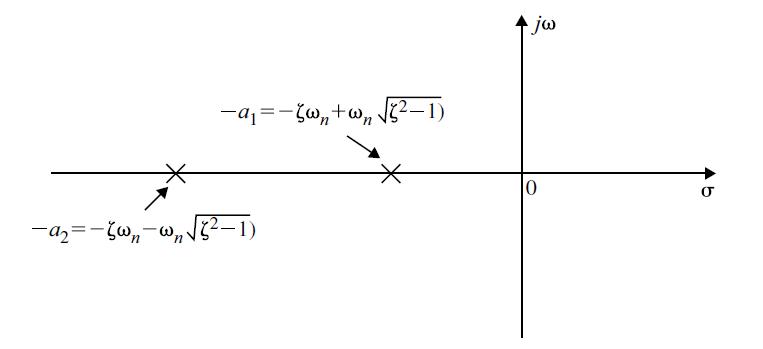
How second-order system is identified according to the nature of damping?
How location of poles are identified in the \(s\)-plane according to the \(+v e\) damping?
What do you understand by negative damping?
What is damped frequency of oscillation of a second-order system?
How system function is defined for a CT system?
A triangular pulse signal \(x(t)\) is shown in Fig. 1.77a. Sketch the following signals. (a) \(x(4 t)\); (b) \(x(4 t+3)\); (c) \(x(-3 t+2)\); (d) \(x\left(\frac{t}{3}+2ight)\); (e) \(x(3 t-2)\); (f) \(x(4 t+\) 3) \(+x(2 t)\). . 0| . (I) =y_ (17 +)==v
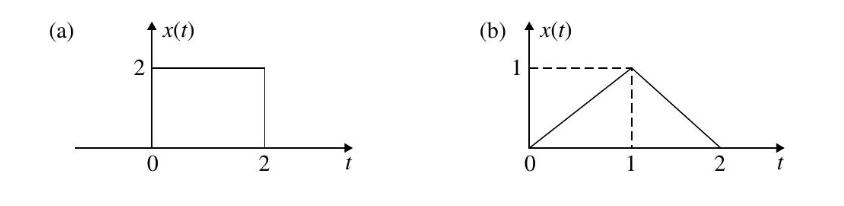
Sketch the even and odd parts of the following signals shown in Fig. 1.88a and \(\mathrm{b}\).Figure 1.88 a and b (a) 2 0 x(t) 2 (b) 1 + x(t) 0 2 t
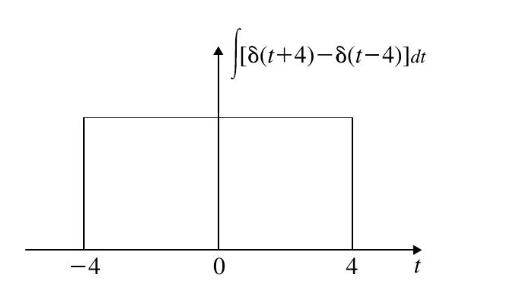
Consider the CT signal \(x(t)=\delta(t+4)-\delta(t-4)\). Sketch \(\int x(t) d t\) and find the energy of the signal (Fig. 1.89).Energy \(E=8\).Figure 1.89 -4 [18(1+4)-8(1-4)]dt 0 4 +
Find the energy of the following CT signal. (a) \(x(t)=\operatorname{tri3} t\); (b) \(x(t)=2 \operatorname{tri}\left(\frac{t}{2}ight)\);(c) \(x(t)=\operatorname{rect10t}\); (d) \(2 \operatorname{rect}\left(\frac{t}{10}ight)\); (e) \(\sin (2 \pi t)\).
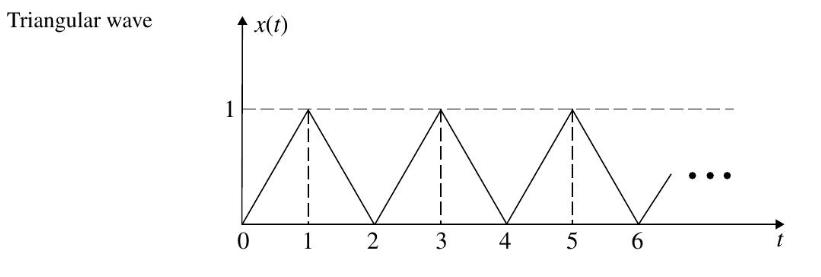
What is the average power of the triangular wave shown in Fig. 1.90? Average power \(P=\frac{1}{3} \mathrm{~W}\).Figure 1.90 Triangular wave 1 0 x(t) 1 M 3 4 2 5 6 t
(a) The system response requires memory. Hence, it is dynamic.(b) The output depends on the present input only. Hence, it is causal.(c) The output due to the delayed input is not the same as the delayed output. Hence, it is time variant.(d) The weighted sum of the output is the same as output due
(a) The output response depends on present and past inputs. Hence, it is dynamic.(b) The output does not depend on the future input. Hence, it is causal.(c) The output due to the delayed input is same as the delayed output. Hence, the system is time invariant.(d) The weighted sum of the output is
(a) The system response depends on present, past, and future inputs. Hence, it is dynamic.(b) Since the output depends on the future input, it is non-causal.(c) The output due to the delayed input is not the same as the delayed output. Hence, the system is time variant.(d) The weighted sum of the
The output depends on present, past, and future inputs.(a) The system is dynamic.(b) The system is non-causal.(c) The output due to the delayed input is not the same as the delayed output. The system is time variant.(d) The weighted sum of the output will be the same as output due to the weighted
(a) The system requires memory and so it is dynamic.(b) The output depends on present and past inputs. Hence, it is causal.(c) The output due to the delayed input is same as the delayed output. The system is time invariant.(d) The weighted sum of the output is the same as output due to the weighted
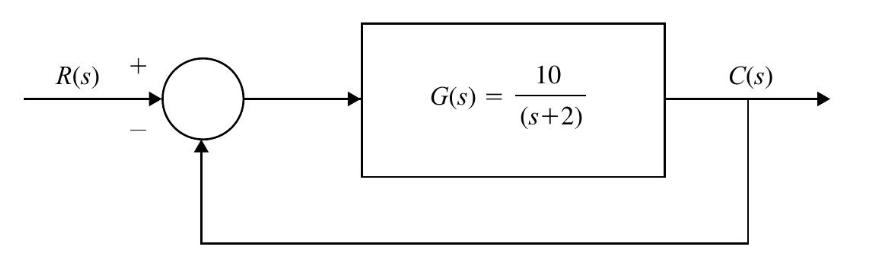
Consider the system shown in Fig. 1.91. Derive expressions for the impulse response and unit step response of the system. Also determine \(T, t_{r}, t_{d}, t_{s}\) for step input.Figure 1.91 R(s) G(s) = 10 (s+2) C(s)
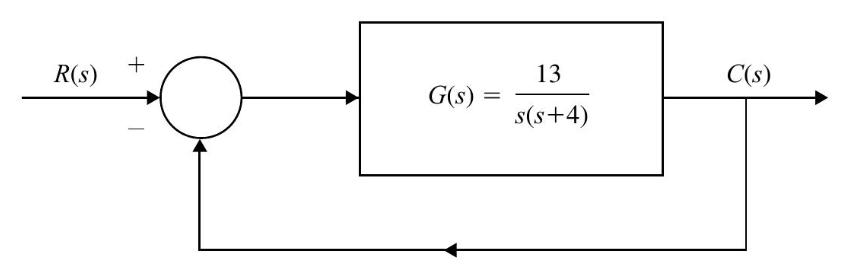
Consider the second-order system shown in Fig. 1.92. The system is subjected to unit step input. Derive the expression for the output variable. Determine the time domain specifications \(T, t_{s}, t_{d}, M_{p}\), and \(t_{p}\). What is the resonant peak \(M_{r}\) and resonant frequency
Explain why system is tested for impulse and step inputs.
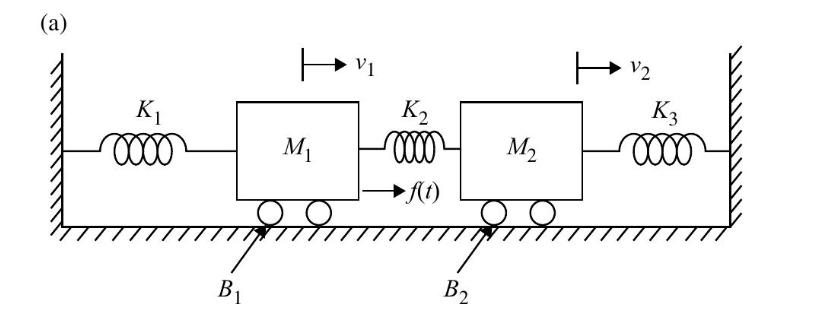
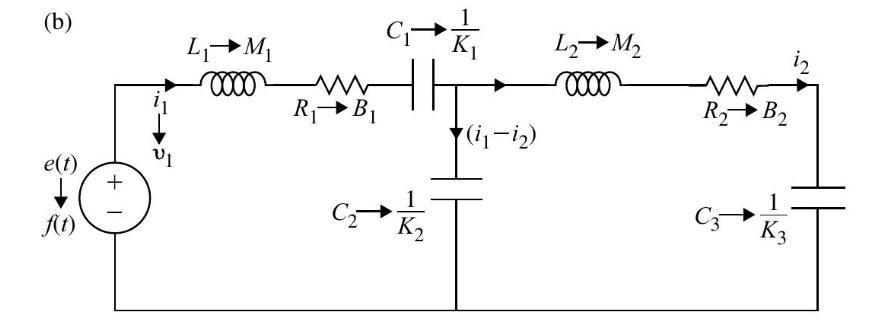
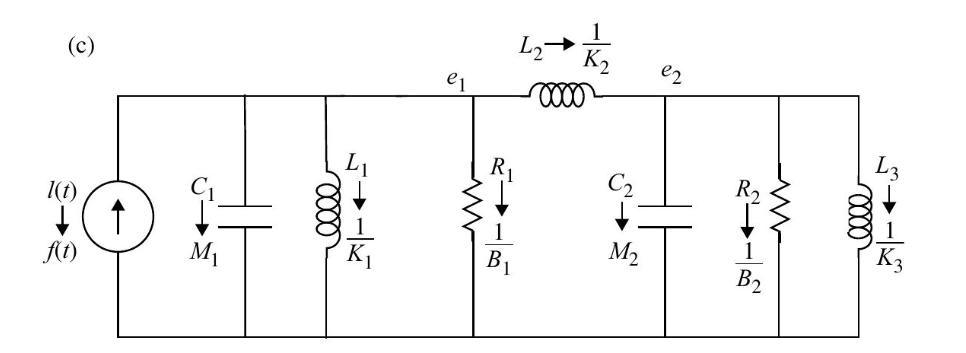
Consider the mechanical system shown in Fig. 1.93a. Draw the F-V and F-I analogous circuits and verify by writing down the dynamic equations describing the given system and the electric circuit so drawn.Figure 1.93a (a) K 0000 B V M K 0000 f(t) B M | 1/2 K3 -0000
What is a Fourier series?
What are the different forms of representing Fourier series?
Give mathematical expression for trigonometric Fourier series?
What is the effect of symmetry in trigonometric Fourier series?
What is half wave symmetry?
Give the mathematical expression for the cosine Fourier series.
Give mathematical expression for the exponential Fourier series?
How the coefficients of exponential Fourier series are related to the coefficients of trigonometric and cosine Fourier series?
Why exponential Fourier series is preferred to represent the Fourier series?
What do you understand by Fourier spectrum?
What do you understand by existence of Fourier series?
What do you understand by convergence of Fourier series in the mean?
What are Dirichlet conditions?
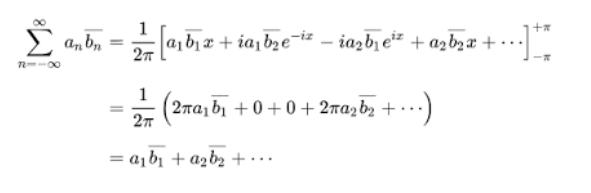
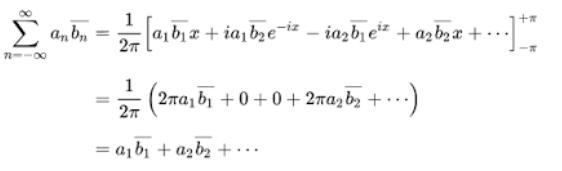
What do you understand by Parseval's theorem as applied to Fourier series?Parseval's theorem anb = [bx + abiz iabjez +abr +.. 12/17 2 1 2 = ab + ab+... (2 b + 0 + 0 + 2;by + ... by + + ...) +* -R
What are differentiating and integrating properties of Fourier series?
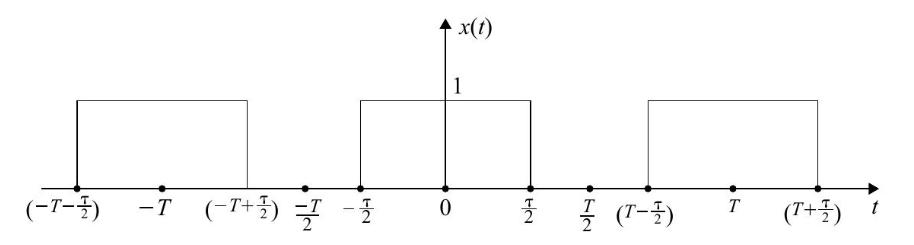
Determine the trigonometric and exponential Fourier series representation of the signal \(x(t)\) shown in Fig. 2.14?Figure 2.14(a) Trigonometric or quadratic Fourier series.(b) Exponential Fourier series. (-T-) -I (-+) T I 4x(1) 1 0 HN T (T-) T (T+1) 1
Consider the following signal:\[x(t)=\cos \left(\frac{1}{3} t+30^{\circ}ight)+\sin \left(\frac{2}{5} t+60^{\circ}ight)\]Determine (a) Whether the signal is periodic, (b) Find the fundamental period and frequency, (c) What harmonics are present in \(x(t)\), (d) Determine the coefficients of
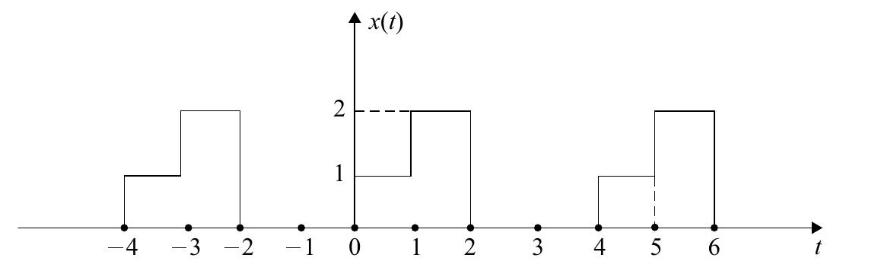
For the signal shown in Fig. 2.15, determine the coefficients of exponential Fourier series. -4 - -3 -2 - 1 2 1 4 x(t) -1 0 | 1 2 93 3 4 5 6 t
Showing 3600 - 3700
of 5294
First
30
31
32
33
34
35
36
37
38
39
40
41
42
43
44
Last
Step by Step Answers

 Get 50% OFF
Claim Now
Get 50% OFF
Claim Now