New Semester
Started
Get
50% OFF
Study Help!
--h --m --s
Claim Now
Question Answers
Textbooks
Find textbooks, questions and answers
Oops, something went wrong!
Change your search query and then try again
S
Books
FREE
Study Help
Expert Questions
Accounting
General Management
Mathematics
Finance
Organizational Behaviour
Law
Physics
Operating System
Management Leadership
Sociology
Programming
Marketing
Database
Computer Network
Economics
Textbooks Solutions
Accounting
Managerial Accounting
Management Leadership
Cost Accounting
Statistics
Business Law
Corporate Finance
Finance
Economics
Auditing
Tutors
Online Tutors
Find a Tutor
Hire a Tutor
Become a Tutor
AI Tutor
AI Study Planner
NEW
Sell Books
Search
Search
Sign In
Register
study help
business
accounting information systems
Accounting Information Systems 9th Edition Pat Wheeler, Ulric J Gelinas, Richard B Dull - Solutions
a. What are the five generic control goals of information processes?b. Explain the difference between the following pairs of control goals:(1) ensure input validity and ensure input accuracy; (2) ensure input completeness and ensure input accuracy; (3) ensure input completeness and ensure update
What are the differences among the control environment, a pervasive control plan, and a business process control plan?
Distinguish among preventive, detective, and corrective control plans.
What are the four major categories of pervasive controls? Why would the PCAOB refer to these controls as entity level?
What are the differences among a pervasive control plan, a business process control plan, an application control plan, and an IT control process?
Segregation of duties consists of separating what four basic functions?Briefly define each function.
Describe some compensating controls that can be used to reduce exposures when it is not possible to properly segregate duties in a small organization.
What are policy controls plans? How do policies differ from laws?
Describe one specific control for each of the following categories of personnel control plans: hiring, retention, development, management, and termination.
Why should an organization conduct monitoring activities? Who should conduct monitoring activities? What are the two major steps in monitoring?
What is IT governance?
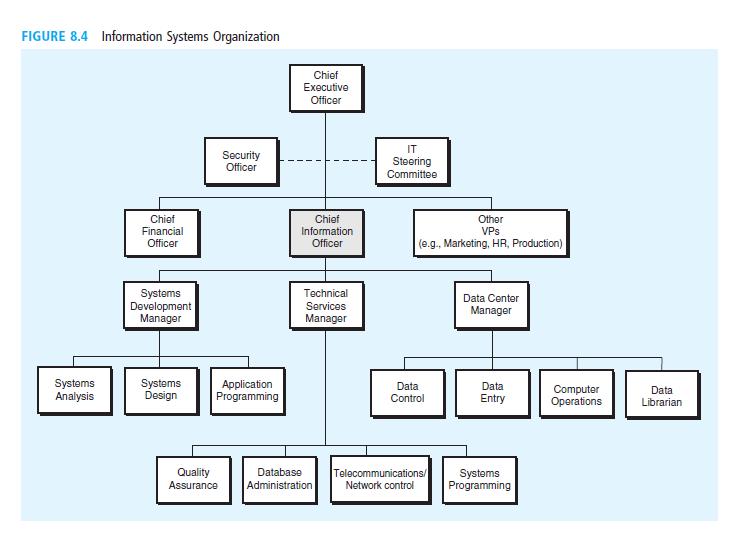
What are the principal responsibilities, major duties, and key control concerns of each functional position pictured in Figure 8.4 on page 266 (i.e., the organization chart of an IT organization)? FIGURE 8.4 Information Systems Organization Systems Analysis Chief Financial Officer Systems
What is the COBIT framework? How does it differ from the COSO framework?
Name the four IT resources as delineated by COBIT.
How does the COBIT framework define control?
What are the four IT control process domains?
What is the purpose of the strategic IT plan?
What are the major elements of the strategic IT plan?
What functions within the IT organization should be segregated?
What is the systems development life cycle (SDLC)?
What types of documentation constitute a well-documented application?Describe each type.
What are the four stages through which a program should move as it is being developed? Who should have responsibility for each of those phases?
What steps are commonly included in a business continuity planning methodology?
Describe backup and recovery.
Describe continuous data protection (CDP), a mirror site, and electronic vaulting.
What is the difference between a hot site and a cold site?
Describe a denial-of-service attack. What controls are recommended to detect or correct such an attack?
Describe the three layers of controls for restricting physical access to computer facilities.
Explain biometric identification systems.
Describe the four layers of controls for restricting logical access to stored programs, data, and documentation.
Distinguish firewalls, intrusion detections systems (IDS), and intrusion prevention systems (IPS).
Describe library controls.
What is data encryption? What is the key in encryption? What is the algorithm in encryption? What is public-key cryptography?
Define computer hacking and cracking, and explain how they undermine resource security.
Provide three examples of hacking techniques. Which technique do you think is most prevalent?
a. What kinds of damage are included in the category of environmental hazards?b. What control plans are designed to prevent such hazards from occurring?c. What control plans are designed to limit losses resulting from such hazards or to recover from such hazards?
1. Using a key of 2, and an algorithm of add and subtract from alternating letters starting with addition, encrypt the word “accounting.”2. Using a key of 3 and an algorithm of add and subtract from alternating letters starting with subtraction, encrypt your professor’s last name.
Explain the difference between the category of business process control and application control.
Describe the relationship between the control matrix and the systems flowchart.
How could the control matrix be used to recommend changes in the system to improve control of that system?
How would the control matrix be useful in evaluating control effectiveness, control efficiency, and control redundancy? Include in your answer a definition of these three terms.
What are the steps involved in preparing a control matrix?
Describe the four common programmed edit checks.
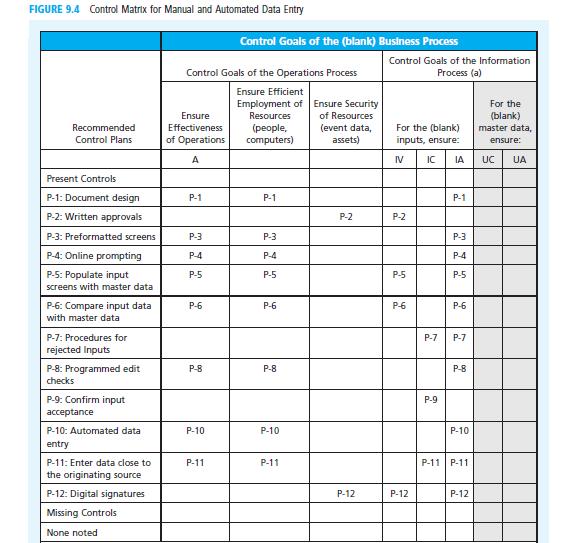
How do the 12 control plans listed in Figure 9.4 (pg. 311) work? FIGURE 9.4 Control Matrix for Manual and Automated Data Entry Recommended Control Plans Present Controls P-1: Document design P-2: Written approvals P-3: Preformatted screens P-4: Online prompting P-5: Populate input screens with
Name and explain four different types of batch totals that could be calculated in a batch processing system.
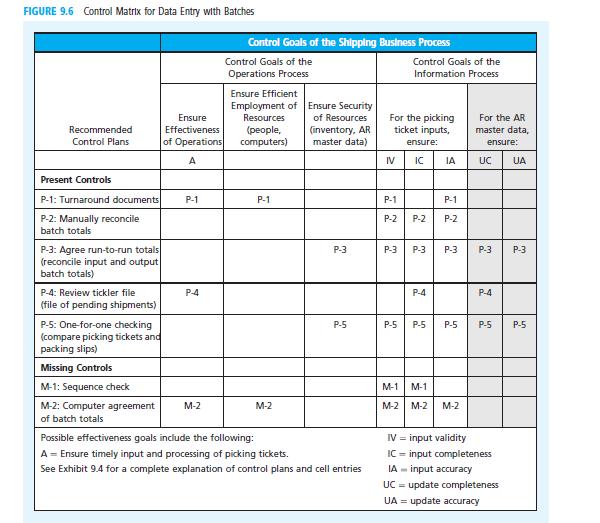
How do the seven control plans (five present, two missing) listed in Figure 9.6(pg. 320) work? FIGURE 9.6 Control Matrix for Data Entry with Batches Recommended Control Plans Present Controls P-1: Turnaround documents P-1 P-2: Manually reconcile batch totals P-3: Agree run-to-run totals (reconcile
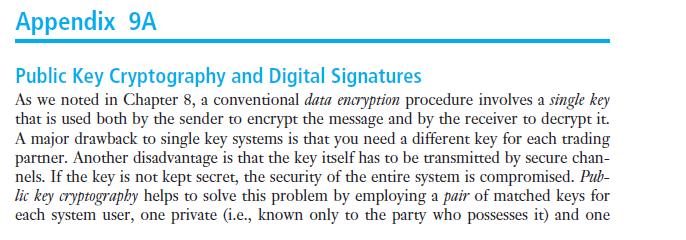
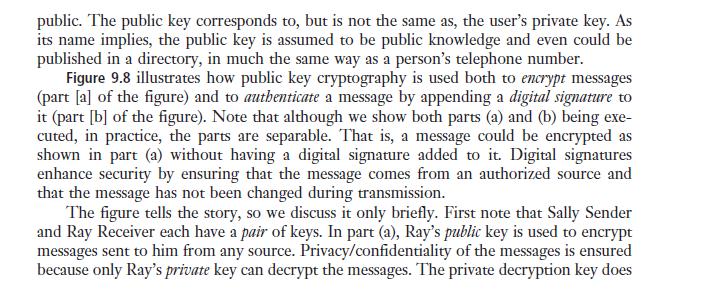
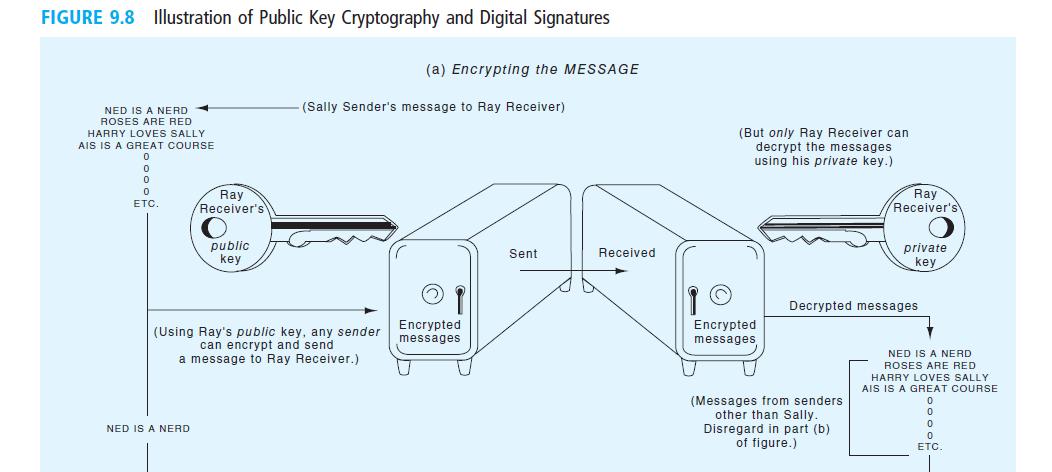
Referring to Appendix 9A, distinguish among data encryption, public key cryptography, and digital signatures. Appendix 9A Public Key Cryptography and Digital Signatures As we noted in Chapter 8, a conventional data encryption procedure involves a single key that is used both by the sender to
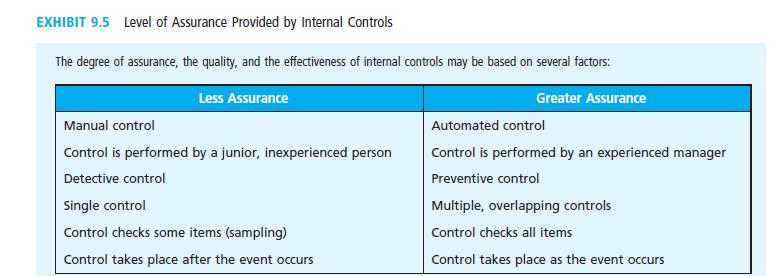
Refer to Exhibit 9.5 (pg. 325). For each pair of factors, describe why you believe the factor in the right column provides a higher level of assurance.That is, why do these factors indicate a stronger control? EXHIBIT 9.5 Level of Assurance Provided by Internal Controls The degree of assurance, the
What is the order entry/sales (OE/S) process?
What are the major functions performed by the OE/S process? Explain each function.
With what internal and external entities does the OE/S process interact?
What “key players” would you expect to find in the marketing function’s organization chart?
Describe Web 2.0. What tools does Web 2.0 include?
Describe several ways that data warehouses and data mining can support the marketing function.
Distinguish buy-side and sell-side systems.
Discuss how customer relationship management (CRM) systems aid a customer service representative (CSR) in providing service to customers.
The following questions concern the logical description of the OE/S process:a. What are the three major processes? Describe the subsidiary processes of each major process.b. What three exception routines may occur when a customer order is processed?
Describe the five master data stores employed by the OE/S process.
a. Explain how bar code readers work.b. Explain how optical character recognition (OCR) works and how it differs from bar code technology.c. Explain how scanners are used to capture data.
How is digital image processing used to support the input and management of images and documents?
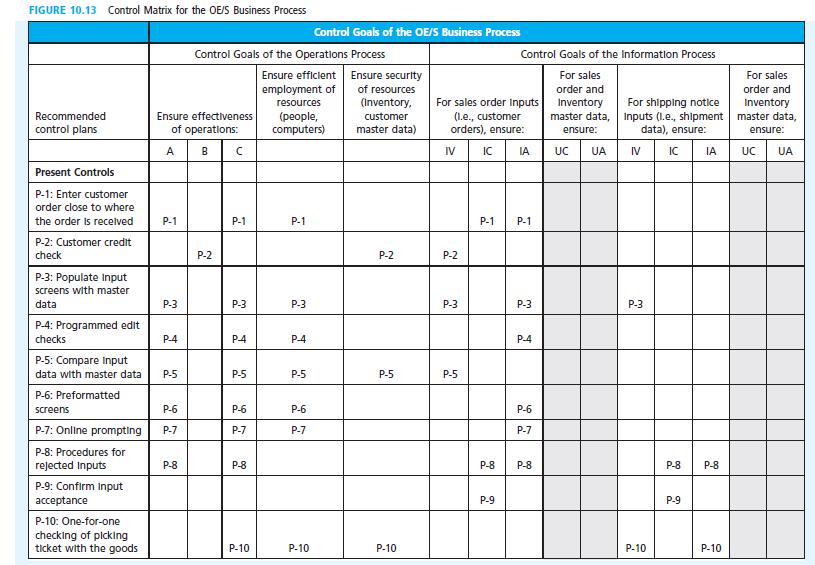
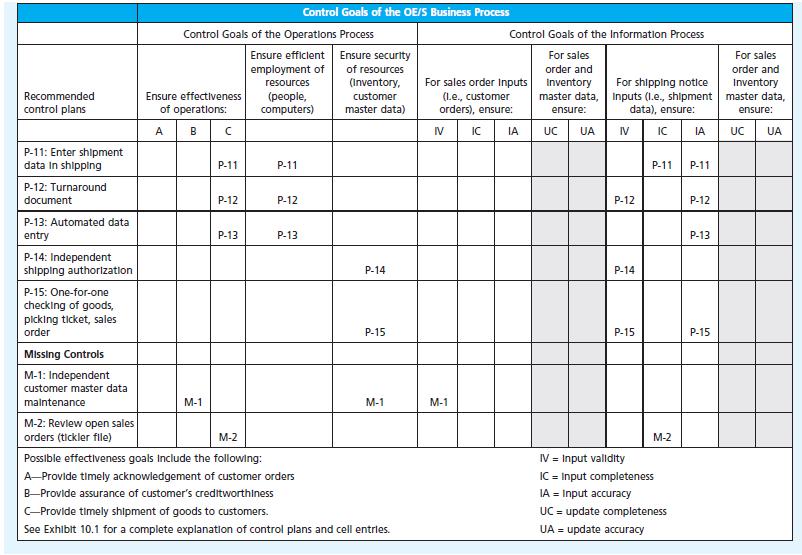
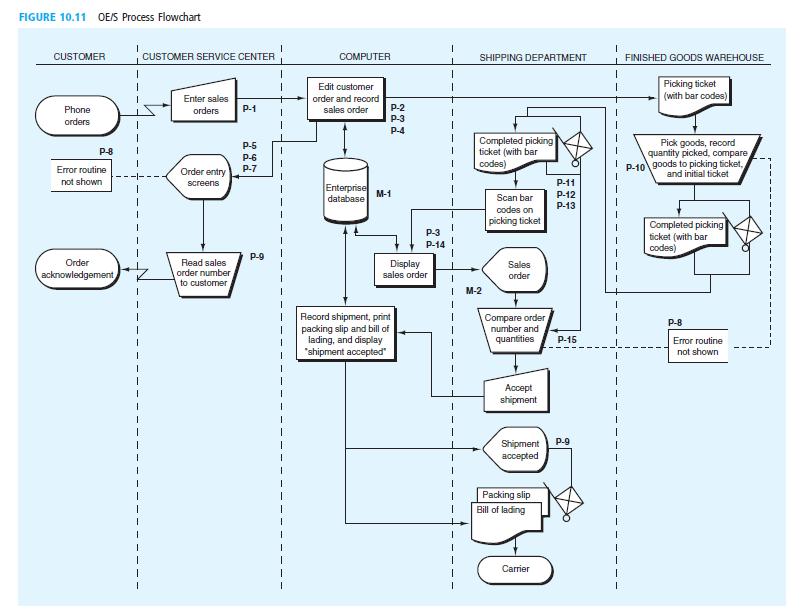
Each of the following questions concerns the control matrix for the OE/S process (Figure 10.13) and its related annotated systems flowchart (Figure 10.11):a. What three effectiveness goals does the matrix show?b. In this process, what particular resources do we want to secure?c. What are the two
Describe the key control plans associated with OE/S processes.
Describe the impact that entity-level controls (i.e., control environment, pervasive controls, and general/IT general controls) can have on the effectiveness of OE/S business process controls.
What is the billing/accounts receivable/cash receipts (B/AR/CR) process?
What primary activities does the B/AR/CR process perform? Explain each activity.
With what internal and external entities does the B/AR/CR interact?
What functions are typically segregated in the B/AR/CR process?
What are electronic bill presentment and payment (EBPP) systems? How do they reduce costs and accelerate cash flows?
Describe several ways that companies have reduced the float connected with cash receipts.
What is lapping? What controls can prevent or detect lapping?
What is a remittance advice (RA)?
What is accounts receivable master data?
What are the major features of a balance-forward and an open-item accounts receivable system?
What are the differences between a post-billing system and a pre-billing system?
What characterizes a valid shipping notice and invoice?
What are the key controls associated with the billing business process?Explain each control.
What characterizes a valid RA (i.e., cash receipt)?
What are the key controls associated with the cash receipts business process?Explain each control.
Describe the impact that entity-level controls (i.e., control environment, pervasive controls, general/IT general controls) can have on the B/AR/CR business process controls.
What is the purchasing process?
What primary functions does the purchasing process perform? Explain each function.
With what internal and external entities does the purchasing process interact?
What are the fundamental responsibilities of each position: purchasing manager, buyer, and receiving supervisor?
Describe supply chain management (SCM).
Describe the five basic components of the Supply Chain Operations Reference(SCOR) model.
How does SCM software support SCM?
Describe Vendor Managed Inventory (VMI), Co-Managed Inventory, Collaborative Forecasting and Replenishment (CFAR), and Collaborative Planning Forecasting and Replenishment (CPFR).
What is the bullwhip effect?
What three major logical processes does the purchasing process perform?Describe each process.
Describe how radio-frequency identification (RFID) works.
What types of frauds are typically found in the purchasing process?
What are the typical effectiveness goals of the purchasing process? Provide an example illustrating each goal.
What characterizes a valid PO input? What characterizes a valid vendor packing slip input?
What are the key control plans associated with the purchasing process?Describe how each works and what it accomplishes.
Describe the impact that entity-level controls (i.e., control environment, pervasive controls, and general/IT general controls) can have on the effectiveness of purchasing business process controls.
What is the AP/CD process?
What primary functions does the AP/CD process perform? Explain each function.
With what internal and external entities does the AP/CD process interact?
What are the fundamental responsibilities of the accounts payable department and the cashier?
What major logical processes does the AP/CD process perform? Explain each.
Showing 3400 - 3500
of 5294
First
28
29
30
31
32
33
34
35
36
37
38
39
40
41
42
Last
Step by Step Answers

 Get 50% OFF
Claim Now
Get 50% OFF
Claim Now