New Semester
Started
Get
50% OFF
Study Help!
--h --m --s
Claim Now
Question Answers
Textbooks
Find textbooks, questions and answers
Oops, something went wrong!
Change your search query and then try again
S
Books
FREE
Study Help
Expert Questions
Accounting
General Management
Mathematics
Finance
Organizational Behaviour
Law
Physics
Operating System
Management Leadership
Sociology
Programming
Marketing
Database
Computer Network
Economics
Textbooks Solutions
Accounting
Managerial Accounting
Management Leadership
Cost Accounting
Statistics
Business Law
Corporate Finance
Finance
Economics
Auditing
Tutors
Online Tutors
Find a Tutor
Hire a Tutor
Become a Tutor
AI Tutor
AI Study Planner
NEW
Sell Books
Search
Search
Sign In
Register
study help
business
accounting information systems
Basic System Analysis 2nd Edition S. Palani - Solutions
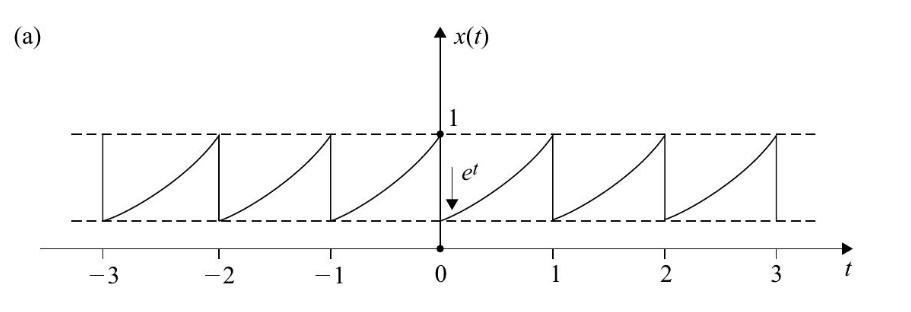
Find the exponential Fourier series coefficients for the signal shown in Fig. 2.16a and plot its amplitude and phase spectrum.Figure 2.16a (a) -3 -2 - 1 - x (t) 1 0 et 1 2 4 3 +
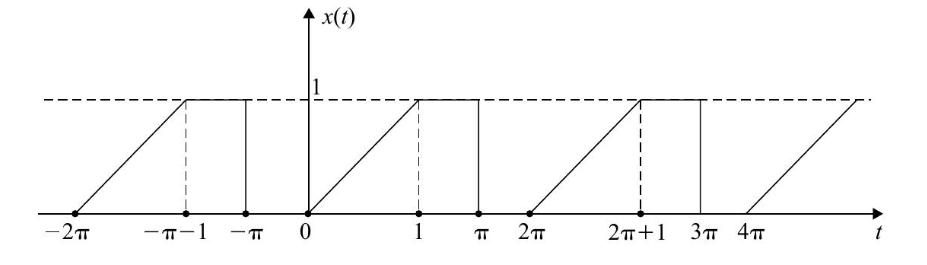
Consider the signal shown in Fig. 2.17. Determine the exponential Fourier series coefficients. - 2 x(1) 1 2 --1 - 0 2+1 3 4
What do you understand by Fourier transform pair?
How Fourier transform is different from Fourier series?
How FT is developed from Fourier series?
How Parseval's Energy theorem is defined for the frequency domain signal?
What is the connection between Fourier transform and Laplace transform?
What do you understand by frequency response?
What is the condition required for the convergence of Fourier transform?
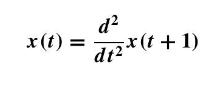
What is the Fourier transform of x (t) = d dt2x (t+1)
What is the FT of \(x(t)=[\delta(t+5)-\delta(t-5)]\) ?
Find the FT of \(x(t)=2[u(t+6)-u(t-6)]\) ?
Consider the following continuous time signal.\[x(t)=e^{-5|t|}\]Find the FT. Hence determine the FT of \(t x(t)\).
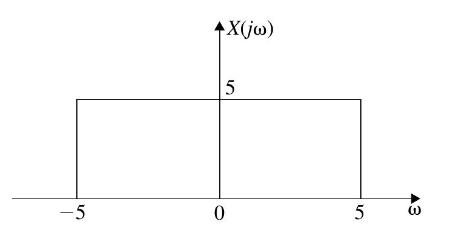
For the signal \(X(j \omega)\) shown in Fig. 3.43, determine \(x(t)\) ?\[x(t)=5 \frac{\sin 5 t}{\pi t}\] -5 X(jw) 5 0 5 3
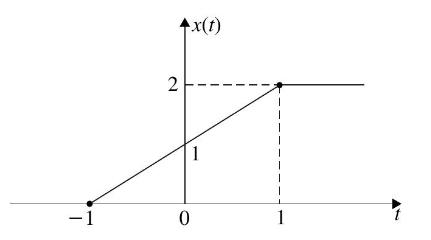
Consider the signal shown in Fig. 3.44. Find \(X(j \omega)\). What is the FT for \(x(t-1)\) ? - 1 - +x(t) 2 1 0 1
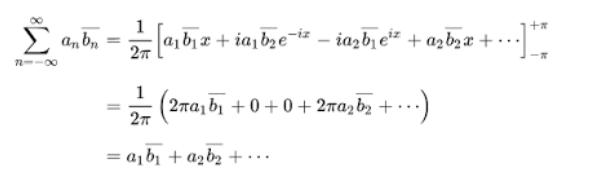
Using Parseval's theorem evaluate energy in the frequency domain. 8118 anbn = . |aybz + iayb2e-iz iagbjeiz + agb2% + - 27 (2 by + 0 + 0 + 2magby + ...) = ab + agbg + ..
\[x(t)=e^{-2 t} u(t)\]and\[\begin{aligned}h(t) & =e^{-4 t} u(t) \\y(t) & =x(t) * h(t)\end{aligned}\]Using time convolution property find \(Y(j \omega)\) and \(y(t)\) ?
\[\begin{aligned}x(t) & =e^{-2 t} u(t) \\h(t) & =e^{-2 t} u(t) \\y(t) & =x(t) * h(t)\end{aligned}\]Find \(Y(j \omega)\) and hence \(y(t)\) ?
A certain LTIC system is described by the following differential equation.\[\frac{d y(t)}{d t}+2 y(t)=x(t)\]Determine the Frequency response and the Impulse response?
What is Laplace Transform?
What do you understand by LT pair?
What is bilateral Laplace transform?
What is unilateral Laplace transform?
What do you understand by LT of right-sided and left-sided signals?
What is the connection between LT and FT?
What do you understand by Region of convergence?
How do you identify the ROC of a causal signal?
How do you identify the ROC of a non-causal (left-sided) signal?
How do you identify the ROC of a bilateral Laplace transform?}
State any three properties of ROC.
Identify the ROCs for the following signals and sketch them in the \(s\)-plane?
Sketch the ROC of the following T.F. of a certain causal system and mark the poles and zeros.
Sketch the ROC of a non-causal system whose T.F. is given as\[H(s)=\frac{(s+2)(s-2)}{s(s+1)(s-3)}\]Mark the poles and zeros of \(H(s)\).
What are initial and final value theorems?
Find the initial and final values of \(x(t)\) whose LT is given by\[X(s)=\frac{(s+5)}{\left(s^{2}+3 s+2ight)}\]
Define transfer function.
Define poles and zeros of the transfer function.
What do you understand by eigenfunction of a system?
What do you understand by causality of an LTIC system?
What do you understand by stability of an LTIC system?
What do you understand by impulse response and step response of a system?
What do you understand by zero state response and zero input response?
What do you understand by natural response and forced response of a system?
Are zero input response and natural response and zero state response and forced response same?
Comment on the solutions of the differential equations obtained by the application of LT and by classical method?
What do you understand by asymptotic stability of an LTIC system?
What do you understand by marginal stability of the system?
What do you understand by zero input stability and zero state stability?
What do you understand by bounded input and bounded output (BIBO) stability?
Find the transfer function of LTI system described by the differential equation\[\frac{d^{2} y(t)}{d t^{2}}+3 \frac{d y(t)}{d t}+2 y(t)=2 \frac{d x(t)}{d t}-3 x(t)\]
Find the LT of \(x(t)=e^{-a t} u(t)\).
Given \(\frac{d y(t)}{d t}+6 y(t)=x(t)\). Find the T.F.
Find the LT of \(\boldsymbol{u}(\boldsymbol{t})-\boldsymbol{u}(\boldsymbol{t}-\boldsymbol{a})\) where \(\boldsymbol{a}>\mathbf{0}\).
Find the LT of \(x(t)=+e^{-3 t} u(t-10)\) ?
Find the LT of \(x(t)=\delta(t-5)\) ?
What is the output of a system whose impulse response \(h(t)=e^{-a t}\) for a delta input?
Find the LT of \(\boldsymbol{x}(\boldsymbol{t})=\boldsymbol{t} \boldsymbol{e}^{-\boldsymbol{a t}} \boldsymbol{u}(\boldsymbol{t})\) where \(\boldsymbol{a}>\mathbf{0}\) ?
Determine the LT of\[\begin{array}{rlrl}x(t) & =2 t & 0 \leq t \leq 1 \\& =0 & & \text { otherwise. }\end{array}\]
Determine the output response of the system whose impulse response \(h(t)=e^{-a t} u(t)\) for the step input?
Find the LT and sketch the pole-zero plot with ROC for \(x(t)=\) \(\left(e^{-2 t}+e^{-3 t}ight) u(t)\).
Find the LT of \(x(t)=\delta(t+1)+\delta(t-1)\) and its ROC.
Find the LT of \(x(t)=u(t+1)+u(t-1)\) and its ROC.
Using convolution property determine \(y(t)=x_{1}(t) * x_{2}(t)\) where \(x_{1}(t)=e^{-2 t} u(t)\) and \(x_{2}(t)=e^{-3 t} u(t) ?\)
Find the zero input response for the following differential equation.
Find the LT \(\frac{d}{d t}[\delta(t)]\).
Find the LT of \(x(t)=\delta(2 t)\).
Find the LT of integrated value of \(\delta(t)\).
Why integrators are preferred to differentiators in structure realization?
What are the components required in structure realization?
Mention the steps to be followed to realize a transposed structure from canonic form structure.
Find the LT of \(x(t)=e^{-2|t|}\) and ROC.
Find the LT of \(x(t)=e^{2|t|}\) and ROC.
Find the LT of \(x(t)=\left(e^{2 t}+e^{-2 t}ight) u(t)\) and the ROC.
Find the LT of \(x(t)=\left(e^{2 t}+e^{-2 t}ight) u(-t)\) and the ROC.
Find the LT of \(x(t)=\left(e^{-6 t}+e^{-4 t}ight) u(t)+\left(e^{-3 t}+e^{-2 t}ight) u(-t)\)
Find the LT of\[x(t)=\left(e^{-6 t}+e^{-3 t}ight) u(t)+\left(e^{-4 t}+e^{-2 t}ight) u(-t)\]
Find the LT and ROC of\[x(t)=e^{-3 t}[u(t)-u(t-4)]\]
Find the inverse LT of the following \(X(s)\) for all possible combinations of ROC.\[X(s)=\frac{4}{(s+1)(s-3)}\]
Find the inverse LT of \(X(s)\) X (s) = 8(s + 2) s(s + 4s + 8) ROC: Re s> -2
Find the inverse LT of X (s) = s + 2s + 4) (s + 2) (s + 4) ROC: Res> -2
Find the inverse LT of X (s) = (s + 3s + 1) (s + 5s + 6) ROC: Re s> -2
Find the inverse \(\mathbf{L T}\) of X (s) = S +85 +21s + 16 (s + 7s +12) ROC: Re s> -3
Find the inverse LT of X (s) = 10se-2s +5e-4s +6 (s + 13s +40) ROC: Re s> -5
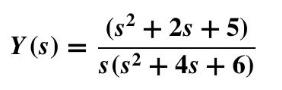
Find the initial and final value of \(y(t)\) if its \(\mathrm{LT} Y(s)\) is given by Y(s) = (s + 2s + 5) s (s + 4s + 6)
Using convolution property of LT find \(y(t)=x_{1}(t) * x_{2}(t)\)\[\begin{aligned}& x_{1}(t)=u(t) \\& x_{2}(t)=e^{-2 t} u(t)\end{aligned}\]
Consider an LTIC system described by the following differential equation\[\frac{d^{2} y(t)}{d t^{2}}+\frac{d y(t)}{d t}-6 y(t)=X(s)\]Determine(a) the system transfer function.(b) impulse response of the system if it is causal.(c) Impulse response of the system if the system is stable.(d) Impulse
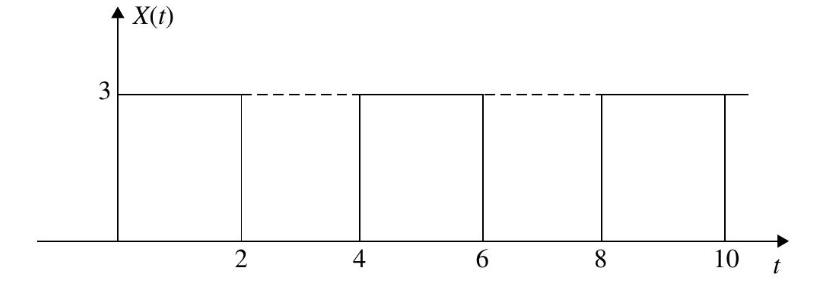
Determine the LT of the periodic signal shown in Fig. 4.53. 3 X(t) 2 1 1 I 4 6 8 10 t
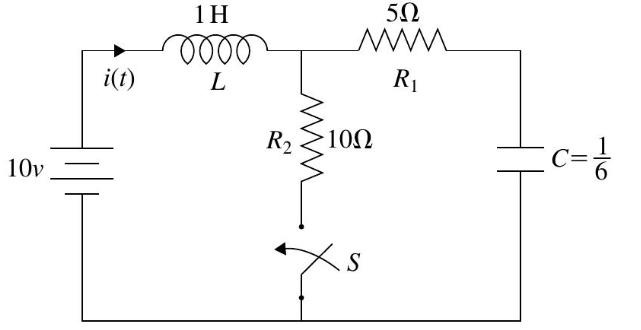
Consider the electrical circuit shown in Fig. 4.54. Initially the switch \(S\) is closed. Derive an expression for the current through the inductor as soon as the switch is open. \(i(t)=\left[3 e^{-3 t}-2 e^{-2 t}ight] u(t)\)Figure 4.54 10v i(t) 1H oooo L 5 www R R100 10 S C c=1 /
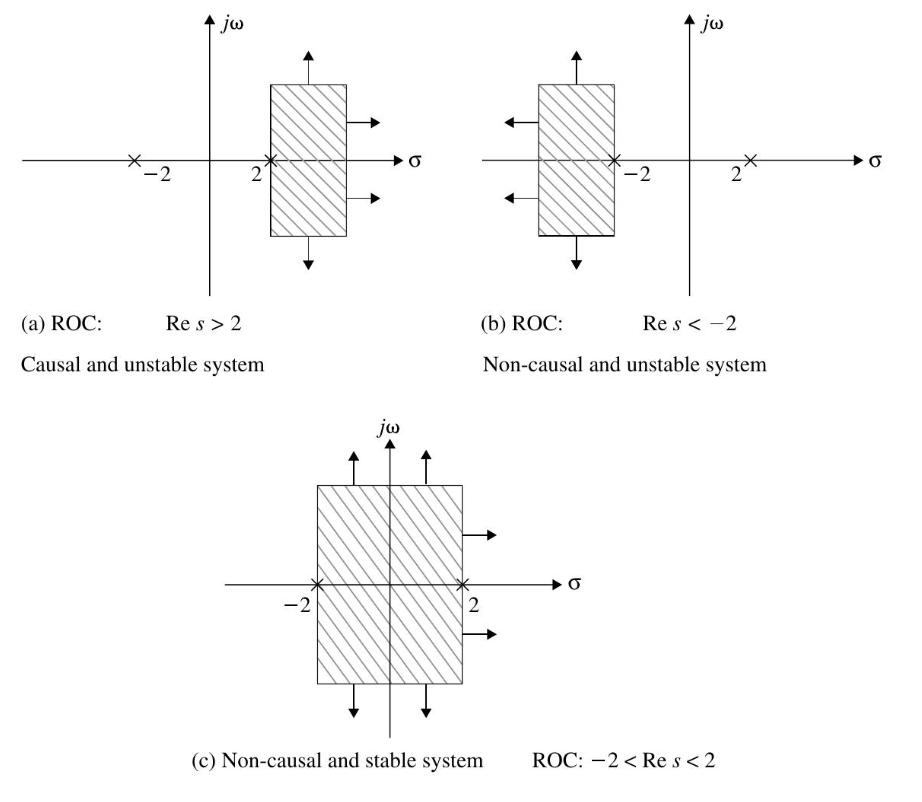
Find the Laplace inverse of the following \(\boldsymbol{X}(\boldsymbol{s})\) (Fig. 4.55): -2 jw 2 (a) ROC: Res > 2 Causal and unstable system -2 jw 0 2 (c) Non-causal and stable system -2 a jw (b) ROC: Res < -2 Non-causal and unstable system * ROC: 2 < Res < 2 2 O
Solve the following differential equation:\[\frac{d^{2} y(t)}{d t^{2}}+\frac{d y(t)}{d t}-2 y(t)=\frac{d x(t)}{d t}+x(t)\]The initial conditions are \(y\left(0^{-}ight)=2 ; \frac{d y\left(0^{-}ight)}{d t}=1\). The input is(a) \(x(t)=\delta(t)\) an impulse(b) \(x(t)=u(t)\) unit step(c) \(x(t)=e^{-4
The unit step response of a certain LTIC system \(y(t)=10 e^{-5 t}\). Find (a) The impulse response? (b) The response due to the exponential decay \(x(t)=e^{-3 t} u(t)\)?
The impulse response of a certain system is \(h_{1}(t)=e^{-3 t} u(t)\) and the impulse response of another system is \(h_{2}(t)=e^{-5 t} u(t)\). These two systems are connected in cascade. Find (a) The impulse response of the cascade-connected system (b). Is the system BIBO stable?
The impulse response of a certain system is given by \(h(t)=e^{-5 t}\). The system is excited by \(x(t)=e^{-3 t} u(t)+e^{-2 t} u(-t)\). Determine(a) The system transfer function(b) Output of the system \(y(t)\)(c) BIBO stability of the system.
A certain LTIC system is described by the following differential equation\[\frac{d^{2} y(t)}{d t^{2}}-\frac{d y(t)}{d t}-30 y(t)=\frac{d x(t)}{d t}+4 x(t)\]The system is subjected to the following input.\[x(t)=e^{-3 t} u(t)\]The initial conditions are \(y\left(0^{+}ight)=3\) and
A certain LTIC system is described by the following differential equation:\[\frac{d^{2} y(t)}{d t^{2}}+3 \frac{d y(t)}{d t}+2 y(t)=\frac{d x(t)}{d t}+4 x(t)\]where \(x(t)=e^{-3 t} u(t)\). The initial conditions are \(y\left(0^{-}ight)=2\) and \(\dot{y}\left(0^{-}ight)=1\). Determine(a) The
An LTIC system has the following T.F\[H(s)=\frac{(s+10)}{s^{3}+5 s^{2}+3 s+4}\]Determine the differential equation.
An LTIC system is described by the following differential equation\[\frac{d^{2} y(t)}{d t^{2}}+4 \frac{d y(t)}{d t}+3 y(t)=\frac{d x(t)}{d t}+4 x(t)\]The system is in the initial state of \(y\left(0^{-}ight)=2\) and \(\dot{y}\left(0^{-}ight)=1\). The system is excited with the input \(x(t)=e^{-5
The impulse response of an LTIC system is given by \(x(t)=e^{-2 t} u(t)\). Is the system causal?
The impulse response of an LTIC system is given by \(h(t)=\boldsymbol{e}^{-2|t|}\). Is the system causal.
Consider the following transfer function.\[X(s)=\frac{1}{(s+2)(s-2)}\]Identify all possible ROCs and in each case find the impulse response, stability, and causality. Also sketch the ROC. (1) ROC: \(\operatorname{Re} s>+2\)
Showing 3700 - 3800
of 5294
First
31
32
33
34
35
36
37
38
39
40
41
42
43
44
45
Last
Step by Step Answers

 Get 50% OFF
Claim Now
Get 50% OFF
Claim Now