New Semester
Started
Get
50% OFF
Study Help!
--h --m --s
Claim Now
Question Answers
Textbooks
Find textbooks, questions and answers
Oops, something went wrong!
Change your search query and then try again
S
Books
FREE
Study Help
Expert Questions
Accounting
General Management
Mathematics
Finance
Organizational Behaviour
Law
Physics
Operating System
Management Leadership
Sociology
Programming
Marketing
Database
Computer Network
Economics
Textbooks Solutions
Accounting
Managerial Accounting
Management Leadership
Cost Accounting
Statistics
Business Law
Corporate Finance
Finance
Economics
Auditing
Tutors
Online Tutors
Find a Tutor
Hire a Tutor
Become a Tutor
AI Tutor
AI Study Planner
NEW
Sell Books
Search
Search
Sign In
Register
study help
business
business process management
Operations And Process Management 6th Edition Nigel Slack, Alistair Brandon-Jones - Solutions
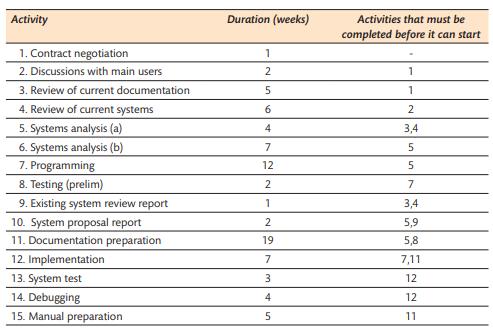
The table below shows the activities, their durations and predecessors for designing, writing and installing a bespoke computer database for a commercial bank headquartered in Singapore. Draw a network diagram (activity-on-node) for the project and calculate the fastest time in which the operation
‘Funding comes from a variety of sources to restore the literally irreplaceable buildings we work on. We try to reconcile historical integrity with commercial viability and rely on the support of volunteers. So, we need to involve all stakeholders all the way through the project.’ (Janine
Revisit the Vasa project case example in this chapter.a) Who should be held responsible for this disaster!b) What can be learned from the Vasa story for the management of different kinds of modern-day projects!
What methods of project learning have been designed into the project process to increase the likelihood of improved performance for subsequent projects!
Have mechanisms for intervening in the project to bring it back to plan been put in place!
Are there mechanisms in place to monitor the progress of the project!
Have potential resource and time schedule constraints been built into the project plan!
Have project planning tools, such as critical path analysis or PERT, been considered for the project!
Have the relationships and dependencies between activities been identified and summarised in the form of a simple network diagram!
Is there sufficient confidence in the time and resource estimates to make planning meaningful!
Have all activity times and resources been estimated using the best possible information!
Have all activities been identified and expressed in the form of a work breakdown structure!
Is sufficient effort being put into the project planning process!
Has the overall strategy of the project been defined in terms of its overall approach, its significant milestones and any decision gateways (stagegates) that may occur in the project!
Has the scope of the project been defined, including technical specifications, limits and exclusions!
Have the objectives of the project been defined, particularly in terms of the relative importance of cost, time and quality!
Do managers have methods of stakeholder mapping, consultation and management!
Do managers understand the importance of identifying and managing project stakeholders!
Do managers understand the key characteristics of the project environment in terms of internal, business, economic–political and geo-social dimensions!
For this particular project, does the project manager have skills appropriate for the project’s intrinsic degree of difficulty!
Is the activity of project management understood and are managers clear on the key responsibilities of a project manager!
Do managers understand the implications of differences in levels of project innovation, pace and complexity!
Do managers understand what projects are, and their innate characteristics!
If you don t think they will support you, how might you manage their opposition!
If they are not likely to be positive about the project, what will win them around!
What is the best way of communicating and consulting with them!
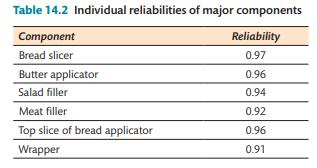
An automated sandwich-making machine in a food manufacturer’s factory has six major components, with individual reliabilities as shown in Table 14.2.a) What is the reliability of the whole system!b) If it is decided that the wrapper in the automated sandwich-making machine is too unreliable and a
(True story) The light bulb in the men’s lavatories of a factory finally burnt out after 70 years of operation. The manager at the firm said, ‘It is actually a little bit sad. I joined the firm when I was fifteen (he is now sixty three) and it was there then’. In fact, the bulb had survived
One cause of aircraft accident is ‘controlled flight into ground’. Predominantly, the reason for this is not mechanical failure but human failure, such as pilot fatigue. Boeing, which dominates the commercial airline business, has calculated that over 60 per cent of all the accidents that have
Wyco is a leading international retailer selling clothing and accessories, with stores throughout the United States, Europe and the Middle East. The countries from which it sources its products include Sri Lanka, Bangladesh, India and Vietnam. It was shocked when a British newspaper reported that
Revisit the examples of failure described in this chapter (Deepwater Horizon, the COVID-19 pandemic, ’Dieselgate’, TSB’s IT meltdown). Compile a table that summarises your view of:a) The reasons for the main failure.b) How it might have been prevented.c) The result (damage) of the failure.
What control problems did it encounter in implementing this strategy (pre- and post-investigation)!
Does the recovery procedure cover all the steps of discover, act, learn and plan!
Is a well-planned recovery procedure in place!
Are specific plans in place for the use of each type of mitigation action!
Has the whole range of mitigation actions been thoroughly evaluated!
Does the operation have a failure mitigation plan!
Is the concept of redundancy economically viable for any potential failures!
Have all approaches to process and technology maintenance been explored!
Has the idea of fail-safeing (poka yoke) been considered as a means of reducing the likelihood of failure!
Has due attention been paid to the possibility of designing out failure points!
Are techniques such as failure mode and effect analysis (FMEA) used!
Has the impact of all potential sources of failure been assessed!
Has the possibility of non-evident failures been addressed!
Has the likelihood of each potential failure been assessed!
Is post-failure analysis carried out when failure does occur!
Have any future changes in the sources of failure been identified!
Have all potential sources of failure been identified!
Does the business have an operations and process resilience policy!
The manager of a sweet shop decides to sample batches of sweets to check that the weight is reasonably consistent. She takes 9 samples, each with 10 bags. The data in Table 13.11 shows the average mean weight for each sample and the weight range. What control limits would a control chart for
An animal park in Amsterdam has decided to sample 50 visitors each day (n) to see how many visitors are from overseas. The data in Table 13.10 is for the last seven days. If it decided to continue recording this data and plot it on a control chart for attributes, what should the upper and lower
Four Seasons Hotels is a chain of very ‘upmarket’ hotels famed for their quality of service.From its inception the group has had the same guiding principle, ‘to make the quality of our service our competitive advantage’. The company has what it calls its Golden Rule: ‘Do to others (guests
Tea and Sympathy is a British restaurant and café in the heart of New York’s West Village.It is tiny, with around a dozen tables packed into an area little bigger than the average British sitting room. Expatriate Brits, native New Yorkers and celebrities queue to get in. It has become famous for
Understanding type I and type II errors is essential for surgeons’ quality planning. In appendectomy operations, for example, removal of the appendix is necessary because of the risk of it bursting and causing potentially fatal poisoning of the blood. The surgical procedure is a relatively simple
Ryanair is the best-known budget airline in Europe, focusing on popular routes and very low operating costs. For years, the boss of the airline Michael O’Leary’s policy on customer service was clear. ‘Our customer service’, he said, ‘is about the most well defined in the world. We
The owner of a small wedding photography business realises that the market is changing. ‘I used to take a few photos during the wedding ceremony and then formal group shots outside. It rarely took more than two hours. Around 30 photos would go in a standard wedding album. You had to get the
Human error is a significant source of quality problems. Think through the times that you have (with hindsight) made an error and answer the following questions:a) How do you think that human error causes quality problems?b) What could one do to minimise human error?
What do you suggest that Petra does next to improve process quality further?
Is a ‘missed opportunity’ in the report and record stage as much of an error as a contaminated sample, as Petra suggests?
How did Petra’s approach differ, and why was it more successful?
In hindsight, what were Vincent’s mistakes in running the lab?
Have quality systems been explored, such as ISO 9000 and the EFQM Excellence Model?
Do individual processes have any idea of their own variability of quality performance?
Has the idea of statistical process control (SPC) been explored as a mechanism for controlling quality?
Is quality adequately controlled?
Are quality costs categorised as prevention, appraisal, internal failure and external failure costs?
Is the cost of quality measured?
Is quality measured using all relevant quality characteristics?
Is quality defined in terms of a series of quality characteristics?
Is some form of gap model used to diagnose quality problems?
Are service-level agreements used to establish concepts of internal customer service?
Do all parts of the organisation understand their contribution to maintaining and improving quality?
Do people understand that there are many different definitions and approaches to quality, and do they understand why the business has chosen its own particular approach?
Is there an accepted definition of quality used within the business?
Does everyone in the business really believe in the importance of quality, or is it just one of those things that people say without really believing it?
a) As a group, identify a ‘high-visibility’ operation that you all are familiar with. This could be a type of quick-service restaurant, clothing store, public transport system, library, etc.b) Once you have identified the broad class of operation, visit a number of them and use your experience
A transport services company provides a whole range of services to railway operators. Its reputation for quality is a valuable asset in its increasingly competitive market. ‘We are continually looking for innovation in the way we deliver our services, because the continuous improvement of our
For over 10 years a hotel group had been developing self-managed improvement groups within its hotels. At one hotel reception desk, staff were concerned about the amount of time the reception desk was left unattended. To investigate this, the staff began keeping track of the reasons they were
Develop cause–effect diagrams for the following types of problem:a) Staff waiting too long for their calls to be answered by their IT helpdesk.b) Poor food in the company restaurant.c) Poor lecturing from teaching staff at a university.d) Customer complaints that the free plastic toy in their
‘Everything we do can be broken down into a process’, said Lucile, COO of an outsourcing business for the ‘back-office’ functions of a range of companies. ‘It may be more straightforward in a manufacturing business, but the concept of process improvement is just as powerful in service
Which two suggestions put forward by Robyn and Nick would you recommend!
What improvement priority would you give to each of these performance measures!
What factors would you use to judge the operations performance of Ferndale Sands!
Does the operation have a well-thought-through approach to managing improvement!
Does the operation show any signs of becoming a fashion victim of the latest improvement approach!
Are the more common improvement techniques used to facilitate improvement within the operation!
Has the Six Sigma approach to improvement been evaluated!
If they are, has continuous improvement become a part of everyone’s job!
Are continuous improvement methods and problem-solving cycles used within the operation!
Have breakthrough improvement approaches such as business process re-engineering been evaluated!
To what extent does the operation have a predisposition towards breakthrough or continuous improvement!
Is some formal method of comparing actual and desired performance (such as the importance–performance matrix) used!
Is benchmarking done on a regular basis and seen as an important contribution to improvement!
Are both performance and process methods benchmarked against similar operations and/or processes externally!
Is target performance set using an appropriate balance between historical, strategic, external and absolute performance targets!
Is some kind of balanced scorecard approach used that includes financial, internal, customer and learning perspectives!
Do performance measures allow likely problem areas to be diagnosed!
Does performance measurement focus on factors that reflect the operation’s strategic objectives!
Is the current performance measurement system seen as forming a basis for improvement!
Is the gap between current and desired performance clearly articulated in all areas!
Showing 900 - 1000
of 1768
First
3
4
5
6
7
8
9
10
11
12
13
14
15
16
17
Last
Step by Step Answers

 Get 50% OFF
Claim Now
Get 50% OFF
Claim Now